It seems quite natural to ask a young child what they are getting for Christmas and it is obviously quite natural for kids to be excited about opening gifts on Christmas morning. Yet we all know that Christmas is more about giving than it is about getting.
A quick look into the origin of Santa Claus will reveal a heart of giving. It begins in the third century with Nicholas. His wealthy parents raised him to be a devout Christian, but died in an epidemic while Nicholas was still young.
Obeying Jesus’ words to “sell what you own and give the money to the poor,” Nicholas used his whole inheritance to assist the needy, the sick, and the suffering. He dedicated his life to serving God and was made Bishop of Myra while still a young man. Bishop Nicholas became known throughout the land for his generosity to those in need, his love for children, and his concern for sailors and ships.
Here is the statement that stands out to me: “Nicholas used his whole inheritance to assist the needy …” Let’s face it, this is the time of year we think much about giving, but our emphasis tends to be towards those who are closest to us (family and friends), not necessarily those in need.
By asking “what are you getting for Christmas,” I wonder if we are putting the emphasis in the wrong place. Obviously, in order for some to receive, someone has to give, so maybe we ought to change the question to: “What are you giving for Christmas?”
However, the focus of one of the articles in the Toronto Sun this week, presents a not so bright picture in Canada, especially when it comes to giving. I couldn’t help taking a screen shot of the online article:

It’s interesting how this article is about being “Scrooge-like” when it comes to charity while there are ads surrounding the headline to entice us to spend our money on costly things. Without some sort of ad blocker, we are constantly bombarded with these ads which actually helps “program” us to want more. Let’s face it, whether younger or older, we are programmed “to get” but not programmed “to give.”
I was disappointed as I read the article as it described how little we are actually giving in Canada. It quotes a new Fraser Institute study stating that Canadians have reached a new ten-year low when it comes to donating to charities.
Here are some of the surprising takeaways from the most recent trackable year, 2015:
*One in five Canadian tax-filers claimed charitable donations on their tax return — compared to almost one in four Americans
*The total amount donated by Canadians — just 0.56% of income — is the lowest amount in a decade and down from a 10-year peak of 0.78 % in 2006.
*The average dollar amount, in local currencies, claimed in Canada was $1,699 – compared to $6,058 in the U.S.
Why are we giving less than 1% of our income to charity?
1. Maybe we think we are more generous than we are. We buy someone a coffee or a meal, we give a few dollars when we are asked at the ckeckout and add it to our bill, or we drop $5 or $10 in the Salvation Army Kettle during the Christmas season … and we feel good when we walk away.
2. Many of the comments after that article said the government takes too much in taxes, so it limits a person’s ability to give.
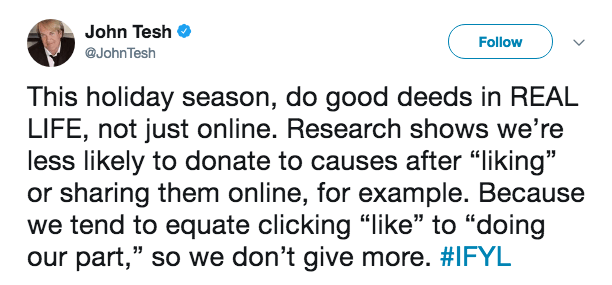
3. Maybe we support a cause with our time and we feel that’s sufficient. In some cases, by just liking or sharing something online, we have a sense that we are giving enough.
4. Maybe we simply don’t see the value in giving. When we give a gift to children or grandchildren, we have the satisification of seeing the joy of the gift being received. When we give to a charity, we often don’t get to see that same impact. Even beyond that, we tend to completely miss the eternal impact and therefore, fail to see our giving as an investment.
In todays society, it is natural to be self-centred so we must determine to give. Otherwise, we will give less and only when we see a need. So just as you set a savings goal for a purchase, education or retirement and set aside funds for that goal, maybe it’s worth establishing a giving goal. If you are working with a financial planner, this ought to be part of your overall strategy and a topic of discussion in your annual review.
Take a look at your overall income. Have you ever calculated where it’s all going? It’s pretty sad to see that just 20% of Canadians are giving and the overall average of the gift is only 0.56% of income (obviously because 80% are not reporting a charitable receipt). On the other hand, 65% of Canadians are saving 4.6% of income. These stats reveal that we are less interested in giving to others and more focused on saving for our future needs or wants.
Obviously we must use wisdom and save, but we ought to make giving more of a priority in life. Let’s re-program ourselves: Instead of “what are you getting for Christmas” let’s ask: “What are you giving for Christmas?”
What percentage of your income will you save next year? What percentage of your income will you give or invest in the lives of others?
Merry Christmas!


 The song is based on
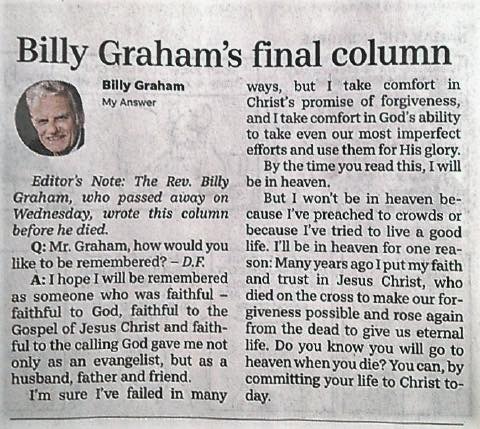 What’s interesting is the reason Billy Graham gives for his entrance into heaven. He states, “But I won’t be in heaven because I preached to the crowds or because I have tried to live a good life.” It is only his faith in Jesus Christ that gave him the confidence of heaven. If Billy Graham will “be in heaven for one reason,” our hope of going to heaven is because of the very same reason.
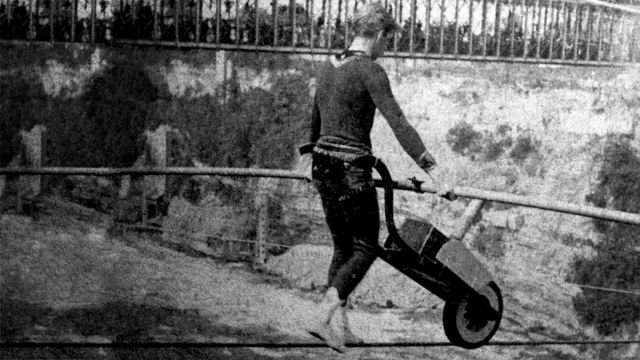
 As the story is told only his manager was willing to take the step beyond belief and have sufficient faith in Blondin, to be carried across the tightrope on Blondin’s back.

 – I have discovered that you can actually fulfill your “calling” in a job or a career but the key is to fulfill your calling, no matter what your hand finds to do. I guess you can say, it’s finding that sweet spot and I think many times that simply means following the voice that is within.
 The speaking of words seems to be important enough that Elizabeth was prevented from hearing the words of unbelief that would have undoubtedly been spoken by Zechariah, and was instead greeted by Mary. Both Mary and Zechariah were visited by an angel. Zechariah didn’t believe despite having prayed for a child. Mary believed without having prayed for a child (at least I suspect that to be the case at this time in her life).



 Think about the business of family for a moment – isn’t it truly about legacy planning?
