
Far too often we can let little things slide but recently I read an article titled “Never Walk by a Mistake.” It served as a good reminder of the importance of correcting even what seems like a small thing.
 General Ann Dunwoody was walking down the street when she saw a soldier in uniform walking with his hands in his pockets. Anyone who’s spent time in the military knows that this is a big no-no. Dunwoody could have literally walked by the mistake and not addressed it. It’s something small, it wasn’t impacting anyone at the time, and the kid probably just forgot. It wasn’t anything overtly heinous. As a general, though, she knew that if she didn’t correct the error, she would be, by the sin of omission, setting a new lower standard for that soldier. So rather than letting it slide, she approached him, kindly addressed the problem (rather than yelling at and demeaning the young guy), and reinforced the ideas of discipline and attention to detail.
Here is what intrigues me: by not correcting the error, we are actually setting a lower standard, which is obviously not acceptable. After reading an article by Jerry Bowyer entitled “Are Christians Allowed to Get Rich?” I saw that there is a standard set for Christian business owners and there are at least two mistakes that lower that standard:
- Not Understanding Your Purpose and Calling
- Not Understanding You are a Steward, not the Owner
1. Purpose & Calling
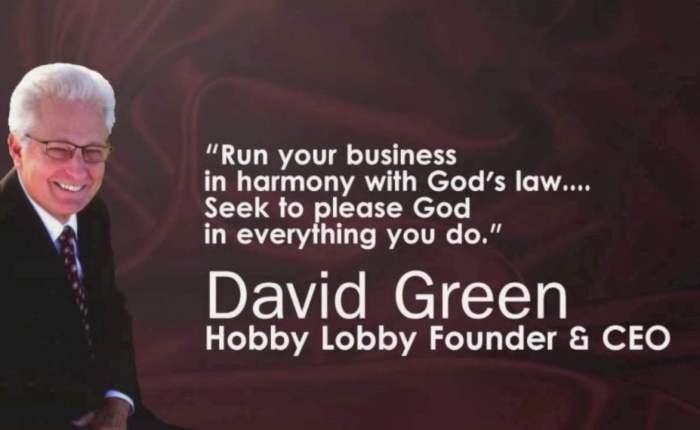
Typically, when we speak of “calling,” business owners are not the first to come to our mind. We tend to immediately think of those with a more sacred calling, like pastors or missionaries. David Green, the founder of Hobby Lobby is “the son of a pastor, and the brother of a large cohort of pastors, pastor’s wives and missionaries.” Like many Christian business owners, “David felt that there was something not fully Christian about his passion for running a successful store.” When he would talk excitedly about his business, his saintly mother would ask him, “Yes, but what are you doing for the Lord?” Obviously his mother meant well, but had a limited understanding of God’s calling.
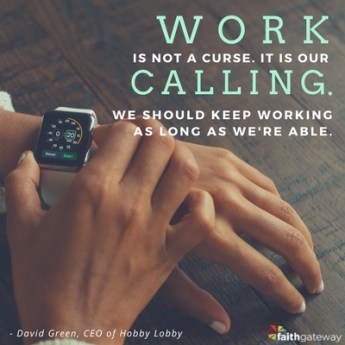 We usually make the same mistake when we categorize our work (or business) as secular, separating it from the sacred (calling). Rather than sensing the pleasure of God through our work, we often consider our work less than God’s calling. It seems that David Green felt like a black sheep because the rest of his family were “ministers” while he was in business. However, when we serve others (in our work), we are actually serving the Lord, not just men (Eph. 6:7) and can fulfill the call God has placed on our lives. Here is a great piece of advice: Whatever you do, do it enthusiastically, as something done for the Lord … (Col 3:23).
In time, David Green discovered that God can use a merchant just as well as He can a pastor. It seems that business was his purpose and calling after all and was a means of engaging in the great commission. I love what he said in the interview with Jerry Bowyer: So I believe I have a calling on my life; I think we all can, no matter where we are, be anointed. I sense God’s anointing on my life as a businessman.
2. A Steward, Not an Owner
It would certainly be valuable to listen to the audio interview with David Green as he provides insight on how Hobby Lobby endeavours to incorporate biblical principles into its business. He speaks about the importance of avoiding long term debt and he says, “We go into debt when we think God isn’t moving fast enough,” which identifies our lack of contentment.
 The part that I found most interesting is the corporate structure of Hobby Lobby, where the shares are owned by a trust rather than by family members. This speaks to the fact that the Green’s are stewards of the company and the corporation is actually held in trust. This means if the company was to be sold, 90% of the value would go to a foundation and subsequently distributed to the Lord’s work. Typically, a business is passed down to the next generation, then the next, but in the case of Hobby Lobby, the family cannot actually touch the assets. Since these assets are seen as under God’s ownership, the corporate structure reflects that and is actually referred to as a “stewardship trust.”
God owns it all, like Psalm 24:1 clearly states, is a statement Christians agree with in principle but despite this knowledge, we often live like we are the owners.
If you are a Christian business owner or a Christian financial advisor, accountant or lawyer directing business owners, please listen to the audio recording for just 10 minutes (start from 14 minutes to 24 minutes). It is easy for Christian business owners and Christian financial professionals to be “conformed to the world” when it comes to business structure and advice. What I heard is transformational because it is based on biblical principles. If we choose to ignore these principles, we are setting a lower standard than has been laid out for us. Does the legal structure of your business align with your theological structure? Does the corporate structure represent the interest of the steward or the interest of the owner?

 Sometimes, language or dialect can be a barrier to understanding. I recall when we had friends from Ontario visit us in Newfoundland and we had a conversation with some locals. Our friends heard us speaking, but did not understand. Maybe I shouldn’t be shocked because the very tone of the common phrase, “Yes b’y,” actually changes its meaning.
 Politicians typically only say what they want us to hear and we have to dig deeper if we desire to get the entire meaning; otherwise our perspective remains limited. For example, the Trudeau government often claims it has cut taxes for middle-class Canadian families. A recent article helped me understand that
  If you think about it, the perspective from which you see things can be the very obstacle that prevents you from seeing another point of view. (Doesn’t this graphic resemble a political debate? It totally depends on which side you are on).
 In a conversation, an accountant told me he keeps his antennas raised when in discussion with clients. Since mankind is spiritual, our spirits are meant to be active and sensitive, which leads to an understanding of others.
 He goes on to cite the reasons for the non-response from God, which could be denominational, or we are not praying enough, or the wrong people are praying, or praying wrongly (kneeling or not, with eyes open or eyes closed).
 Dr. Emoto and his team observed that after the experiment very beautiful crystals had formed in some of the frozen water samples where the positive vibrational waves were directed. Dr. Emoto then exposed water samples to music from Mozart, Beethoven, and other classical composers and found that beautiful crystal shapes formed in these samples as well.
 Think about politics for a moment. Just look back one year when the United States was in the midst of an election campaign. Let’s be honest, when you first heard that Donald Trump was running for President, how many thought he would actually become President? Most didn’t believe he had a shot at becoming the candidate to represent the Republicans in the run up to the election, let alone be in the presidential race. For many, the unthinkable happened … Breaking News: Donald Trump is now the President.



 On a recent flight back to Newfoundland, I watched a movie called “42” which is the story of
  When Robinson asked why he did it, Rickey explained that he loved this game of baseball and that he had given his whole life to the game. Then he referenced the past unfairness he saw when he was a player and their Negro catcher, Charlie Thomas, “a coloured boy was laid low, broken, because of the colour of his skin and I didn’t do enough to help. I ignored it.” He continued, “There was something unfair at the heart of the game I loved, but the time came I could no longer do that.” As a manager Rickey chose Robinson to bring change to the game. He told Jackie how he watched some kids playing and said, “I saw a little white boy up at bat … you know what he was doing? … pretending he was like you … little white boy pretending he is a black man. You made me love baseball again. Thank you!”

 In the next verse, Paul notes that he received the gift, but also that it was “well pleasing to God.” So the gift that was given to Paul’s ministry was actually credited to the kingdom account of these people; treasure was being “stored up” in their account in heaven. It was a gift on earth, but an investment in a heavenly account.
