
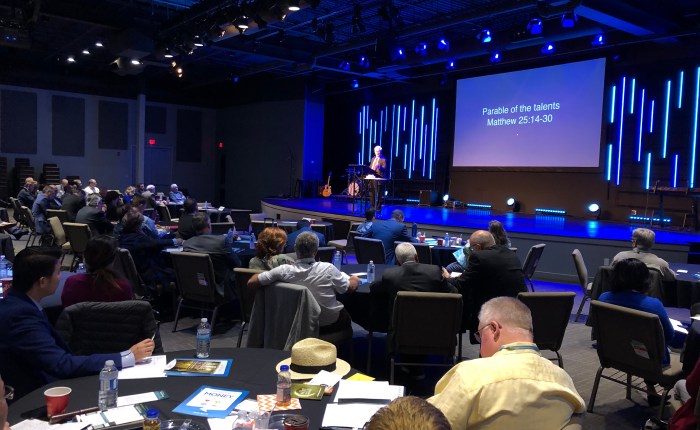
Last week was one of those special weeks where I was privileged to interact with some amazing influencers in the Christian financial services industry. More than ninety financial professionals from 7 of the 10 provinces in Canada came together in Toronto for the Kingdom Advisors Canada Conference.
 The majority of these advisors have figured out why they do what they do and surprisingly, it’s not just for the career, the money or the position. It’s because they feel called and that calling is usually defined by some life experience. After the conference, I was intrigued to read an article about one of our speakers, Brad Smith.
Photo taken from an article published by Wealth Professional Canada, written by Leo Almazora.
The article describes how Brad always saw protecting his clients’ wealth as his primary role. I believe this to be true for most financial advisors but that all changed for Brad after an incident with one of his very first clients.
“Henry was a factory worker, and he had done everything right,” he said. “He’d put his kids through school; by the time he retired, he was financially set to achieve everything we’d planned for. He couldn’t wait to leave the factory behind.”
No one could have imagined what would happen next: not long after his retirement, the man who’d done everything right tried to take his life. After finding out what happened from Henry’s wife, Smith visited him at the hospital and asked what drove him to it.
“Henry said ‘Nobody needs me. Nobody at work needs me, my kids don’t need me,’” he recalled. “’I went to my doctor because I was losing sleep, and he just gave me pills. I took them home, asked myself what it all meant, and downed all of them.’”
Genuinely concerned, Smith and a few of Henry’s loved ones brainstormed to help him find a purpose; he was passionate about hockey, so he decided to coach minor-league hockey teams and ultimately got out of his funk.
The whole affair marked a turning point for Smith. “I realized that if I succeed only in taking care of my client’s money — making sure it’s used well and ensuring a good return on investment — I have failed as an advisor,” he said. “I didn’t want another Henry.”
It seems this is when Brad began to find out his “why” and purpose in his profession as a financial advisor. The typical thinking is that dealing with a financial advisor is about rates of return on an investment portfolio or taking care of a client’s money. No doubt it does include those things, but discovering that his career path was about something far more important had a significant impact on his business and client relationships.
Over time, Smith found a similar pattern with other clients; many who were financially prepared for retirement were actually unprepared in emotional or psychological ways. That prompted them to develop a seven-step program to help clients lead lives of success and significance, a major part of which is to give generously to the benefit of others.
The seven step process that Brad walks his clients through is the “journey to meaningful significance.” Every year the Kingdom Advisors conference recognizes someone whose life demonstrates Christian character, unparalleled professional competency, along with the integration of biblical wisdom into their advice and counsel. Brad journeys with his clients toward a life of significance and in this process has discovered his own life of significance. At the KA Conference in September 2018, Brad became the recipient of the Advisor with Purpose award because he has truly become an advisor with purpose.



 The song is based on
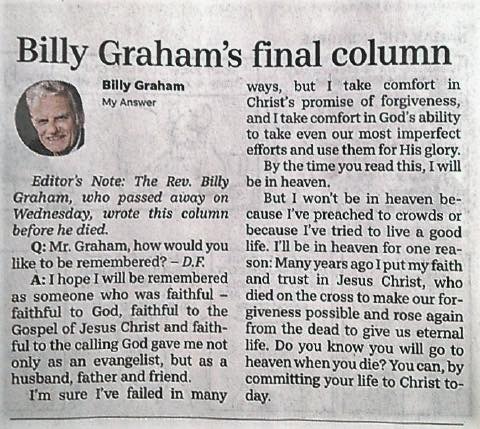 What’s interesting is the reason Billy Graham gives for his entrance into heaven. He states, “But I won’t be in heaven because I preached to the crowds or because I have tried to live a good life.” It is only his faith in Jesus Christ that gave him the confidence of heaven. If Billy Graham will “be in heaven for one reason,” our hope of going to heaven is because of the very same reason.


 Think about the business of family for a moment – isn’t it truly about legacy planning?
 Sometimes, language or dialect can be a barrier to understanding. I recall when we had friends from Ontario visit us in Newfoundland and we had a conversation with some locals. Our friends heard us speaking, but did not understand. Maybe I shouldn’t be shocked because the very tone of the common phrase, “Yes b’y,” actually changes its meaning.
 Politicians typically only say what they want us to hear and we have to dig deeper if we desire to get the entire meaning; otherwise our perspective remains limited. For example, the Trudeau government often claims it has cut taxes for middle-class Canadian families. A recent article helped me understand that
  If you think about it, the perspective from which you see things can be the very obstacle that prevents you from seeing another point of view. (Doesn’t this graphic resemble a political debate? It totally depends on which side you are on).
 In a conversation, an accountant told me he keeps his antennas raised when in discussion with clients. Since mankind is spiritual, our spirits are meant to be active and sensitive, which leads to an understanding of others.
 In the next verse, Paul notes that he received the gift, but also that it was “well pleasing to God.” So the gift that was given to Paul’s ministry was actually credited to the kingdom account of these people; treasure was being “stored up” in their account in heaven. It was a gift on earth, but an investment in a heavenly account.
 Lorne Robinson's Blog