

I often joke about the first piece of financial advice I gave to my wife after only 6 months of marriage. During her first year of teaching and before we were married, she had been counselled by her Credit Union to start saving in a Registered Retirement Savings Plan (RRSP). Just starting out, we didn’t have many other resources and we, (actually, more like I), desired to have a motorcycle. We did not want to borrow to purchase, so unknowingly, we did live by one Biblical financial principle which is to “avoid the use of debt.”
My financial advice as a brand new husband was to cash in the RRSP so we could enjoy some time together on our motorcycle. I had no idea that there would even be a tax consequence to this redemption, so this was not part of my thinking. The other thing I failed to consider was the time value of money. That original investment (more than 30 years ago), would now be worth 15 to 20 times more than the value at that time. I did not know or understand the biblical financial principles shared in my last blog. As a young couple, building liquidity or setting long term goals were not on our list of priorities.
While this financial decision may not have been the best, it did bring us much enjoyment, which is one of the things money can accomplish. In 1 Timothy 6:17b, we are instructed not to trust in money, but have confidence in God “who richly supplies us with all things to enjoy.”
The irony is amazing because this same Credit Union that gave good advice to my wife (to invest in an RRSP) later became my employer. As one of their financial planners, naturally, my advice was based on industry standards. As a Christian, I acted with integrity and provided good counsel to clients, but the focus of my advice did not intentionally incorporate biblical financial principles.
If you watch my story that I briefly shared last week at the 2019 Kingdom Advisors Conference, you will learn that I became an advisor out of necessity, not purpose. You will also begin to understand that the level of fulfillment as a financial planner increased tremendously once I realized my work was not just a job but a calling. My role was to educate people in financial wisdom, which in reality, is a means of fulfilling the Great Commission by teaching them.
Once I realized my unique position where I was able to use my competency as a Certified Financial Planner® and incorporate the wisdom gained as a Certified Kingdom Advisor®, my career became my calling. I was finally in the sweet spot and was able to build deeper relationships with clients than ever before.
In my current role, I connect with many advisors across Canada who are very much like I was, enjoying their career and client relationships, yet sensing there is another level of fulfillment that can be reached. My experience is that you can flourish in your work when you realize God has called you to do that work. When you apply wisdom that is timeless (James 3:17) to the advice you share, the results are heavenly and you can enjoy the ride!


 1. There was a federal election in Canada,
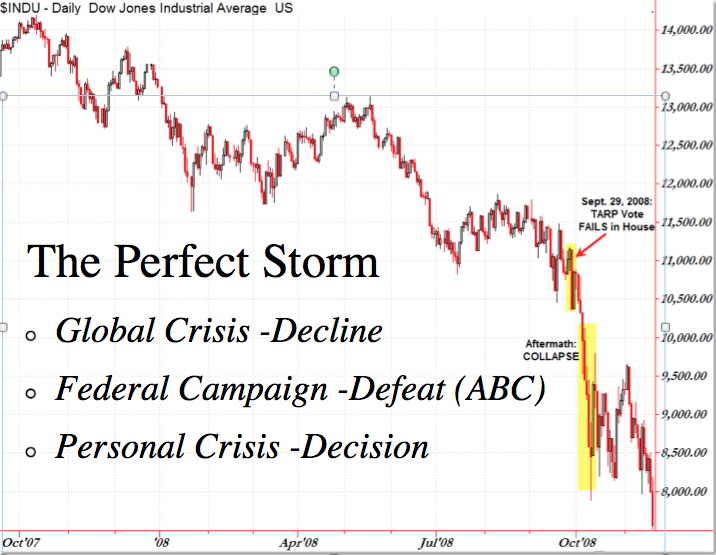 This led me to a very dark place, what my wife often refers to as my mid-life crisis. I struggled with the fact that I was not there for my clients when they needed me most; that was a fail. I put my name forward to run in a federal election and felt very much alone, especially after the devastating election night. I felt defeated (in more ways than just the election) and questioned my purpose. If you look at the chart and the shaded area of yellow, the stock market decline seemed to parallel my life at this time. What was my life all about anyway? It was one of my lowest, darkest times.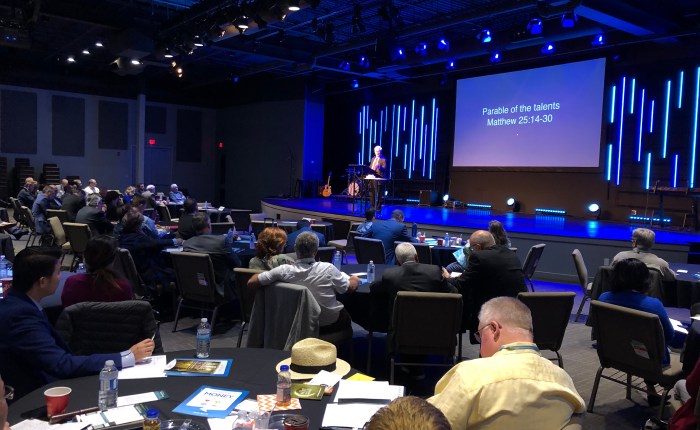
 The majority of these advisors have figured out why they do what they do and surprisingly, it’s not just for the career, the money or the position. It’s because they feel called and that calling is usually defined by some life experience. After the conference, I was intrigued to read an article about one of our speakers,

 The song is based on
 What’s interesting is the reason Billy Graham gives for his entrance into heaven. He states, “But I won’t be in heaven because I preached to the crowds or because I have tried to live a good life.” It is only his faith in Jesus Christ that gave him the confidence of heaven. If Billy Graham will “be in heaven for one reason,” our hope of going to heaven is because of the very same reason.
 General Ann Dunwoody was walking down the street when she saw a soldier in uniform walking with his hands in his pockets. Anyone who’s spent time in the military knows that this is a big no-no. Dunwoody could have literally walked by the mistake and not addressed it. It’s something small, it wasn’t impacting anyone at the time, and the kid probably just forgot. It wasn’t anything overtly heinous. As a general, though, she knew that if she didn’t correct the error, she would be, by the sin of omission, setting a new lower standard for that soldier. So rather than letting it slide, she approached him, kindly addressed the problem (rather than yelling at and demeaning the young guy), and reinforced the ideas of discipline and attention to detail.
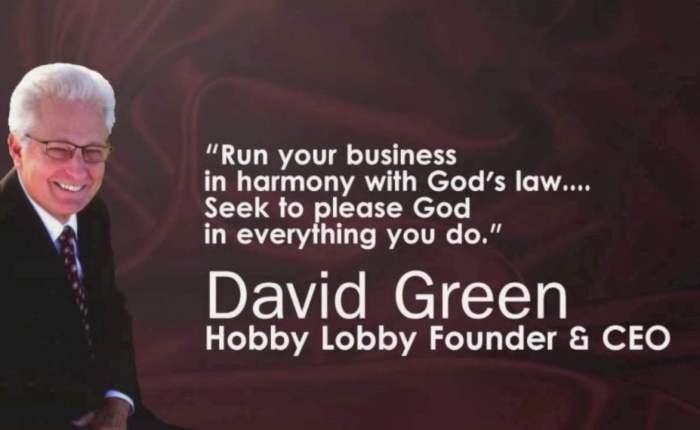
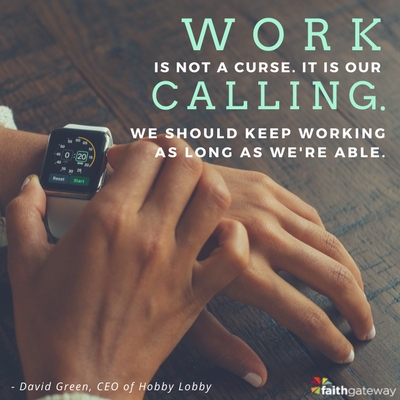 We usually make the same mistake when we categorize our work (or business) as secular, separating it from the sacred (calling). Rather than sensing the pleasure of God through our work, we often consider our work less than God’s calling. It seems that David Green felt like a black sheep because the rest of his family were “ministers” while he was in business. However, when we serve others (in our work), we are actually serving the Lord, not just men (Eph. 6:7) and can fulfill the call God has placed on our lives. Here is a great piece of advice: Whatever you do, do it enthusiastically, as something done for the Lord … (Col 3:23).
 The part that I found most interesting is the corporate structure of Hobby Lobby, where the shares are owned by a trust rather than by family members. This speaks to the fact that the Green’s are stewards of the company and the corporation is actually held in trust. This means if the company was to be sold, 90% of the value would go to a foundation and subsequently distributed to the Lord’s work. Typically, a business is passed down to the next generation, then the next, but in the case of Hobby Lobby, the family cannot actually touch the assets. Since these assets are seen as under God’s ownership, the corporate structure reflects that and is actually referred to as a “stewardship trust.”
  Lorne Robinson's Blog