
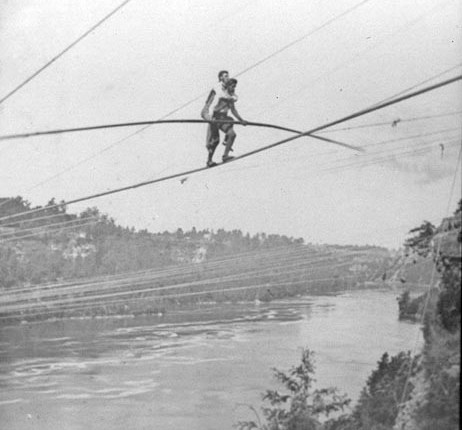
Recently, I heard the amazing story of Charles Blondin, a famous French tightrope walker, which illustrates how we can be challenged.
Blondin’s greatest fame came on September 14, 1860, when he became the first person to cross a tightrope stretched 11,000 feet (over a quarter of a mile) across the mighty Niagara Falls. People from both Canada and America came from miles away to see this great feat.
He walked across, 160 feet above the falls, several times… each time with a different daring feat – once in a sack, on stilts, on a bicycle, in the dark, and blindfolded. One time he even carried a stove and cooked an omelet in the middle of the rope!
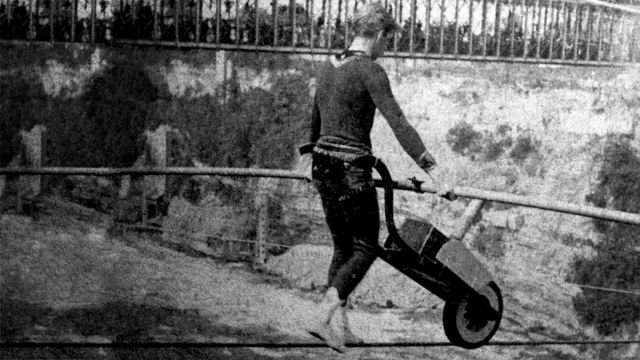
He also went across pushing a wheelbarrow and then a one point, he asked for the participation of a volunteer. Upon reaching the other side, the crowd’s applause was louder than the roar of the falls!
The crowd enthusiastically yelled, “Yes! You are the greatest tightrope walker in the world. We believe!” How many volunteers do you think stepped forward? There were none, but the reason is the most interesting: They only observed and believed.
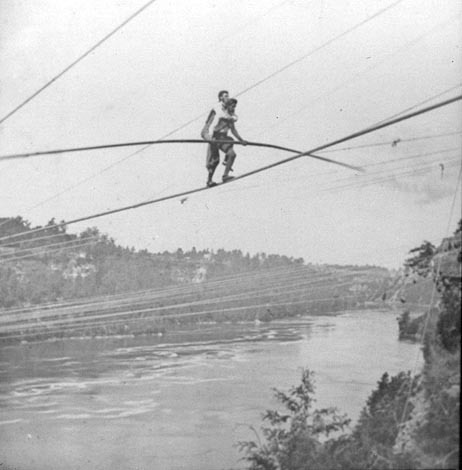 As the story is told only his manager was willing to take the step beyond belief and have sufficient faith in Blondin, to be carried across the tightrope on Blondin’s back.
Standing on the ground, it was easy to believe based on what the crowd was witnessing. However, when asked to risk their own life, it required more than simply believing. There is obviously an entirely different level that takes us beyond belief.
In June 1990, Petra release an album featuring a song written by Bob Hartman entitled: “Beyond Belief” which was based on Heb. 6:1a, Phil. 1:6 Rom. 1:17. Here is the chorus:
There’s a higher place to go, beyond belief, beyond belief
Where we reach the next plateau, beyond belief, beyond belief
And from faith to faith we grow
Towards the center of the flow
Where He beckons us to go, beyond belief, beyond belief
The song did not actually name on that place that is beyond belief, but I would call it trust. What Bondin was asking of the crowd is very similar to what “believers” are called to do, not just believe but trust. Trust is much difficult and beyond belief.
In my search to highlight the difference between belief and trust I read a blog that quoted Peter Enns and he provides a great illustration. Jesus tells a famous story about why those who follow him need not worry about anything. Don’t fret about how much you have, what you wear, or what you will eat. Don’t worry. Trust. (Matthew 6:25-34).
Jesus illustrates the point in what at first blush seems rather off topic–at best marginally helpful. He tells us to consider the grass of the field and the birds of the sky. Look at them, Jesus says. They’re doing just fine and they don’t worry for a second.
Of course they don’t worry, Jesus, because they are–if I’m not mistaken–grass and birds. Grass doesn’t have a brain and birds are skittish little things that fly into windows. These things aren’t really relevant, Jesus, because, you see, by definition, Jesus, these things are incapable of worry.
And when you put it that way, you can see the profound point–and challenge–of what Jesus is saying: worry should be as impossible for us as it is for grass and birds. His followers–if they get it–should be as incapable of worry as insentient grass and bird-brained birds.
“Believing in God” doesn’t get you to that place Jesus is describing here. Belief leaves room for worry. Trust explodes it.
The question I would leave you with is this: Are you one who can step further than the crowd of believers, beyond belief, and move to trust, where you are incapable of worry?


 – I have discovered that you can actually fulfill your “calling” in a job or a career but the key is to fulfill your calling, no matter what your hand finds to do. I guess you can say, it’s finding that sweet spot and I think many times that simply means following the voice that is within.
 The speaking of words seems to be important enough that Elizabeth was prevented from hearing the words of unbelief that would have undoubtedly been spoken by Zechariah, and was instead greeted by Mary. Both Mary and Zechariah were visited by an angel. Zechariah didn’t believe despite having prayed for a child. Mary believed without having prayed for a child (at least I suspect that to be the case at this time in her life).



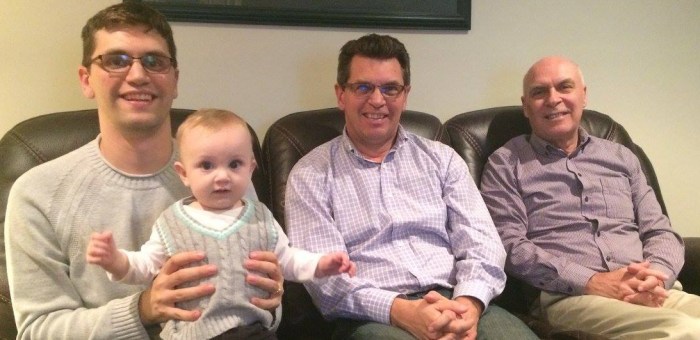 Think about the business of family for a moment – isn’t it truly about legacy planning?
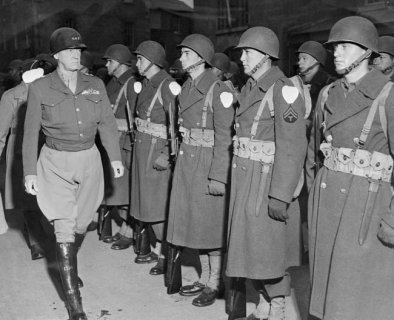 General Ann Dunwoody was walking down the street when she saw a soldier in uniform walking with his hands in his pockets. Anyone who’s spent time in the military knows that this is a big no-no. Dunwoody could have literally walked by the mistake and not addressed it. It’s something small, it wasn’t impacting anyone at the time, and the kid probably just forgot. It wasn’t anything overtly heinous. As a general, though, she knew that if she didn’t correct the error, she would be, by the sin of omission, setting a new lower standard for that soldier. So rather than letting it slide, she approached him, kindly addressed the problem (rather than yelling at and demeaning the young guy), and reinforced the ideas of discipline and attention to detail.
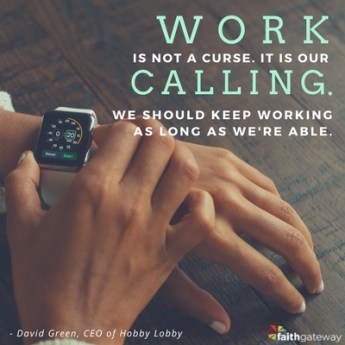 We usually make the same mistake when we categorize our work (or business) as secular, separating it from the sacred (calling). Rather than sensing the pleasure of God through our work, we often consider our work less than God’s calling. It seems that David Green felt like a black sheep because the rest of his family were “ministers” while he was in business. However, when we serve others (in our work), we are actually serving the Lord, not just men (Eph. 6:7) and can fulfill the call God has placed on our lives. Here is a great piece of advice: Whatever you do, do it enthusiastically, as something done for the Lord … (Col 3:23).
 The part that I found most interesting is the corporate structure of Hobby Lobby, where the shares are owned by a trust rather than by family members. This speaks to the fact that the Green’s are stewards of the company and the corporation is actually held in trust. This means if the company was to be sold, 90% of the value would go to a foundation and subsequently distributed to the Lord’s work. Typically, a business is passed down to the next generation, then the next, but in the case of Hobby Lobby, the family cannot actually touch the assets. Since these assets are seen as under God’s ownership, the corporate structure reflects that and is actually referred to as a “stewardship trust.”
 Sometimes, language or dialect can be a barrier to understanding. I recall when we had friends from Ontario visit us in Newfoundland and we had a conversation with some locals. Our friends heard us speaking, but did not understand. Maybe I shouldn’t be shocked because the very tone of the common phrase, “Yes b’y,” actually changes its meaning.
 Politicians typically only say what they want us to hear and we have to dig deeper if we desire to get the entire meaning; otherwise our perspective remains limited. For example, the Trudeau government often claims it has cut taxes for middle-class Canadian families. A recent article helped me understand that
  If you think about it, the perspective from which you see things can be the very obstacle that prevents you from seeing another point of view. (Doesn’t this graphic resemble a political debate? It totally depends on which side you are on).
 In a conversation, an accountant told me he keeps his antennas raised when in discussion with clients. Since mankind is spiritual, our spirits are meant to be active and sensitive, which leads to an understanding of others.
  Lorne Robinson's Blog