An Eye Exam

An Eye Exam

I recently had an eye exam and there was no significant change in my prescription. This reminded me of the words of Jesus in the famous Sermon on the Mount. I googled the verse of interest and immediately received this AI generated overview:

The Bible verse “If your eyes are healthy, your whole body will be full of light,” is found in Matthew 6:22. It essentially means that if your mind and heart are focused on good things, your whole life will be filled with light and positivity. If your “eye” (representing your inner self) is not focused on God, the truth, and good things, your whole life will be filled with darkness. 

Is Your Eye Healthy?

That certainly seems to be a reasonable explanation, but is that really the extent of what Jesus was saying here? To fully understand, might I suggest we need more SI (Spiritual Insight), since AI (Artificial Intelligence) has its limits. Maybe a quick look at the context of this verse might give us a clue.

Matt. 6:20 talks about treasure and the places it can be stored (heaven or earth). The next verse connects our heart with where we place our treasure. Inserted here are two verses about having a healthy or clear eye vs. an evil or unhealthy eye which results in darkness. This is followed by the reference to two masters and the inability to serve both with the simple conclusion: “You cannot serve God and money.” Then, the instruction to not worry about the things needed in life, like food and drink and clothes – some of the things we purchase with money.

With this context in mind, why does Jesus speak about the eye being good or evil, bringing light or darkness? Could the health of the eye be a reference to our attitude about our financial resources?

Is Your Eye Envious?

This is not the only time Jesus referenced the eye. In Matthew 20, He spoke about “the kingdom of heaven” being like a landowner who hired workers for his vineyard. These individuals were hired at different times during the day – some early morning, others at 9 am, others at noon, then others at 3 pm and more at 5 pm. At the end of the workday, the workers were called to receive their pay, “beginning with the last ones hired and going on to the first” (v. 8). Naturally, the people who worked the entire day expected to be paid more than those who started work at 3 or 5 pm and this led to complaints.

The story concludes with a few questions:

“Is it not lawful for me to do what I wish with what is my own? Or is your eye envious because I am generous?”

In this story, Jesus was illustrating that the darkness on the inside of these workers was due to a desire for more (an amount above the original agreed amount). All day these workers knew what they were going to be paid but this focus shifted when they saw that others who worked less were being paid the same (meaning their hourly wage was less than those hired later). There was an immediate discontentment when they compared themselves with people who were hired 8 hours later. Comparison is the enemy of contentment.

Let’s assume you or I were hired at the start of the day – would we be any different? If we worked 10 -12 in the day and others worked only two hours, it would be natural to expect more pay, wouldn’t it?

Is Your Eye Clear?

The point Jesus is making here is that the eye is not clear and greed enters the heart through our eyes. How would you define greed? Maybe it’s as simple as the desire for more. AI says it is characterized by a strong, often selfish, yearning for more than what is needed or deserved. Greed is often associated with materialism, envy, and a focus on self-interest. 

Here’s how Tim Keller spoke about the eye and greed:

Greed is different than other sins. This is why Jesus says this is an eye sin. This darkens your eye spiritually. Jesus did not say to anybody, “Watch out, you might be committing adultery.” If you’re committing adultery; you know you’re committing adultery. You don’t say, “Oh, you’re not my wife!” It doesn’t happen. But Jesus has to say, Watch out, you might be greedy. Greed hides itself. It blinds you in a way that adultery doesn’t. Over the years as a pastor, I’ve had people come in to talk to me about sins, but I don’t remember anybody coming to me to confess the sin of greed.

https://www.plough.com/en/topics/faith/discipleship/watch-out-you-might-be-greedy

It’s such a challenge to recognize this darkness or even know it has found a place in our hearts. In fact, “The heart is deceitful above all things and beyond cure. Who can understand it?” (Jer. 17:9)

Jesus said that “from within, out of the heart proceed …” a long list which includes coveting and envy (Mark 7:21, 22). The word envy is literally “an evil eye.”

Tim Keller explained how easy it is for us to not even consider the possibility that we might be materialistic with this realistic example:

Materialism has the power to get you to choose a job, not one that you love, not one that you’re good at, not one that helps people, but one that makes you money. You do it because it will get you to a certain status in life. You choose the job on the basis of that. For five to ten years the adrenaline can keep you going, but after a while you find yourself empty inside. Why did you choose the job? Your eye was dark.

https://www.plough.com/en/topics/faith/discipleship/watch-out-you-might-be-greedy

Is Your Eye Focused?

When your eye is dark it is easier to refuse to help someone who has a genuine need (Deut. 15:9) than to truly have compassion and help them. Our response to others is determined by what is in our heart and Jesus is saying the entrance into the heart is through the eye. The instruction in the verse that follows is pretty clear:

Give generously to the poor, not grudgingly, for the LORD your God will bless you in everything you do.

Deut. 15:10 NLT

So what did Jesus mean when he spoke about a clear eye? It wasn’t just focusing on good things (as AI suggests), so your life will be filled with positive things. It was about having the right perspective – shifting your focus away from greed and discontentment which is the darkness. Instead, the light brings generosity and contentment into view. A clear eye means we view the resources we have differently, we begin to ask why we have these resources.

The “evil eye” focuses on getting more while the “good eye” focuses on giving more.

Let me wrap this up with Proverbs 22:9:

“He who is generous will be blessed, For he gives from his food to the poor.”

The newer translations just use the word generous here, but that word refers to one who “has a good eye” – the KJV translates it as one with a bountiful eye.

Consider this in light of what Jesus said:

“When your eye is healthy, your whole body is filled with light.”

The healthy or “bountiful eye” speaks of generosity that flows from an abundance mindset and is not restricted at all by scarcity thinking.

Do You Need Corrective Lenses?

In a 2012 study published in Science, behavioural economists Mullainathan and Shafir discovered something remarkable:

When we perceive scarcity (even if it doesn’t match reality), our brain undergoes a measurable shift. Our mental bandwidth narrows, focusing intensely on what we might lose while becoming blind to potential gains.

https://breakingbank.media/ca/breaking-the-scarcity-cycle-a-guide-for-smarter-wealth-management/?ref=sadeyemi&utm_source=email&utm_medium=email+marketing

This confirms what the Sermon on the Mount stated more than 2000 years earlier:

But when your eye is unhealthy (perceiving scarcity), your whole body is filled with darkness (your mental bandwidth narrows). And if the light you think you have is actually darkness, how deep that darkness is!

A scarcity mindset negatively limits our ability to be generous, which is a dark place. Lord, open our eyes to Your light and deliver us from the dark. For my physical eyes, I need corrective lenses and I use them every day. Do we not need the same discipline to wear our spiritual lenses daily? How else can we have “a bountiful eye?”

The Key to Business Success

The Key to Business Success

This is a significant month in my history – Nine years ago in April 2015, at the peak of my earning years, I left my role as a financial planner after 24 years.

In my last blog, I explained how God multiplied my business significantly in less than five years. A logical question is, why would I ever consider leaving a business that God had obviously blessed?

Journey

I find it so interesting how God uses little things to nudge us along the way. In April 2012, we visited our daughter in Calgary, AB. We attended Centre Street Church, then the book store after the service. There I discovered the NIV Stewardship Study Bible. I briefly looked through it and saw there was so much alignment with the Kingdom Advisors Core Training that I had studied in 2011. I decided to purchase it (USD $39.99) and proceeded to the cashier. I waited in line, then laid the Bible on the counter and took out my wallet to pay.

The cashier simply said, “That’s yours!”
I responded by saying, “No, I just picked this up and am here to pay for it.”

She then explained how someone had donated this Bible with the understanding that whoever expressed an interest in it – it was to be a gift to them! I was completely shocked but couldn’t help believing that God was working through this somehow.

Interestingly, about one year earlier a pastor shared something with me (a “word from the Lord”) that I sincerely questioned. For me, this was one of those things that needed to be tested and confirmed, but I decided that rather than reject it, I would park it, then wait and see. It went something like this: “You are to leave the old word and God will give you a new word that He wants you to share.” The question that I struggled with was that I love God’s word so much; how could I leave any word that was God-given and so meaningful?

The Word – Stewardship

That first evening I had gotten my Stewardship Bible, I opened it to Genesis 50 and read such a powerful story. It illustrated even deeper what Joseph meant when he said to his brothers (in vs. 20),

“You intended to harm me, but God intended it for good to accomplish what is now being done, the saving of many lives.”

Immediately across from this verse was a story that came from the province that I was born and raised in and where I was practicing as an advisor for more than 20 years.

God Meant It For Good

Good things can come out of bad beginnings. The story of a fishing fleet that left a small harbour in Newfoundland and was caught in a terrible storm illustrates this point. The ships, caught in a storm, did not return home when expected, and during the night, the mothers, wives, and children of the fishermen, walked along the shore looking for some sign of their loved ones and praying for their safe return. That same night, one of the homes in the village caught fire and burned to the ground. When morning dawned, the entire fleet of ships sailed back into the harbour. Everyone rejoiced except the woman whose house had burned. She approached her husband in grief and said, “We are ruined! Our house and everything we had was destroyed by fire.” Her husband shook his head. “Thank God for the fire. It was the light of our burning home that guided the whole fleet into port.”

Ronald E. Vallet

Was it a coincidence that we were in Calgary and just happened to into the bookstore that day? What are the chances of walking into a Christian bookstore that exists to sell products and be given such a gift? Was God involved and using this event to lead me toward “a new word” which was clearly stewardship?

Living as a Steward!

I remember the day well. It was the end of my work day – I sat alone in the waiting area and just looked around at the reception area, my office, then the filing cabinet which represented my clients and the assets under management (AUM). I started to pray (out loud) and surrendered my business to God. “This is yours, Lord. It’s not my business, I surrender it to you. Please use this business for your glory.”

The overriding purpose of Christian stewardship is glorifying God. God was transforming my thinking – I was no longer the owner, I was only the steward. I was overcome with gratitude as I recognized how God had been active in my business to help me build meaningful relationships.

Today, as I continue to read my Stewardship Bible, I see how King David was “overcome with gratitude. His natural inclination was to give back to God and he longs to build a house for the Lord. But Nathan shuts down David’s enthusiasm” with a message from God:

“God reminds David that he has never asked for a house. In fact, God turns David’s offer on its head, announcing the he (God) will instead build David a house, establishing his throne forever.”

The Stewardship Bible, How We Give to God, p. 504

Reading this made me realize that what David desired was quite different than what God intended. It’s less about what we want to do for God and more about what He wants to do for us! When we completely surrender our business to God, our deepest desire shifts to running that business for God’s glory. Interestingly, it seems God turns our offer to Him on its head! Our work becomes an opportunity for God; He (God) works to build a business for us.

That my friend is the real key to business success!

As it is in Heaven

As it is in Heaven

As I awoke this morning, my thoughts went to the line in the Lord’s Prayer where it speaks about “His will be done on earth just as it is in heaven” (my paraphrase). I guess that summarizes a deep inner desire within each of us: to live out what God’s will is today, just as God already planned it in heaven.

I believe a person would have a greater level of fulfillment if they believed their activity and work somehow had its origin in a divine purpose for their lives. In essence, knowing God’s will for us (in heaven), and then living it out.

The problem: heaven is not typically our focus. We haven’t been there, so how can we know or connect the plans in heaven with what happens on earth? To be clear, from the very time of creation, earth is separate from heaven. When we fly, we get a little sense of be separated from the earth; It’s like we are shifted into a different realm.

Screenshot of flight path

In August 2021, we flew to St. John’s, Newfoundland. As we approached our destination, the pilot announced that we were unable to land because the runway lights were not working due to a power outage. We didn’t think much of it, but looked at the airplane app and took a few screenshots of the plane circling. Then after about an hour, we began to descend below the clouds into the darkness and rain.

We discovered that the storm had caused a power outage. Until we landed, we had no idea there was even a storm because we were circling above it.

Maybe the Lord’s prayer is telling us that even in the midst of the storms (on earth), we can live out God’s purpose because our perspective is based on being above the storm (in heaven). Maybe that’s why Paul instructed us to set our mind on the things that are above!

Here’s where many people unfortunately find themselves:

“Yet when I surveyed all that my hands had done and what I had toiled to achieve, everything was meaningless, a chasing after the wind; nothing was gained under the sun.”

Ecclesiastes 2:11

Saying that everything is meaningless brings you down (pun intentional), but we must understand Solomon’s point of view.

“I have seen all the things that are done under the sun; all of them are meaningless, a chasing after the wind.”

Ecclesiastes 1:14

The key phrase is under the sun, which is repeated throughout the book. Solomon is sharing an earth-bound perspective. He is only considering life “under the sun”; that is, a human life lived to the exclusion of any consideration of God. From that godless perspective, everything is indeed “meaningless.”

https://www.gotquestions.org/everything-is-meaningless.html

Here’s a prayer that was written by Ken Boa:

Dear Lord, where would I be without Your Word? What would guide me and teach me the answers to the fundamental questions of origin, purpose, and destiny? Human speculation is utterly inadequate for this task, because the answers to these and other questions require a word from without, a revelation that is not under the sun but from above the sun. Teach me to treasure Your Word, and give me the wisdom to read, meditate on, and memorize Your revealed truths—this is the sure foundation upon which to live and flourish. May I be different from the corrupt culture in which I live and value the things that have eternal rather than passing worth. Then I will order my steps with wisdom, prudence, discernment, and good counsel. I want Your Word to make a difference in my life and to be evident to all.

Ken Boa, Reflections Ministries

Is Your Olympics Over?

Is Your Olympics Over?

It’s been quite interesting to watch some of the Olympics this summer and now the paralympics begin. The display of talent in the closing ceremonies and the endurance and strength in the athletes is something that comes through discipline and training. What human beings are able to accomplish is astounding.

Thank you for making me so wonderfully complex! Your workmanship is marvelous—how well I know it.

Psalm 139:14 NLT

I am certain that not every athlete may consider a higher power when they are competing. I do find it interesting to see a photo of Canadian Andre De Grass after winning the gold in the men’s 200m; he is on one knee, looking and pointing up. It reminded me of a blog I wrote about olympic medalist, Eric Liddell.

Eric Liddell was a devout Christian and missionary to China, who felt it a priority to run in the Olympic games. His sister felt that his training for the 1924 Olympics deterred him from returning to China. He said, “I believe God made me for a purpose, but he also made me fast! And when I run I feel His pleasure.” We usually would not class running or involvement in a sporting activity as spiritual, or God-honouring, but more a physical activity. For Liddell, running wasn’t just a fun activity but a God-honouring one.

Word4Now Blog – June 2017

The Bible describes our bodies as temples and indicates that there is a greater purpose in everything we do, maybe even greater than we realize.

You are not your own, for you were bought with a price. So glorify God in your body.

Paul, 1 Cor. 6:20 ESV

Whatever you do, do it enthusiastically, as something done for the Lord, and not for men.

Paul, Col. 3:23 HCSB

The Apostle Paul made many references to sport like “running in a race” with the goal to “get the prize” and also referenced boxing and wrestling in his writings. This got me to wondering if he might have attended the Olympics. In my search I found this article titled: The Historical Background of Paul’s Athletic Allusions by Jerry M Hullinger which states:

The chief athletic contest in Greece was the Olympic games. Founded in 776 B.C., these games were held every four years.

Many other athletic contests were spawned from the Olympics and there was one held in Corinth. The Isthmian Games form the backdrop for 1 Corinthians 9:24-27.

Paul probably was in Corinth when the games of A.D. 49 or 51 were held. A further reason that lends weight to the idea that Paul attended these games is his profession as a tentmaker. At such occasions, large numbers of tents would be needed to provide shelter for the crowds of visitors …

Even if Paul were not, technically speaking, a tentmaker but rather a leatherworker, this would not have precluded his making or repairing tents or shelters.

It’s quite fascinating to think that Paul’s writings were influenced by these competitions because he was likely an eyewitness to many of these events.

24Don’t you realize that in a race everyone runs, but only one person gets the prize? So run to win! 25All athletes are disciplined in their training. They do it to win a prize that will fade away, but we do it for an eternal prize. 26So I run with purpose in every step. I am not just shadowboxing. 27I discipline my body like an athlete, training it to do what it should. Otherwise, I fear that after preaching to others I myself might be disqualified.

Paul, 1 Cor. 9:24-27 NLT

Some lessons Paul shared from these games:

  • Bring glory to God by using one’s strength and talent, not only in sport, but also in life’s work.
  • Apply the same sort of discipline and training in life as those in sport in order to obtain a crown (earned in the ancient games) or a medal in our modern day Olympics
  • To know your purpose you need to look up (beyond the sun).

Sometimes it’s easy to think that what we do on this earth lacks meaning and purpose and finding fulfilment can be exasperating. There is even a book in the Bible dedicated to “the Futility of All Endeavour” (Ecclesiates).

I have seen all the things that are done under the sun; all of them are meaningless, a chasing after the wind.

Solomon, Eccl. 1:14 NIV

It is natural to only look “under the sun” to discover our purpose. I recently read that the way to discover meaning is to look beyond the sun, into the heavenliness. That’s why Paul encouraged us “to work for the Lord” (rather than men) and this is to “win a prize that will not fade away.” Through the games, Paul was reminding us that our focus can so easily be on the wrong prize.

Paul stated in 1 Corinthians 9:25 that the reason he exerted him­self in his ministry was so that he would obtain an incorruptible crown (στέφανος; cf. 2 Tim. 2:5; 4:8).

Jerry M Hullinger, The Historical Background of Paul’s Athletic Allusions.

Paul’s references to the believer’s prize seem to be related to conflict in the spiritual life, a prize that can be won only if one throws himself and his resources entirely into the struggle.

Ethelbert Stauffer, “βραβεύω? in Theological Dictionary of the New Testament
vol. 1 (1964), 638; and Smith, “Games,” 2:1173.

What a powerful statement: the prize can only be won by a complete investment of oneself and the resources that have been entrusted to our care. Are we putting all our energy and resources into what we have been called to do? Are we looking beyond the sun daily in order to walk in the work that God has prepared (in advance) for us to do (see Eph 2:10)?

Possessing this crown signified spiritual, emotional, financial, and social benefits. Yet as Paul wrote, as grand as this earthly attainment was, it paled in significance when compared to the heavenly reward for the faithful believer (1 Cor. 9:25).

Jerry M Hullinger, The Historical Background of Paul’s Athletic Allusions.

Any recognition or reward for our efforts and accomplishments in the industry that we work in or sport in which we compete, will pale in comparison to the reward we can look forward to. This happens when we invest our lives with a perspective that’s beyond this world.

Just as a side note: My son, David completed some research and did a project using Legos to explore the history of the Olympics in a 7 minute video for one of his classes in university. Thought you might find it interesting.

10% or 90% – What Concerns God Most?

10% or 90% – What Concerns God Most?

In most cases when you hear a sermon on the topic of money, the message is about giving, which which tends to focus on the 10%. The tithe (10%) was part of the law in the OT, and there is even a reference to it before the law.

Probably the most quoted portion of scripture for this topic is from Malachi 3:7-10 where the instruction is clear: “Bring the whole tithe into the storehouse …(vs.10)” A closer examination of what comes before and after this verse reveals more than I had previously considered.

7Ever since the days of your ancestors, you have scorned my decrees and failed to obey them. Now return to me, and I will return to you,” says the LORD of Heaven’s Armies.“

But you ask, ‘How can we return when we have never gone away?’

8“Should people cheat God? Yet you have cheated me! “

But you ask, ‘What do you mean? When did we ever cheat you?’

“You have cheated me of the tithes and offerings due to me.

Malachi 3:7-8 NLT

9You are suffering under a curse, yet you — the whole nation — are still robbing me. 

10Bring the full tenth into the storehouse so that there may be food in my house. Test me in this way,” says the Lord of Armies. “See if I will not open the floodgates of heaven and pour out a blessing for you without measure. 

11I will rebuke the devourer for you, so that it will not ruin the produce of your land and your vine in your field will not fail to produce fruit,” says the Lord of Armies. 

12“Then all the nations will consider you fortunate, for you will be a delightful land,” says the Lord of Armies.

Malachi 3:9-12 CSB

What Comes Before:

The context of this verse is about drifting away from God without even recognizing that we have done so. The “drift away” is demonstrated in finances. The question is posed: “Will a man rob God?” and immediately answered: “Yet you have cheated me!” Then a more specific question follows: “How have you robbed me?” We know God owns everything so if we believe this to be true, how exactly can we rob God? The answer seems clear enough: “By not making the payments of the tenth and the contributions” (Mal. 3:8 CSB). However, we need to consider more fully what is being robbed from God.

What Comes After:

What follows the return and “bringing the tithe” is the promise of

  • Heaven being opened
  • The rebuke of the devourer
  • Your fields will not fail to produce
  • Every nation will talk about how God has blessed you and about your wonderful land.

Why would these things happen? The results are directly connected to our returning to God and more importantly, His return to us. It seems our drifting away, as evidenced by our lack of giving, keeps God from returning to us. This reminds me of the parable Jesus shared about the prodigal son. The father was waiting for the son’s return and was unable to bless the son until he returned.

How We Rob God

God is describing how he desires to bless his people and is saying that his people are robbing him of that opportunity. We put the emphasis of these verses on the giving of 10% (we rob God by withholding the 10%). In fact, the robbery is actually more about the 90% (or better still, the blessing of 100%). When we give we are learning to trust God, so these verses are about the whole of our financial well-being.

Another word for rob is to defraud which means “to take something illegally from a person or to prevent someone from having something that is legally theirs by deceiving them.” Is it possible that our financial decisions are legally preventing God from opening heaven? Without the 10%, God and heaven are being hindered from acting on our behalf and therefore, God is robbed. The robbery then, is not only of the finances that we may choose to keep for ourselves (10%) but of how God might be prevented to “pour out a blessing for you without measure.”

Where Jesus focused – How did Jesus talk about money?

Jesus seems to confirm the importance of the 10% but clearly rebukes the religious leaders because they have neglected some of the more important matters of this life.

23“Woe to you, scribes and Pharisees, hypocrites! You pay a tenth of mint, dill, and cumin, and yet you have neglected the more important matters of the law — justice, mercy, and faithfulness. These things should have been done without neglecting the others. 

Jesus – Matthew 23:23 CSB

Considering the matter of faithfulness and finances, it is required that a steward be found faithful in their management of all.

Now it is required that those who have been given a trust must prove faithful.

Paul – 2 Corinthians 4:2 NIV

Two Parables About Money

Jesus told many parables and at least a third of them involved money. Money played a significant role in the story of the prodigal son, but not 10% only. The parable that follows (in Luke 16) is the about the dishonest manager who is being fired for his mismanagement of the owner’s assets, not 10% only, but 100% of what he managed. The word “squander” is used in both these parables. The son wanted ownership so he could make his own decisions. The manager did not have ownership but was empowered to make financial decisions. Upon the shock of being fired, the realization hits the manager that the financial books are now going to be audited and he is losing his respectable job.

Maybe the foundational principle to understand is simply that we are “managers or stewards” rather than owners. We must treat everything that we receive as a sacred trust, but the sad reality is that it is far too easy to “squander” what comes into our hands (as both parables illustrate). When it comes to our finances, the starting point for the Christ-follower should be this: God owns it all.

It’s easy to focus on the 10% as an obligation, feeling guilt if we do not give to that level, rather than seeing giving as an opportunity to act in the interest of the owner of the 100% that has been entrusted to us. When we act in the interest of the owner, the owner is then positioned to act in the interest of the steward.

Here is the lesson for our lives: one day our management of the resources entrusted to us will come to an end and the books will be audited. What we do with the 10% is important but when the books are audited, it is the 100% that will be reviewed. Will we hear this statement?Well Done …

Eternal Perspective Ministries with Randy Alcorn

Becoming a Shrewd Manager!

Becoming a Shrewd Manager!

Jesus often spoke in parables and fulfilled the prophecy that he would speak things that were hidden (Matt. 13:34, 35). The parable of “The Unjust Steward” or “The Shrewd Manager” in Luke 16:1-13 is possibly one of the most difficult of Jesus’ teachings to understand. Interestingly, it precedes a very familiar and often-quoted verse (13) which says, “You cannot serve two masters…You cannot serve God and be enslaved to money.” This shrewd manager, despite his unrighteousness, was “praised” by his master which is the shocking part of this parable . There is a powerful truth about eternal perspective revealed in this parable.

The facts are important and need to be clearly understood:

1. The main character has the job of stewarding the assets of "a certain rich man."
2. There is going to be an audit of the books because of the steward’s poor management.
3. The steward’s days in his role are numbered because of the "squandering of his (the owner’s)possessions."
4. The steward uses the relationships that he has developed to re-negotiate the debt that is owed his master.
5. Despite being “unrighteous” or “unjust” he is praised for his “shrewdness” in his handling of the circumstance. 

What principles can we apply to our own management of money and possessions? Here are some of my conclusions:

1. The main thing that we need to understand about this life is that ultimately our role is to be a steward over what is put into our hands.

We are each given talents “depending on each one’s ability” (Matt. 25:15b). My goal is to invest my gifts with the time I have to bring glory to God. We have also been given resources (or treasure) to manage. The Lord also gives us relationships which is often an overlooked element of our stewardship responsibilities. The requirement of a steward is to be found faithful (1 Cor. 4:2).

Understanding that whatever we have in this life belongs to another is a very deep concept. We work and earn money so it is easy to assume it belongs to us. The Israelites had the same thoughts but in Deut. 8:18 it is made clear that it is God who gives us “the power to gain wealth.” This parable teaches that we are called to be faithful in what belongs to someone else (Luke 16:12). Considering what we have been called to manage, it’s definitely a high calling.

2. At some point, the books will be audited. 

As followers of Christ, our lives will be examined or judged by God with the goal of providing a reward. Paul describes how our works will be revealed or become obvious; “the fire will test the quality of each one’s work” (1 Cor. 3:13b). What we do with the resources we have been given may have no eternal consequence (they are burnt up or consumed) or they remain after being tested.

Some of the final recorded words of Jesus are these: “I am coming soon and my reward is with me to repay each person according to his work” (Rev. 22:12). This is likened to a settling of accounts (Matt. 25:19) and the goal is to hear the words: “Well done, good and faithful servant!” (Matt. 25:21).

3. We must understand that we have a limited time to accomplish the goal.  

This adds a significant level of urgency to the management of the resources we have been entrusted with. To realize that we are “created in Christ Jesus for good works, which God prepared ahead of time for us to do” is a very sobering thought. Are we completing that work or are we squandering the opportunities that present themselves during our days? There is a reason for the instruction: “Teach us to number our days” (Psalms 90:12).

For this manager, the loss of his job made him think more deeply about his options. He knew he had a limited time to act, so he called the clients for a final meeting. This is certainly one of the reasons he is considered to be shrewd.

Shrewd” is not necessarily negative – to call a businessman shrewd is generally a compliment, meaning “taking advantage of hidden opportunities”.

Until he was faced with this personal crisis, this opportunity was hidden to him and not a consideration. In a similar fashion, we do not have unlimited time and we all could use more wisdom that comes by numbering our days. Maybe the difficult things we face (like job loss) in life, have the purpose of growing wisdom within us.

4. We need to understand that the relationships that we have with others are truly a gift from God. 

“When you are with people, they are his people, relationships he’s given you, people whom you can serve with eternal values at heart.”

Ken Boa, Rewriting Your Broken Story, p. 15

This may require us to intentionally focus on those relationships strategically in order to accomplish all that God intends for us to produce from that relationship. Consider that God actually has a plan for each of those relationships and he positions us at the right time in that person’s life.

What happens next is most interesting: he calls “his master’s debtors and reduces their debt, thereby engendering their friendship.”

Randy Alcorn, Money, Possessions & Eternity, p. 142

From the point of view of the debtors, the steward will have used his last moments in office (though they will only learn later that these are his last moments in office) to show generosity to them on a grand scale. The ancient world ran on the basis of a reciprocity ethic: good turns given and returned. The steward’s move gave him a claim upon his master’s debtors that was much more secure than any contract. Public honor required that they make some appropriate return to their benefactor. The steward had secured his future!

John Nolland, Luke 9:21–18:34, vol. 35B, Word Biblical Commentary (Dallas: Word, Incorporated, 1993), 796–803.
5. The results that will bring praise from the master is when the impact reaches beyond this temporal life and extends into the eternal.

What the steward is praised for is not his unrighteousness but his “shrewdness” or “prudence.” This is the key that unlocks the parable. He is indeed a “son of this world,” but he is more prudent in planning for the only future he is concerned about than the typical religious person is in planning for his eternal future with God.

James R. Edwards, The Gospel according to Luke, ed. D. A. Carson, The Pillar New Testament Commentar

The “worldly wealth” can be used strategically to invest in relationships with people. Only then can it be transformed into “true riches” (v. 11). The parable ends in verse 8 when the steward accomplishes his goal. What follows is the instruction to use “worldly wealth so that when it fails, they may welcome you into eternal dwellings.” Why was this steward “more shrewd than the children of light?” It might be because he acted according to his worldview (securing his future).

The natural inclination is to view all of the resources as our own (just as the children of this age do). This parable demonstrates the importance of managing prudently the relationships and resources on behalf of the owner or master (the task of the children of light). Instead of squandering the “worldly wealth” we ought to seek out hidden opportunities, likely relationships we already have. We are to become “faithful in the use of that which is another’s …” (v. 12).

The unrighteousness manager’s actions were consistent with his worldview more than the actions of most followers of Jesus are consistent with their worldview. The instruction of Jesus is: “store up treasures for yourselves in heaven.”

We can accomplish this by our “shrewd” use of “worldly wealth.” To be shrewd means to find hidden opportunities to live according to our worldview, as citizens of heaven. This means we make investments that are long term … really long-term, as in eternal!

How shrewd are we in handling the resources that are placed in our hands? Are we looking for hidden opportunities to use “worldly wealth” to establish “true riches?” (cf. v. 11) Are we living as citizens of heaven, while we are citizens of this earth?

My Work and Easter

My Work and Easter

For many, the greatest impact of Easter is a few extra days off from work. I have to be honest, until this year (2019), I have never drawn a connection between my work and the resurrection. However, this is absolutely exciting for us all to consider. We tend to limit our thinking around Easter to spiritual matters only because it is a religious event on our calendars. I believe that Easter is meant to impact every part of our lives!

As I started my Good Friday, I read an article entitled: How Easter Changes Everything About Your Work and it was an eye-opener for me. I gained a new perspective and this fresh focus allowed me to see something I had previously missed. Let me explain.

In 1 Corinthians 15, the apostle Paul explains that Christ’s resurrection at Easter is the very cornerstone of the gospel. Without it, nothing else matters.

How Easter Changes Everything About Your Work

And if Christ has not been raised, then our preaching is in vain and your faith is in vain.

1 Cor. 15:14

You may have heard some of 1 Corinthians 15 read at a funeral, but what does it have to do with our lives today, particularly our work? The gospel is meant to impact every area of our lives, not just the spiritual. The resurrection power is to be effective in our lives now, not just at death. We make a grave (pardon the pun) mistake if we read these verses and limit the application only to the dead being transformed with resurrected bodies to live on the new earth.

At the end of this incredible chapter on the resurrection, what does Paul say? “Since there is a resurrection, look forward to this glorious future?” No. He says something quite different:Always give yourselves fully to the work of the Lord, because you know that your labour in the Lord is not in vain (1 Cor. 15:58).

When we read “the work of the Lord” we tend to immediately think of something spiritual, in the church, but our labour refers to all our work. It could represent our volunteer work or our vocations. Here’s the part in the article that grabbed me. Paul’s encouragement is to remember that what we do in this life is directly connected to our life in eternity. The resurrection is the key! Easter gives new meaning to our work! NT Wright in his book, How Then Shall We Work says,

Everything you do in the present life, in the power of the Spirit and in union with Christ, everything that flows out of love and hope and grace and goodness somehow will be part of God’s eventual kingdom.”

The resurrection is the key to all of this. Just as our bodies are changed and we are given new bodies, so too, is our work for the Lord. Everything about us will be changed. It’s part of the mystery but the truth of Paul’s message is that “… your toil is not in vain.” If we read this on its own, we get the message that everything we do for the Lord is important in this present age, so we must do our best. Reading it in context makes this verse so much more powerful. Our work “is not in vain in the Lord” because our labours on earth somehow matter in eternity. Everything about us will be redeemed – not just our bodies, but the work we did through those bodies.

NT Wright ends with this statement:

The resurrection is your new body in which you will be gloriously, truly wonderfully you. The resurrection means everything you’ve done in the present through your body – works of justice and mercy and love and hope – somehow in ways we don’t understand will be part of God’s new creation.

When I think of my life, I truly want to see it as a masterpiece of God (although, on most days I don’t feel anything like that), where I am doing good works. If you read Ephesians 2:10, you will find that these works are what God prepared beforehand, or in advance, for us to do.

Think about it for a moment; God prepared works for us to do before we were born and because we are His workmanship, we walk in them. When that happens, our work is “not in vain, in the Lord,” but becomes part of our future through the resurrection. We live in the present, that is what we know and understand. Paul, however, describes a mystery concerning our future beyond our life on earth. I honestly think we should spend more time meditating on that mystery. God prepared work in advance of our present and the resurrection transforms that work so it can be part of our eternal future. This explains clearly why Paul exhorted us to:

… be stedfast, immovable, always abounding in the work of the Lord, knowing that your toil is not in vain in the Lord.

Psalm 90:17b says, “…confirm (give permanence to) the work of our hands.” Have you considered that the work you do every day is having eternal significance? Will you allow this perspective to bring a new meaning to your work life?

Photo by Terry Grimes (Divine Design)

The Difference in a Decade

The Difference in a Decade

Facebook has a way of reminding you of what you were doing 10 years ago and of course, encourages you to share those memories.

Do you remember what was happening 10 years ago? Two things are pretty significant because it would affect so many Canadians:

PM Harper at Deer Lake1. There was a federal election in Canada,
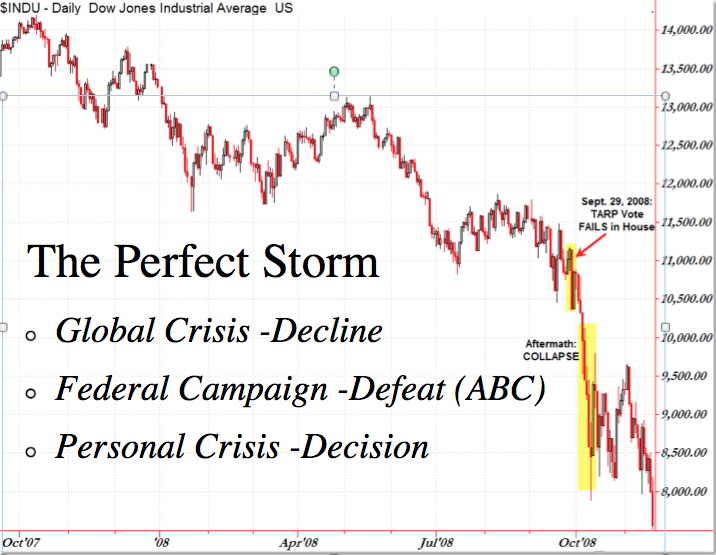
2. The stock market was dropping and could not seem to find a bottom.

For me, those times included some of the most dramatic events that led to a major life change. I ran as a Conservative candidate in the 40th Canadian General Election. Whenever people find out about my election run they ask, “How did you do?” My reply usually starts with, “Do you remember Danny Williams, the Premier of Newfoundland Labrador? Remember his ABC campaign (Anybody But Conservative)?” The result: no Conservative was elected in the province in that election, not even those who were favoured!

After the election, I returned to my financial planning practice (10 years ago on this very day, October 15th).  My clients, like others around the world, were seeing their portfolios declining by thousands, especially in the weeks I was campaigning in an election that I had no chance of winning. They were still on an emotional roller coaster wondering if they would ever regain what was lost.

Screen Shot 2018-10-15 at 10.38.02 AMThis led me to a very dark place, what my wife often refers to as my mid-life crisis. I struggled with the fact that I was not there for my clients when they needed me most; that was a fail. I put my name forward to run in a federal election and felt very much alone, especially after the devastating election night. I felt defeated (in more ways than just the election) and questioned my purpose. If you look at the chart and the shaded area of yellow, the stock market decline seemed to parallel my life at this time. What was my life all about anyway? It was one of my lowest, darkest times.

I needed a change, a new direction, maybe a new career. I needed something to get me out of this dark place. I searched the web every evening after work for opportunities that I felt suited for but came up empty. Or did I? I prayed but those results didn’t appear any better. I did, however, find a new role with a different Credit Union. This did not seem to make much sense though because it meant I would be managing less than 20% of the assets I was managing where I was. That decision just didn’t seem to make sense but I just knew I had to make a change.

What is interesting is that in my job search, I also found a membership organization for Christian financial professionals known as Advisors with Purpose (now known as Kingdom Advisors). I joined as a member and started to participate in the monthly coaching calls. I also did the KA Core Training which helped me understand what it meant to be called to the role of financial planning. I never really felt called to be a financial planner; it was more like just a job for me, but my perspective began to change. As time progressed, I realized more and more that I was “called” to do what I was doing. It was not just a job, but my interaction with clients was indeed an answer to the calling I felt in life for many years.

Fast forward to the fall of 2013 when I am asked to become the National Director of Kingdom Advisors in Canada. This would mean helping other Christian financial professionals understand their own calling; that excited me. It also meant leaving my practice and clients and leaving “the rock” (Newfoundland), where I had lived all my life; that scared me.

In 2015, I left my book of business behind and my wife and I moved to Ontario, just on the outskirts of Ottawa. I ended up in the Ottawa region anyway, not because I was elected as a Member of Parliament, but to fulfill a completely different purpose. Life has taken a very different path than I thought. I can truly say it is a journey of faith that is not without dark moments.

I am reminded of this scripture in Isaiah 45:3 (NIV):

I will give you hidden treasures, riches stored in secret places, so that you may know that I am the LORD, the God of Israel (& Canada), who summons (or calls) you by name.

Have you ever felt like your life is like a chart of the stock market? Has it often resembled that sort of roller coaster ride? Look for the treasures that may be hidden in the dark place, invest your life at that point where opportunity presents itself because the return on the investment of your life can be significant and have eternal rewards!

Yesterday’s Miracle

Yesterday’s Miracle

Yesterday didn’t start at all the way I desired. I was scheduled to speak at a local church and was pretty excited about sharing until I woke up at 5:45 AM feeling quite dizzy and nauseous. I tried to sleep longer but by 9 AM I actually felt worse and began throwing up. What was I to do? I knew the pastor was away so as weak as I felt, I went to the church and sat through the entire service until it was time to speak. I felt so exhausted that I wondered if I should stand or if it might be best to speak from a stool instead.

What’s interesting is that my topic was “Let These Words Sink Into Your Ears” with the idea that God’s Word has the power to provide health to your body and nourishment to your bones. I told the people that as I drove to the church I felt my strength was at about 25%, but after the worship time, I was at least 50%. When I was about halfway through the message, I felt much stronger, like I was at 75% – 85%. Two people came up to me after and said that when I started, I looked very pale but as I shared God’s Word, the colour in my face returned.

Here was my prayer at the beginning which were really my sermon points:

Lord, open my:

Ears to hear Your Word

Mind to Understand Your Word

Heart to Believe Your Word

Spirit to Trust Your Word

Bones to be Healed and Refreshed by Your Word.

I’m convinced that healing came to me as a result of God’s Word being spoken. After having a nap and eating lunch, I felt well enough to ride 25 kilometres on my bicycle.

If you would like to listen to my message follow this link:

Let These Words Sink In

When you consider it, the words you hear bring you to a place of understanding. Your thinking gradually shifts to shape what you believe. Your beliefs determine who you trust and when you have confidence in someone, it will impact how you live. So that’s really how words filter into you bones and bring life!

Father’s Day Reversal

Father’s Day Reversal

Well this Father’s Day will be the most different of any that I can remember. I don’t expect to see any of my children today and my wife is not even with me, because she is with her Dad today, which is pretty special for her.

Since I have been asked to share this morning in a local church I have been thinking, “What is Father’s Day all about anyway?”  Here is the brief history of this special day:

Some credit the first Father’s Day celebration to Sonora Smart Dodd for honouring her father, a veteran of the Civil War, who raised his family as a single Dad when his wife died giving birth to their sixth child. To show her appreciation for her father’s efforts, after listening to a church sermon on Mother’s Day in 1909, Sonora initially suggested that there should be a day to celebrate him and other dads like him in the State in which they lived and farmed. After much campaigning, the first Father’s Day was held in Washington State on June 19, 1910. Although Father’s Day was celebrated throughout the U.S. as an unofficial day for Dads after that date, it was in 1966, Lyndon B. Johnson, through an executive order, designated the third Sunday in June as the official day to celebrate Father’s Day. It wasn’t until 1972, during the Nixon administration, that Father’s Day was officially recognized as a national holiday.

While it’s great to celebrate Dads, I’ve been thinking that I need to celebrate my children. Here is what I mean: if you think about a fathers role, isn’t it about investing your life into your children? I take this lesson from our Heavenly Father. When Jesus was baptized here is what Scripture records in Mark 1:10-11.

As soon as he came up out of the water, he saw the heavens being torn open and the Spirit descending on him like a dove. And a voice came from heaven: You are My beloved Son; I take delight in You!

Three things to note for Dads:

1. The heavens were opened

Our inspiration needs to come from heaven, that is where the initial example of fatherhood comes from. Heaven was obviously closed but opened up or was “torn open” for a reason. Most of us just think about heaven as a place prepared for us, that we will go to when we die. Isn’t heaven is so much more? Can heaven impact our world today? I believe heaven is what sustains the earth (see Hebrews 1:3) so in that sense sustains everyone on the earth.  That is what makes the Lord’s prayer so powerful, it is asking heaven to open and influence the earth!

DB91925F-CA05-4D14-91C5-9054BAE6788C

2. A voice from heaven (the Father spoke)

When I think about my voice being heard I realize I need to think before I speak. As I reflect on the words I’ve spoken to my children, sometimes in anger and frustration, I must ask for their forgiveness. The words spoken in my wedding vows come to mind: “… always speak words of grace that will build you up.” The word “always” stands out to me. I have never forgotten those words but have often fallen short of them. I cannot claim that my words are always inspired by heaven because they are at time influenced more by the earthly challenges I deal with from day to day. My prayer this morning is: “May I look more to heaven before I speak words to my children.”

3. Words of love and acceptance

The time of baptism is seen as the beginning of Jesus’ ministry so in one sense He hadn’t accomplished too much in life because he was just getting started. However, He was a carpenter so maybe more was accomplished than we may typically think about. Why was the Father pleased? I think the reason is pretty simple: the Son was on the earth and moving toward His purpose. He was an example to us and contributed in His world before His baptism and most certainly after these words were spoken to Him. Did it matter what He had done? The Father was “well pleased” and expressed exactly that to the Son.

Today I want to reverse Father’s Day! Instead of waiting for messages from my children, to celebrate Father’s Day, I want to send them a message:

“I’m very proud of you, not for what you have accomplished or will accomplish in your life, but simply because you are my child! You are on this earth and moving toward your purpose! You are a gift to me and I will always love you. Whatever difficulties you may face in life, I pray you will always feel you can come to me and find a place of acceptance. After all, I am your father!”

Happy Father’s Day!