

Financial advisors have a special call and what the Apostle Paul shared with Timothy in 1 Tim 6:17-19 is totally relevant for advisors in our current times as they instruct the rich: Tell them to use their money to do good. They should be rich in good works and generous to those in need, always being ready to share with others, (NLT) storing up treasure for themselves as a good foundation for the coming age, so that they may take hold of what is truly life. (CSB)
The rich are not told to take a vow of poverty. They are told to take a vow of generosity.
Randy Alcorn, Money Possessions & Eternity, p. 291
The ultimate achievement of a financial planner is not just putting together a financial plan, but helping clients take hold of what is truly life.
Every advisor and every client has a plan or purpose in life that needs to be discovered. Often this is hidden and can be difficult to discover. This verse is majorly important: A plan in the heart of a man is like deep water, But a man of understanding draws it out (Prov. 20:5 NASB). The financial advisor must be “an advisor of understanding” who will have deeper conversations that probe beyond “the numbers” such as rates of returns, etc.
For from him and through him and to him are all things. To him be glory forever. Amen. (Rom. 11:36 ESV – Remember the purpose of all we do is to bring God glory. It is something we all fall short of (Rom. 3:23) personally and professionally but our goal is to hear: ‘Well done, good and faithful servant. You have been faithful over a little; I will set you over much. Enter into the joy of your master.’ (Matt. 25:23 ESV)
As I consider one advisor leaving the financial services industry (semi-retiring or retiring) and passing his/her business along to a younger advisor, I cannot help but think of Elijah and Elisha. When they had crossed, Elijah said to Elisha, “Ask what I shall do for you, before I am taken from you.” And Elisha said, “Please let there be a double portion of your spirit on me.” (2 Kings 2:9 ESV) If there is a secret to a successful transition, it is to have the younger advisor receive “the spirit” of the senior advisor because that is truly what has created this business in the first place.
Often, money is viewed as something we can trust, particularly the more money, the easier it is to have confidence in wealth. The rich think of their wealth as a strong defense; they imagine it to be a high wall of safety (Prov. 18:11 NLT).
Whatever you do, do it from the heart, as something done for the Lord and not for people, knowing that you will receive the reward of an inheritance from the Lord. You serve the Lord Christ (Col. 3:23,24 CSB). This verse is challenging because Certified Financial Planners understand based on their Code of Ethics and particularly Principle # 1: Duty of Loyalty to the Client. “The duty to act in the client’s interest by placing the client’s interests first.” If we truly see our work as being done for the Lord, this is a higher standard and one that ensures we will have placed the client’s interest ahead of our own and all other interests.
Let the favour of the Lord our God be upon us, and establish the work of our hands upon us; yes, establish the work of our hands! (Ps. 90:17 ESV) This prayer asks the Lord to make our efforts on earth permanent, meaning the advice we provide will have an eternal impact.
May this be the prayer of every Christian financial advisor.







 1. There was a federal election in Canada,
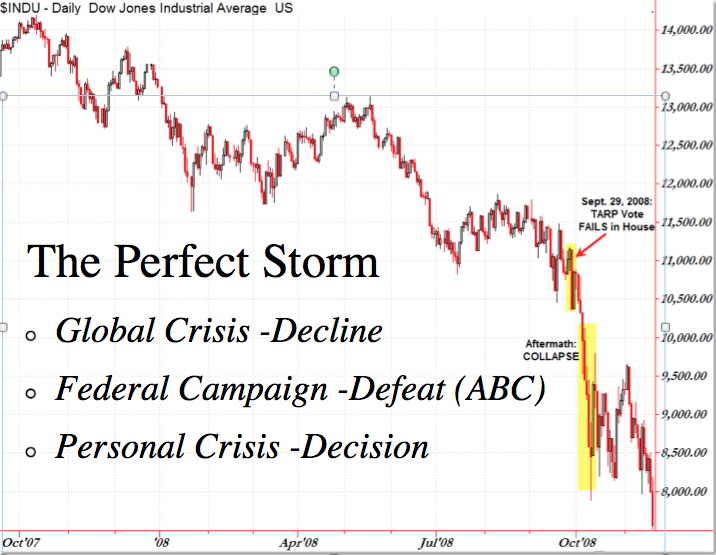 This led me to a very dark place, what my wife often refers to as my mid-life crisis. I struggled with the fact that I was not there for my clients when they needed me most; that was a fail. I put my name forward to run in a federal election and felt very much alone, especially after the devastating election night. I felt defeated (in more ways than just the election) and questioned my purpose. If you look at the chart and the shaded area of yellow, the stock market decline seemed to parallel my life at this time. What was my life all about anyway? It was one of my lowest, darkest times.
 What’s interesting is the reason Billy Graham gives for his entrance into heaven. He states, “But I won’t be in heaven because I preached to the crowds or because I have tried to live a good life.” It is only his faith in Jesus Christ that gave him the confidence of heaven. If Billy Graham will “be in heaven for one reason,” our hope of going to heaven is because of the very same reason.
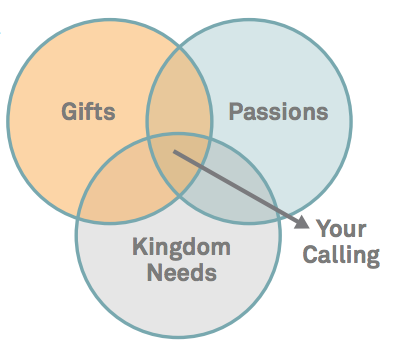 – I have discovered that you can actually fulfill your “calling” in a job or a career but the key is to fulfill your calling, no matter what your hand finds to do. I guess you can say, it’s finding that sweet spot and I think many times that simply means following the voice that is within.
 Lorne Robinson's Blog