A Truck By Accident

A Truck By Accident

Three years ago, we left Newfoundland and moved to Ontario. Now in 2018, it was time to rent another Uhaul to move our son, his wife along with our grandson from Toronto, Ontario to Gatineau, Quebec. That’s where this story gets interesting.

I go to pick up the rental truck, only to be told the 15 foot truck my daughter-in-law Amanda had ordered was in an accident and had to be inspected and was no longer available for us to rent. He said, “I have another truck for you though, it’s a little bigger, would that be OK?”

I replied by explaining how they had moved from Toronto a month ago in a 15 foot truck, stored everything in my garage and since that time they purchased an oak table with 6 chairs plus two night tables for their bedroom, so an extra 5 feet would not go astray.

Here is how Amanda explained her day (before moving day) on her Facebook post:

Well, today was eventful. I lost my keys, then found them under the seat of my car. We went to pick up our truck for tomorrow’s move, but it was in an accident. So we picked up a 20′ truck at 5 for the same price as the 15′ truck. Then I got a call that our fridge/stove order was cancelled, and wouldn’t be delivered tomorrow but we’d have to wait a week or two for it to arrive. So we went to Home Depot and got the same fridge and almost the same stove for $800 cheaper than our original order. We’re picking them up with our Uhaul tomorrow morning.

The one thing she didn’t really explain was that the Home Depot in Carleton Place could not deliver to Quebec, so the fridge and stove would need to be  transported rather than be delivered. I quickly realized the 20′ truck was not just a replacement for the smaller truck but actually needed to make the move in one trip.

It was like someone knew and even arranged a larger truck for us to make the move. When I picked it up, I understood Home Depot was delivering the fridge to their Gatineau home the following day. I certainly had no idea we would need the extra space in the truck, nor did the guy at Uhaul.

Many people would say that all of this is simply things falling into place, but I can’t help but think about the words of Jesus:

Consider the birds of the sky: They don’t sow or reap or gather into barns, yet your Heavenly Father feeds them. Aren’t you worth more than they? (Matt. 6:26)

Many would probably say that God is not involved in our lives like that but here is the answer  I would respond with:

Just as you don’t know the path of the wind, or how bones develop in the womb of a pregnant woman, so also you don’t know the work of God (see Eccl. 11:5).

You can choose to say these events are just coincidence and has nothing to do with God’s activity. I choose instead to give God glory for caring for us similar to how He cares for the birds of the sky or the grass of the field. If God feeds the birds and cares for the grass, I believe He can arrange the right size of Uhaul we need, even if we ordered a smaller one.

Have you ever had good things happen that are almost too good to be true? Do you thing God has any part of this or is it just coincidence?

Yesterday’s Miracle

Yesterday’s Miracle

Yesterday didn’t start at all the way I desired. I was scheduled to speak at a local church and was pretty excited about sharing until I woke up at 5:45 AM feeling quite dizzy and nauseous. I tried to sleep longer but by 9 AM I actually felt worse and began throwing up. What was I to do? I knew the pastor was away so as weak as I felt, I went to the church and sat through the entire service until it was time to speak. I felt so exhausted that I wondered if I should stand or if it might be best to speak from a stool instead.

What’s interesting is that my topic was “Let These Words Sink Into Your Ears” with the idea that God’s Word has the power to provide health to your body and nourishment to your bones. I told the people that as I drove to the church I felt my strength was at about 25%, but after the worship time, I was at least 50%. When I was about halfway through the message, I felt much stronger, like I was at 75% – 85%. Two people came up to me after and said that when I started, I looked very pale but as I shared God’s Word, the colour in my face returned.

Here was my prayer at the beginning which were really my sermon points:

Lord, open my:

Ears to hear Your Word

Mind to Understand Your Word

Heart to Believe Your Word

Spirit to Trust Your Word

Bones to be Healed and Refreshed by Your Word.

I’m convinced that healing came to me as a result of God’s Word being spoken. After having a nap and eating lunch, I felt well enough to ride 25 kilometres on my bicycle.

If you would like to listen to my message follow this link:

Let These Words Sink In

When you consider it, the words you hear bring you to a place of understanding. Your thinking gradually shifts to shape what you believe. Your beliefs determine who you trust and when you have confidence in someone, it will impact how you live. So that’s really how words filter into you bones and bring life!

When Time Touches Eternity

When Time Touches Eternity

The US Marines have a saying – “In order to get to heaven, you have to die!”

That statement is interesting indeed, but I would ask the following questions: Is your life over when you die? What comes after death? Do you think of life in two parts – one part that we are living now, which ends when we die, and then a second part, eternal life (or getting to heaven)?

When I have asked those questions, most answer: the afterlife is an entirely different life than our present life, whether you believe in God or not. In order to get to heaven (eternal life), you have to die (so this life ends).

Is this belief biblical? Or is it more like: when you die physically, you actually continue to live on, just in a different place? Maybe you haven’t given this much thought but it is really important to consider.

We typically think about our existence as two entirely separate lives, but Jesus spoke of  one life that continues into eternity because we believe in Him. He said that our life here (on earth) actually impacts our life there (in heaven).

For the Son of Man is going to come in the glory of His Father with His angels, and WILL THEN REPAY EVERY MAN ACCORDING TO HIS DEEDS.

In other words, the consequences of our actions while we are here on earth are actually meaningful in eternity, yet most just “live for today” not considering any future return from the investment of our present lives. We often quote “He/she will reap what they sow” and typically are thinking about consequences soon after the action(s) occurs, not in eternity. This, of course, is true in the example of the farmer who sows seed to reap a harvest later in the fall of the year. It is interesting that the next verse following Gal. 6:7 (reaping and sowing) references reaping “eternal life,” connecting our life in the present with our eternal destiny.

Maybe we live our lives with too much of a disconnect from the eternal life that we are promised. I read something interesting from Mark Batterson’s book entitled “If.”

In the Screwtape Letters, C.S. Lewis demonstrates that God wants humankind to attend chiefly to two things: “to eternity itself, and to that point in time which they call the Present. For the Present is the point at which time touches eternity.
In light of that truth, Screwtape, the veteran demon, advises a novice named Wormwood with these words: “Our business is to get them away from the eternal, and from the Present. With this in mind we sometimes tempt a human … to live in the Past.”

Two things grabbed my attention:

1. The Present is the point at which time touches eternity

2. The conversation between demons discussing their business of distracting humans “away from the eternal.”

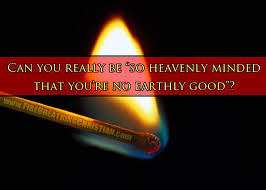
heavenly mindedOur present lives today are meant to be lived in a manner that touches or impacts eternity. In order for that to happen, we must have an eternal perspective which will impact what we value.  If all we do is live for today, we may be living a distracted life, distracted from what should be our true priority.

C.S. Lewis says it this way:

If you read history you will find that the Christians who did the most for the present world are those who thought most of the next.

This means the idea about being “so heavenly minded that you are no earthly good” is a fallacy.

Do you feel you are only living for today?  Would it be more impactful today if you could gain an eternal perspective?

Father’s Day Reversal

Father’s Day Reversal

Well this Father’s Day will be the most different of any that I can remember. I don’t expect to see any of my children today and my wife is not even with me, because she is with her Dad today, which is pretty special for her.

Since I have been asked to share this morning in a local church I have been thinking, “What is Father’s Day all about anyway?”  Here is the brief history of this special day:

Some credit the first Father’s Day celebration to Sonora Smart Dodd for honouring her father, a veteran of the Civil War, who raised his family as a single Dad when his wife died giving birth to their sixth child. To show her appreciation for her father’s efforts, after listening to a church sermon on Mother’s Day in 1909, Sonora initially suggested that there should be a day to celebrate him and other dads like him in the State in which they lived and farmed. After much campaigning, the first Father’s Day was held in Washington State on June 19, 1910. Although Father’s Day was celebrated throughout the U.S. as an unofficial day for Dads after that date, it was in 1966, Lyndon B. Johnson, through an executive order, designated the third Sunday in June as the official day to celebrate Father’s Day. It wasn’t until 1972, during the Nixon administration, that Father’s Day was officially recognized as a national holiday.

While it’s great to celebrate Dads, I’ve been thinking that I need to celebrate my children. Here is what I mean: if you think about a fathers role, isn’t it about investing your life into your children? I take this lesson from our Heavenly Father. When Jesus was baptized here is what Scripture records in Mark 1:10-11.

As soon as he came up out of the water, he saw the heavens being torn open and the Spirit descending on him like a dove. And a voice came from heaven: You are My beloved Son; I take delight in You!

Three things to note for Dads:

1. The heavens were opened

Our inspiration needs to come from heaven, that is where the initial example of fatherhood comes from. Heaven was obviously closed but opened up or was “torn open” for a reason. Most of us just think about heaven as a place prepared for us, that we will go to when we die. Isn’t heaven is so much more? Can heaven impact our world today? I believe heaven is what sustains the earth (see Hebrews 1:3) so in that sense sustains everyone on the earth.  That is what makes the Lord’s prayer so powerful, it is asking heaven to open and influence the earth!

DB91925F-CA05-4D14-91C5-9054BAE6788C

2. A voice from heaven (the Father spoke)

When I think about my voice being heard I realize I need to think before I speak. As I reflect on the words I’ve spoken to my children, sometimes in anger and frustration, I must ask for their forgiveness. The words spoken in my wedding vows come to mind: “… always speak words of grace that will build you up.” The word “always” stands out to me. I have never forgotten those words but have often fallen short of them. I cannot claim that my words are always inspired by heaven because they are at time influenced more by the earthly challenges I deal with from day to day. My prayer this morning is: “May I look more to heaven before I speak words to my children.”

3. Words of love and acceptance

The time of baptism is seen as the beginning of Jesus’ ministry so in one sense He hadn’t accomplished too much in life because he was just getting started. However, He was a carpenter so maybe more was accomplished than we may typically think about. Why was the Father pleased? I think the reason is pretty simple: the Son was on the earth and moving toward His purpose. He was an example to us and contributed in His world before His baptism and most certainly after these words were spoken to Him. Did it matter what He had done? The Father was “well pleased” and expressed exactly that to the Son.

Today I want to reverse Father’s Day! Instead of waiting for messages from my children, to celebrate Father’s Day, I want to send them a message:

“I’m very proud of you, not for what you have accomplished or will accomplish in your life, but simply because you are my child! You are on this earth and moving toward your purpose! You are a gift to me and I will always love you. Whatever difficulties you may face in life, I pray you will always feel you can come to me and find a place of acceptance. After all, I am your father!”

Happy Father’s Day!


I Lost My Watch

I Lost My Watch

In April 2015, I transitioned from 24 years as a financial planner and became the National Director for Kingdom Advisors where I now connect with Christian financial professionals across Canada. At that time, I was given a Hugo Boss watch from a fund company which meant a lot to me because it was a symbol of an important time of transition in my life.

Fast forward to August 2017 – my wife and I flew back to our home province for a few weeks. We were blessed to have friends who offered us their car to use while we were there. Let me interject a little about my friends, Keith and Alma: we have spent sufficient time together to be completely comfortable with them and they really understand that “The Lord owns it all.” To illustrate our relationship, I sent this text to them when we were about to fly back home: “So thankful for the use of the BMW the Lord blessed you with. Note: I avoided saying ‘your vehicle’ because I know you understand that what you have is the Lord’s. You are such a blessing!!”

After we arrived home from our trip, I searched through every piece of luggage and pockets of my jacket but could not find my watch. We called back to my in-laws, where I thought I had likely left it; they searched the room where we stayed. No watch. We called Alma and asked her to look in the car, but the result was the same – no watch found. We called the airport thinking I may have left my watch in the tray when I went through security.  Again, my watch was not found.

Where was my watch? It was lost and I learned today (May 22, 2018) that it actually had been in Alma’s car for all these months, completely hidden under the front seat.  The car had been cleaned several times since August without discovering the watch. In April, when the car was driven over a bumpy road, Alma’s sun glasses fell on the floor underneath the seat and when she reached for them, she pulled out the watch!

The problem was she had completely forgotten that I had even borrowed their car and her immediate action was to send  messages to those she knew who had recently used her car.  The response every time was “I didn’t lose a watch.” When the watch was found, the battery was dead so they thought that it may have been there for a long time, maybe even before they purchased the vehicle.  Could it belong to the original owner?

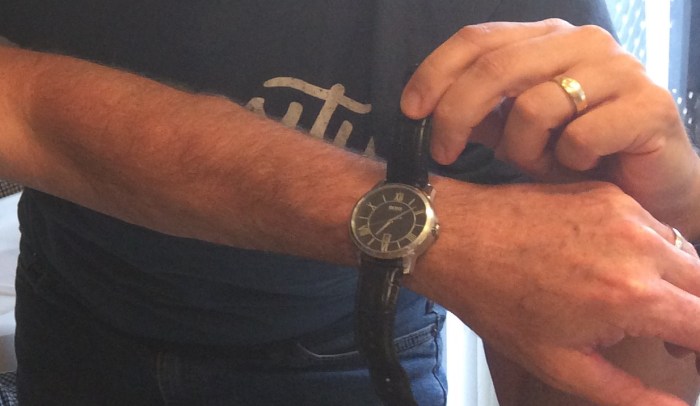
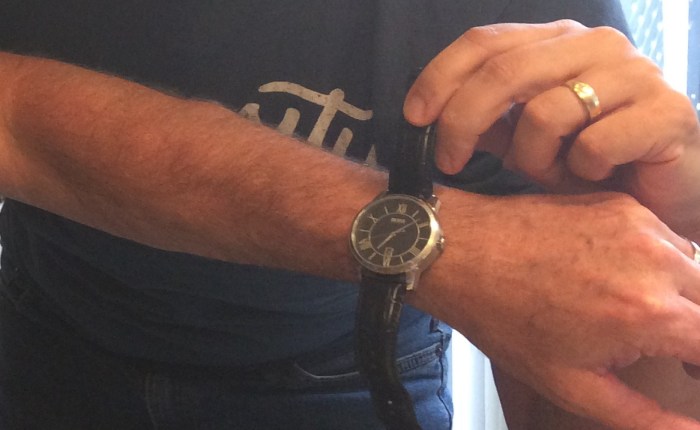
Here’s the amazing part of this story: Alma’s husband, Keith didn’t even know I had lost my watch on my visit. He took the watch, replaced the battery and began wearing it on occasion. For me, any hope of finding the watch was long gone, even when they texted and said they were coming for a visit. They arrived at our house and we enjoyed catching up in conversation over a delicious meal. I had no thought about the watch until I saw it on Keith’s arm. I felt a little awkward at first and did not want to interrupt the flow of conversation. How could I ask about the watch or where and when he had found it? Maybe I should just ask, “Where did you get such a nice watch?” Our conversation continued and out of nowhere, Keith lifted his arm to look at the watch and then said, “I have to change the subject: Lorne this watch is yours!”

Seriously! We were all shocked at the quick change in conversation and I realized how the Lord cares about the little details that concern us, especially regarding something that was lost. Keith said, “I just felt the Lord say, ‘This is Lorne’s watch.’” I realized that the Lord was using this circumstance to give Keith more confidence to follow the Lord when prompted. It confirmed to him that he could trust the still small voice of the Lord.

7716F8B3-48AE-43CD-813E-8F201CA12EF4
Many times Keith doesn’t even wear a watch. He could have easily worn a different watch when he visited, or no watch at all. Was it just coincidence that he chose to wear the Boss watch for his visit to my house?

Here is what I realized from this whole thing: the Lord is interested in using every day situations to help us be more sensitive to His promptings.
What is most amazing about this story? It’s not as much about my lost watch being found as it is about a man being sensitive to know when the Lord is speaking to him and having a willingness to act on it. Do you have the confidence to follow the inner promptings from the Lord?

Reckless Love & The Cop Who Didn’t Shoot

Reckless Love & The Cop Who Didn’t Shoot

The news is filled with the shocking story of the Toronto van attack where 10 people have been killed. We seem to have become more accustomed to this sort of violence in Europe or America, but not Toronto, so close to home. We have family in Toronto and it is only hours from where we live!

After reading the article published at Maclean’s written by Scott Gilmore entitled: Toronto Van Attack: The Cop Who Didn’t Shoot, I couldn’t help but think of the Christian song: Reckless Love, since I have already written two blogs about this song. No doubt, the actions of the perpetrator were violently reckless but could the actions of the officer, Const. Ken Lam also be considered reckless? We have likely all see the video as he stands about 30 ft from the van with his gun pointed at the driver. Gilmore writes:

What was he thinking at that moment? He knew this was the van that had reportedly just mowed down more than two dozen people. He could see the smashed grill. He could see the man behind the wheel. Did he think it was about to explode? Did he expect the driver to jump out shooting? The cop holds his fire.

Screen Shot 2018-04-25 at 7.26.58 AM

It is obvious the driver of the van is looking to be shot, because he pretends more than once, to pull a gun from his pocket. Most of us would probably agree that this man deserved to be shot and killed, after his completely reckless behaviour. Ten innocent people are dead and another 15 injured, but the officer didn’t shoot. Another article said: This officer clearly had de-escalation in mind.

I wonder if some police officers think the actions of Const. Lam might have been a little reckless. Did he realize what the consequences of not shooting could be at that precise moment? After all, there wasn’t much time to think this through.  Only thirty-seven seconds elapsed from when the driver emerged from his van, to when he was face-down on the sidewalk. Not one shot was fired!

Const. Lam is rightly being praised because he didn’t shoot. The shooting of the driver was the expected outcome; after all, it is usually how the story ends.

Gilmore concludes his article this way:

We kill each other out of hate, or fear, or ignorance, or duty. Sadly, we understand this instinct well. This is the dark side of humanity. And rightly, we are mesmerized by the horror of it.

But there is light inside us too. We also possess the instinct to keep each other alive. This part of us can be more difficult to understand. But it deserves our devotion much more than the act of killing does. These moments of humanity are not uncommon, but they are precious. It would be good if we could remember that about Toronto, remember the cop who didn’t shoot.

Maybe it was the light inside Const. Ken Lam that made the difference and didn’t take that drivers life, even though we might agree he deserved to die. The driver of the van exhibited completely reckless actions motivated by hate. It can easily be argued the cop may have also acted recklessly, motivated by the light inside him, and in the opposite fashion with such a positive result.

The song Reckless Love says in regards to God’s love:

I couldn’t earn it, I don’t deserve it, still you give yourself away. Oh the overwhelming, never ending, reckless love of God.

Many people are not able to wrap their heads around the thought that God can love humanity recklessly despite how depraved our behaviour is at times. Doesn’t God reach out to us to give us what we do not deserve? Didn’t this cop demonstrate “Reckless Love” (mercy) in a most beautiful way?

“Where Was God?”

“Where Was God?”

8090B62D-A050-4801-AF8D-A6311B72E04F“Why did this happen? Where was God?” These are the two major questions that were posed by the team pastor at the Humboldt Broncos vigil.

Humboldt Broncos vigil: Team pastor delivers tearful and powerful address

The beautiful part of his answer is that He is with us, that He is with the broken hearted. The more challenging part of his answer is when he said, “God is on the throne.” The thought that immediately follows is that if God is on the throne, He is, therefore, in control. As these thoughts were being expressed, the camera was on a tearful young lady who was shaking her head as if to say “No.”

Rejection of this kind of thinking at a time like this is understandable. “How can a loving God allow such a tragedy to happen?” If you look closer at the Scriptures, you will find that God is more accurately pictured as sovereign, which is actually different than being “in control.” As a matter of fact, the Scripture says, “that the world around us is under the control of the evil one” (1 John 5:19). Can I suggest that this tragedy had  more to do with the “evil one” than the God who is sovereign? Why did this happen? The evil one is said to have a purpose of stealing, killing and destroying (John 10:10). Why not bring the evil one a little more into focus for the responsibility of these types of circumstances or even just human failure?

Read a previous blog to help answer the question: Is God Really in Control?

In this blog, I use the example of the Queen, who is considered the Sovereign over Canada, but she does not control the decisions or even influence the government of Canada. Interestingly, the Queen sent a message of condolence which is definitely a positive thing. My concern is more about the message the Sovereign God is trying to send.

The fact is, we experience hardship in this life and the primary reason is that satan and sin are still at large in this broken world. During times like these, we certainly shake our heads “no” and may be tempted to think that God is not there and is not sovereign or reigning. He is, however, very much interested in your brokenness and can somehow bring good from the evil that has happened. That can be very difficult to comprehend at a time like this. In fact, He can take these awful events that satan intends for evil and turn them around, and bring eternal good out of them.

Maybe instead of asking, “Where was God” we should ask, “Where is God now?” God’s promise is this: “I will never leave you nor forsake you” (Heb. 13:5). Pastors may not have all the answers during such difficult times, but we can all have the confidence that, “we know that in all things God works for the good of those who love him, who have been called according to his purpose” (Romans 8:28).

We can all have the assurance that God is with us in life’s darkest valley.

“Our Season Was Painful” #humboldtbroncos

There is much sadness in Canada today whether you are a hockey fan or not, due to the bus tragedy in Saskatchewan. I just happened to turn on SportsCentre this morning and the main story of course, is about the Humboldt Broncos hockey team with 15 dead and others critically injured.

Many coaches, players, politicians and even those who really have not had much connection are heart broken over this loss. One comment made by Glen Gulutzan, coach of the Calgary Flames was particularly striking. Here are his exact words:

I said in Winnipeg, our season was painful, and I would like to take that back … I can’t imagine what Mom’s and Dad’s are going through.

That provides perspective! Sometimes our experiences in a particular season (of life) can be so challenging, often because it may represent a loss of some sort. Obviously, a season of loss and failure to make the playoffs is not loss at all in comparison to this.

It is pretty clear that the pain of this tradegy has impacted the hearts of so many.  Thus far more than 40,000 people have donated 3 million dollars through the gofundme.com/funds-forHumboldt-Broncos.

What will be the legacy of this Humboldt Broncos team? Legacy may prove to be the greatest consolation for these families.

In law, a legacy is something acquired by inheritance, or by a will. In historical terms, a legacy is something that is handed down from one period of time to another period of time. Often it means something handed down from an ancestor or predecessor.

Humboldt players range in age from 16 – 21, which is not a significantly long period of time. My prayer is that the short period of time lived, will enable a legacy that is meaningful enough to provide some consolation for those families who are now feeling the pain of loss.

I am not sure anyone can find the right words at a time like this. I searched google and found this quote below about a power that is able to make a way out of no way and can transform dark yesterdays into bright tomorrows.

E90D87E2-FF95-4733-93B5-9DAB10DB2F48

Is God’s Love Reckless? Part II

After writing my blog in January concerning the powerful song “The Reckless of God,” my wife and I were able to visit a few churches as we travelled during February month. Interestingly, in the first two churches we visited, they sang this song and I was moved to tears on both occasions. Why? It is such a significant expression of God’s love reaching out to those who are distant and away from Him.

This song is definitely controversial simply because it uses the word “reckless” to describe God’s love. One response to my blog asked a couple of very good questions: “How can you separate God from His love? In fact, God is love, so by speaking of His love being reckless, are we not saying that God Himself is reckless?” My question in response is this: Can we limit God’s love by our theology? God is not confined to our way of thinking and as much as we think we understand God, we should never underestimate His ability to reach out to others in the manner He chooses.

In my devotions this week, I have been reading the book of Hosea and could not help but reflect on this song again as I read. Here is how Hosea starts in verse 2 with an unusual instruction to the prophet:

When the Lord first spoke to Hosea, He said this to him: Go and marry a promiscuous wife and have children of promiscuity, for the land is committing blatant acts of promiscuity by abandoning the Lord.

Seems like pretty reckless strategy, don’t you think? The command from God was to marry a prostitute, but wasn’t God concerned about the reputation of his servant? Reckless is defined as utterly unconcerned about the consequences of some action. That sounds like the attitude of God when choosing a wife for the prophet. The essence of the story is really to illustrate exactly how God loves and pursues His people despite their unfaithfulness to Him. Patiently, God continued to pursue this one-sided relationship by lavishing love and mercy on a nation that rejected Him. The devotional I read all but quoted the lyrics to the Reckless Love song but fell a little short of actually referencing His love as reckless.

Oh, the unstoppable, unmatchable, inextinguishable, everlasting love of God! We don’t deserve it. We can’t fully comprehend it.

The song is based on Luke 15; the lost sheep and the lost son, which can be argued as evidence of “the reckless love of God.” However, if you search the Bible you can easily find multiple examples that can support the truth expressed in this song. Just take a look at the genealogy of Christ, particularly some of the females (who are not normally mentioned at all). I won’t go into the stories in detail but Tamar is the first female (Matt. 1:3) who pretends to be a prostitute and tricks her father-in-law to continue the family tree (Tamar’s story is in Gen. 38). Then there is Rahab (Matt 1:5), who was a prostitute who had no hesitation to lie and deceive her own people to protect herself and her family (Joshua 2). Then one name is not mentioned, but she is referred to as the wife of Uriah (Matt. 1:6). Remember he was the guy David sent to the front lines to make sure he was killed to try and cover the adulterous affair he had with Uriah’s wife (2 Sam. 11).

Why are these stories brought forward and included in the genealogy of Christ? What do these stories have in common? They all include sexual promiscuity. You would think God would be more interested in covering these details, rather than reminding all the readers about the details. Let’s face it, those are the types of things most of us would prefer to cover, not remind everyone that these things are part of the family history. God is obviously not at all concerned about the consequences of using people who have been involved in these sexual sins.

God is interested in redeeming those lives and including them in His story, reckless as that might seem. Maybe as you read this you can relate in some way to some of these people. You are distant from your Creator and feeling hopeless. Be assured of this fact, He is pursuing you with a goal of including you in His great story.

The video below is 12 minutes long but includes Cory Asbury’s story behind the song. Is this song being sung in your church?

Billy Graham: Not in Heaven Because He Preached to the Crowds

Billy Graham: Not in Heaven Because He Preached to the Crowds

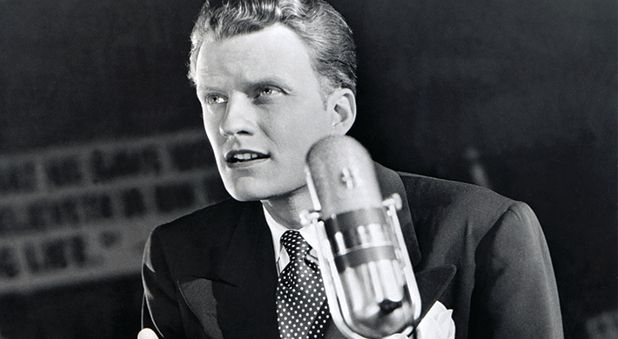
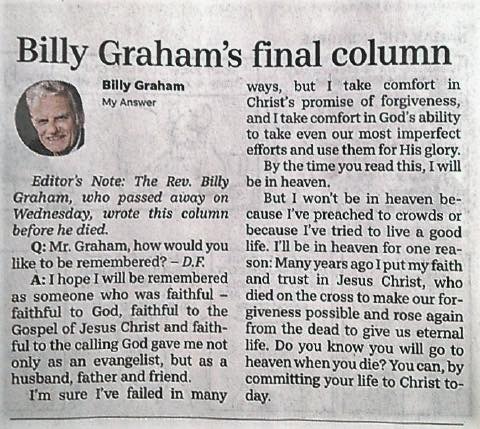
After watching the funeral of Billy Graham this week, I discovered his final column where Billy states: “By the time you read this, I will be in heaven.” I don’t think there is a doubt in anyone’s mind that Billy Graham is in heaven. Why are we all agreed that he is in heaven? We might answer, with all the good he has done through his preaching to millions, you know he is going to be in heaven. After all he was “America’s Pastor” and the world’s best known evangelist, so he is a obviously in heaven.

F82EB9F9-DBF9-4EBC-9A4A-C6ADF24A9A53What’s interesting is the reason Billy Graham gives for his entrance into heaven. He states, “But I won’t be in heaven because I preached to the crowds or because I have tried to live a good life.” It is only his faith in Jesus Christ that gave him the  confidence of heaven. If Billy Graham will “be in heaven for one reason,” our hope of going to heaven is because of  the very same reason.

Randy Alcorn says this:

Many mistakenly believe that heaven is our reward for doing good things. This is absolutely not the case. Our presence in heaven is in no sense a reward for our works, but a gift freely given by God in response to faith.

Well, what about the millions that Billy Graham preached to and the lives who came to Christ because of his preaching? Doesn’t that account for anything? The answer can be found in Eph. 2:9, which Billy clearly understood: “Salvation is not a reward for the good things we have done, so none of us can boast about it” (NLT). In other words, what you believe is the key to entering heaven, not what you do.  That is a good thing because if it is based on our efforts then most of us would have a difficult challenge ahead, especially if we compare ourselves to the accomplishments of someone like Graham.

However, we can’t stop reading there because immediately after saying salvation is “not by works,” the next verse clarifies that our works matter a great deal.

For we are his workmanship, created in Christ Jesus for good works, which God prepared ahead of time for us to do.

Even though salvation is not through our works, we are actually created to do good works. A lifetime of good works was actually prepared in advance by God for us to do. A few years ago I did a study using a book by Bruce Wilkinson called “A Life God Rewards” which explained how Jesus taught the promise of reward in heaven.

“He will reward each according to his works” (Matthew 16:27)

“You will have treasure in heaven” (Matthew 19:21).

“You will be blessed … for you shall be repaid at the resurrection” (Luke 14:14).

This certainly suggests that God is keeping track of what we do for Him every day. Wilkinson speaks of two keys: The first is belief that unlocks the door to eternal life and determines where we spend eternity. The second is our behaviour which unlocks the door to reward and determines how we will spend eternity.

The reality is we have the same hope of heaven that Billy Graham had because it is simply through faith that we enter heaven, which is really the foundation. At the end of Wilkinson’s book, there are several quotes from well-known theologians and preachers, of which is Billy Graham.

“The believer has his foundation in Jesus Christ. Now we are to build upon this foundation, and the work we have done must stand the ultimate test; the final exams come at the Judgment Seat of Christ when we receive our rewards.” –  Billy Graham

Are we living and working everyday with an eternal perspective? Will our good deeds, acts of kindness (works) pass the ultimate test?