Who to Trust in These Times

Who to Trust in These Times

It seems that everyone is talking about President Trump these days. Some are fearing what seems to be inevitable now – a recession, while others see Trump’s aggression on Canada as a threat to its sovereignty as a nation. Politicians are searching for ways to negotiate or strike back against the imposed tariffs. There are more questions than answers, right now. One thing is certain, things have become extremely uncertain.

As Christians, we often quote this very familiar verse about trust from Proverbs that says “Trust in the Lord with all your heart and lean not on your own understanding.” At times of uncertainty like our world is facing right now, the tendency is to lean more on ourselves and try to understand, which is not real trust. My experience tells me it is much easier to say “I trust the Lord,” but much more difficult to really live a life trusting Him. The tendency is to lean and begin to trust what we understand.

“Trust Me”

Canada is in the middle of a leadership transition and therefore, not in a strong bargaining position. In the coming days, each of these leaders will try and position themselves as the best person and the best party to stand for the interests of Canada. In essence, they are saying, “Trust me.”

It’s difficult to understand what the end game might be for President Donald Trump in regards to Canada. It is also a challenge to determine who can be trusted most to lead Canada through these challenging times. Maybe our focus is completely wrong. Maybe this is the perfect opportunity to trust God!

The fact is this: when we do not understand, we can so easily spiral into anxious thoughts about our future – job insecurity, higher cost of living, etc. When we focus on our understanding or lack of understanding, the result is the same which is the opposite of rest.

Trust Yourself

Compare Proverbs 3:5 to a much less familiar verse in Proverbs that uses a similar word for “understanding:”


Do not wear yourself out to get rich;

do not trust your own cleverness (emphasis mine).

Proverbs 23:4 NIV

The pursuit of wealth is so easily connected with an individual’s own cleverness. The NASB says we should not exhaust ourselves to gain wealth; in fact we should “Cease from the consideration (or understanding) of it.” What exactly are we to cease from? Surely the instruction is not to stop considering how we ought to earn income, after all, we are also instructed to provide for our family (1 Tim 5:8).

It’s pretty clear: Proverbs instructs us to seek wisdom and understanding (Prov. 4:1-9). Consider King Solomon who had the unique opportunity to ask God for anything (1 Kings 3:5) … his request was to have an understanding mind. “And God gave Solomon wisdom and understanding beyond measure” (1 Kings 4:29). God not only gave Solomon wisdom, but also added an extra bonus by giving him what he did not ask for: “both riches and honour” (1 Kings 3:13). So he was granted wisdom and wealth, but the choice before him is the choice we all must make: where to lean.

Consider the Source

Clearly, Scripture is teaching us that the source of wisdom and understanding matters. When we look at Solomons’s life and leadership we can see how he drifted from the source of wisdom.

It’s far too easy to think we are the source of any wealth we have accumulated and lean on our own cleverness for more wealth. Where we lean affects our heart, often without us even realizing it. Maybe that’s why the Israelites were reminded to remember that the Lord your God gives you the power to gain wealth (Deut 8:18).

In the same way, political leaders around the world can naturally lean on their own understanding or cleverness to resolve issues that affect millions of citizens. Take a look at these verses as it relates to the King of Tyre:

Your wisdom has certainly made you rich, because you have storehouses filled with gold and silver. You’re a clever businessman and are extremely wealthy, but your wealth has led to arrogance! Ezekiel 28:4-5 CEV (Emphasis mine)

When one possesses wealth and wisdom and sees themselves as the source of what they have, it can lead to arrogance and pride.

When you set your eyes on wealth, it is [suddenly] gone. For wealth certainly makes itself wings Like an eagle that flies to the heavens. Do not eat the bread of a selfish man, Or desire his delicacies; for he is like one who is inwardly calculating. “Eat and drink!” he says to you, but his heart is not with you.

Proverbs 23:5-6 AMP, 7 ESV

Why would someone who is trying to impress you by offering a meal be “inwardly calculating” the cost of that meal? Maybe it is because when someone sees themselves as the source of this wealth, it is natural to think about how much this generosity costs.

Trust the Lord

When you recognize that any wealth you have is from another source other than yourself, you begin to understand that you are a steward, therefore you are not the true source. Then, where you lean shifts to the true source of the wealth (Deut 8:18). At this point, our own ability to gain wealth shifts to a source that is much great than ourselves.

This is a significant heart shift – this shift means that what we “treasure” also shifts (see Matt. 6:21) because our heart now has a different focus – one where giving is a greater priority, greater than the cost of generosity or how this amount will be replaced. The heart of the steward has trust in a higher source than their own “cleverness” to generate wealth. The steward has clarity about money that was previously missing: wealth is now seen as a tool rather than just a resource to be stored.

The End Game is trust!

Setting Financial Priorities

When you receive your income on a weekly, bi-weekly or monthly basis, it is important to set priorities around the use of these funds. In my study of biblical financial principles I have discovered there are only five things that you can do with money. These are listed here based on rhyme rather than priority:

  1. Live (lifestyle varies depending on personal decisions around spending)
  2. Give (determine to live a generous life)
  3. Owe – repay what we have borrowed which is really an extension of our lifestyle
  4. Owe – taxes (for most, this is an automatic deduction from pay)
  5. Grow – saving for a future goal (education, major purchase, retirement, etc.)

As a simple budget practice, it is helpful to calculate the percentage amount that goes to each of these five areas; however, the big question becomes, “In what order should funds be allocated?” What is the foundation for setting these priorities?

For the Christian, the Bible is to be our guide in life and there are 2350 verses referencing money and possessions. Thankfully, many have researched these truths and can help us determine what our financial priorities ought to be.

In his book, Financial Discipleship for Families, author Brian Holtz shares five priorities based on biblical wisdom.

Priority 1 – Giving Generously: Righteousness is associated with generosity in Psm. 37:21 which states, “The wicked borrows but does not repay, but the righteous is generous and gives!” Jesus emphasizes in His Sermon on the Mount to, “Seek first the kingdom of God and his righteousness, and all these things will be added to you” (Matt 6:33 ESV). Do we seek His kingdom first in our financial decisions? Or are we more focused on adding the the things?

Priority 2 – Providing for Family Needs: The Apostle Paul instructs readers in 1 Tim. 5:8 to “provide for their own family and especially for a member of their household …” (CEB). This directive to care for our loved ones tends to come naturally, and for many it is the top priority.

Priority 3 – Meeting Financial Obligations: Again, the Apostle Paul in Romans 13:7-8 gives the instruction: “pay your taxes and government fees and … owe nothing to anyone – except for your obligation to love one another” (NLT). Holtz says, “After giving and providing for the basic needs of our family, we need to prioritize the various financial obligations we have made.” Paying taxes with gratitude for the income earned can be challenging at tax time and paying off debt can feel burdensome, but is an obligation.

Priority 4 – Saving for the Future: Proverbs 21:20 gives clear guidance to save for future needs which maybe unseen or unknown in the present. It reads, “The wise have wealth and luxury, but fools spend whatever they get.”

Priority 5 – Enjoying God’s Abundant Blessings: When Paul mentored Timothy, he told him to “Instruct the rich… not to be conceited or fix their hope on the uncertainty of riches, but on God, who richly supplies us with all things to enjoy.” Clearly, it is God who gives us these things with purpose – enjoyment being one, but this is not necessarily the top priority. He continues the instruction reiterating priority 1, which is to use what we have been given “to do good, to be rich in good works, to be generous and ready to share” (1 Tim. 6:17-18 NASB).

Our natural tendency is to order our financial priorities like this:

  • Priority 2 – Providing for Family Needs
  • Priority 5 – Enjoying God’s Abundant Blessings
  • Priority 3 – Meeting Financial Obligations
  • Priority 4 – Saving for the Future
  • Priority 1 – Giving Generously

The Kingdom Advisors theme for February focuses on priority 1 and the giving process. Chris Gabriel says, “Giving is a superhighway to the soul. Christian advisors can be agents of redemption in the area of generosity and giving.” As agents of redemption, we are called disciple and help others shape their financial priorities based on biblical financial wisdom.

Questions to consider:

  • Have you ever calculated what percentage of your income goes to each of the five uses of money?
  • Are the financial priorities for Christians any different than non-Christians?
  • How would you personally rank these five priorities?
  • Which of these priorities presents the greatest challenge for you?
  • Do you need to make adjustments to your financial priorities?

Where Are You?

Have you ever asked a question even though you knew the answer? This is a common technique used when engaging with children or grandchildren. It’s a great way to help them think about a situation they find themselves in and how they ended up there.

Similarly, sometimes we ask the question “Where are you?” even though the answer seems obvious.

In life, we all have moments where we wish we could make a different decision. Maybe you’ve been there too.

When God asked Adam and Eve, “Where are you?” it wasn’t about their physical location but rather their proximity to Him! It wasn’t about making them feel guilty for their mistakes, or even how their choices was a failure to trust Him when tempted.

It’s easy to get stuck dwelling on our past mistakes and the resulting consequences. But what’s the point of that? The mistake is behind us, and we can’t change it. Instead, we should focus on where we are now and where we want to go. After all, mistakes are just detours on the journey to our true purpose. Let’s not allow them define us or hold us back.

I am reading through the Bible this year and just finished the story of Joseph. If anyone in life was shifted off course, it was Joseph. Having a dream (at age 17), being sold by his brothers, then elevated to a position of authority only to be falsely accused of sexual misconduct, thrown in jail and eventually becoming the second in command in all of Egypt (when he was 30). Where was Joseph? That’s 13 years of utter turmoil when Joseph went from a pit to prison, yet had success even in the darkest times.

Where are you? This simple question has a deeper meaning than just location. It’s an invitation to reflect on where you are in life and where you are meant to be. Taking time to reflect on your relationship with God and your life’s purpose can lead to powerful transformations. Don’t underestimate the power of this question and the impact it can have on your life.

Can you just imagine the scene where Joseph’s brothers meet him 15 years later after causing so much pain and disruption in his life? He is now in a position of authority above all of them. This turn of events likely left them in shock and fear.

What amazes me is “where” Joseph was … not in his position, but in his perspective. Joseph explains to his brothers that yes, “you sold me here” but more significant is the fact that “God sent me before you to preserve life” (Gen. 45:5). Joseph recognized that every difficult situation he faced had a greater purpose than he realized at the time. His story reminds us that our perspective can be more significant than our position.

So, where are you right now? Instead of just naming a place or position, we should consider our proximity to God and the work that He has prepared for us to do. Let’s focus on our perspective and trust that every step we take, even in difficult times, is leading us towards a greater purpose.

What Is Your Legacy?

What Is Your Legacy?

Every month, I am involved in a Kingdom Advisors Study Group and January’s focus is on legacy.

Children are the living messages we send to a time we will not see.

J.W. Whitehead from Exploring Stewardship section of The Stewardship Study Bible

Did you know that there are three kinds of legacy!

1. The Legacy We Received

Father’s Day 2006 with my Grandfather, Arch Woodworth

When considering the legacy I received, my thoughts immediately went to my grandfather, Arch Woodworth, who has been described as “a good man.” He was consistent in his work, loved his Lord and maybe without realizing it, was an example to me. I remember as a child seeing him stand in church and quote: “Be not weary in well doing, for in due season you will reap if you faint not.” He lived that verse; it was part of the fabric of who he was.

As a financial advisor, when I was asked about my family background (particularly when doing business on the Baie Verte peninsula), I would often share who my grandfather was and that he had worked in Advocate mines. When they knew whose grandson I was, it created an immediate connection of trust because of him. That’s part of the legacy I received.

2. The Legacy We Leave

As we age, we think more deeply about the legacy we will leave. What will our children and grandchildren receive from us? A similar word for legacy is inheritance, which is what you receive from another person, usually through a legal document, like a will. We can leave a financial legacy which can be valued by our heirs, but Ron Blue says, it is important to transfer wisdom before you transfer wealth. In his book, Splitting Heirs, Ron warns;

The worst thing you can do is to pass wealth if you haven’t passed wisdom. Good stewardship includes not only providing for your family, but also being sure that every family knows how to manage that provision.

Ron Blue, Splitting Heirs, p.71

3. The Legacy We Live

This may be the most challenging, but because you are reading this today, it means that you still have an opportunity to live out your legacy. One activity we did with our adult children was to ask them to think of 5 words that would describe our values as a family. This provided a significant opportunity for conversation and helped reveal what we have lived as parents. Words such as compassion, respect, delight, authenticity, and fun-loving were some of the values shared.

Surprisingly, all of the kids chose one word in common and that was “generosity.” You may have heard the phrase, “sometimes things are more often caught than taught.” That was the case here because even though mine and Cathy’s lists did not include that word, our children had seen it lived out. That’s when your values actually become virtues.

We may hold generosity as a value, but the virtue is behaving generously. Alignment occurs when we transform our values into virtues. Simply identifying our primary values is not sufficient. The next step is to define more precisely how we intend to embody the values in our daily lives – regardless of external pressures.

Jim Loehr and Tony Schwartz, The Power of Full Engagement

Take the time to ponder the questions in these four areas of legacy as you pass on the wisdom you have acquired in life.

1. Personal Legacy Question:

What will you be remembered for? You will leave a legacy whether it is by design or by default.

2. Family Legacy Questions:

Are you intentional to build into, or live out the values that represent your family? Have you discussed your family values and codified your family vision/mission statement?

3. Financial Legacy Questions:

Considering your financial legacy, what do you hope your inheritance will accomplish in the lives of your heirs? How prepared are your children to receive an inheritance?

4. Charitable Legacy Questions:

What are your current giving practices? If you are leaving money to charity, are your children the ones to give it away and are they trained and prepared for such a task?

Teach us to realize the brevity of life, so that we may grow in wisdom.

Psalm 90:12 NLT

Black Friday, Cyber Monday, Giving Tuesday

Black Friday, Cyber Monday, Giving Tuesday

Following the US Thanksgiving holiday on Thursday comes “Black Friday” where consumers shop for great deals which is a great lead-up to the frantic shopping Christmas season. I’m sure you have received and have maybe even taken advantage of some of these deals.

The shopping frenzy typically goes through the weekend and even extends into “Cyber Monday” – more deals.

In response to all this spending comes “Giving Tuesday” which highlights the importance of not just spending our resources on ourselves or the people we love, but also on giving to those we may or may not even know.

We have to set our priorities because all of these uses for our money are calling to us everyday! Honestly, I wish “Giving Tuesday” was a week earlier, before the big sales weekend.

The sequence of these days speaks to what is priority for most. There are typically only five places that money is directed:

  1. Lifestyle – typically the top priority / when we get a raise or bonus we tend to increase our standard of living.
  2. Owe – when we are not able to pay immediately for large purchases (house or vehicle), we often borrow for it, so in essence, debt is an extension of our lifestyle.
  3. Owe – let’s not forget what else we owe – tax. Amounts for tax are deducted from our pay so the taxman makes tax our top priority since this deduction happens as we receive our pay.
  4. Grow – “Pay yourself first” is a tag line used by many financial advisors to motivate you to save for your financial future.
  5. Give – sadly, giving is often the lowest on the priority list.

Maybe it’s time we adjust our financial priorities: instead of focusing on our lifestyle first and giving out of what’s left, maybe we should adjust our priorities:

  1. Give – Let this become our top priority / When we get a raise or bonus let’s increase our standard of giving (instead of our standard of living).
  2. Owe – The bank and CRA sets this as a high priority for us anyway.
  3. Grow – The wise save for the future while the fool spends whatever is received.
  4. Live – Our lifestyle can be based on what remains which will mean some adjusting.
Rev. Billy Graham

When we set the right priorities, our spending habits and our attitude toward money will change. Billy Graham believed that our thinking toward money has a profound impact on the areas of our life.

I didn’t realize Billy Graham shared so much wisdom about how to use money:

“God has given us two hands, one to receive with and the other to give with.”

We would do well to “remember the words of the Lord Jesus, how He himself said, ‘It is more blessed to give than to receive.’” (Acts 20:35 ESV).

During this weekend, remember your priorities! Will you give on Tuesday based on what’s left after Black Friday and Cyber Monday? Or is Giving Tuesday more of a priority?

Without a (Financial) Vision …

Without a (Financial) Vision …

I was challenged at the 2020 Kingdom Advisors Conference! One of the highlights for me was the idea of having a vision, particularly as it relates to finances. Dr. Henry Cloud spoke about vision and pruning toward that vision. He talked of “pruning the good” in order for the best to be possible. Upon first hearing this, my thought was “I’m happy when my life bears good fruit, (rather than bad)” but the truth is that good is often the enemy of best. We must prune the good to allow the nourishment to be directed to the best.

As financial advisors, helping people accumulate money is certainly the norm and represents what is good. Clients desire to save tax efficiently and utilize TFSA’s or RRSP’s for short term or long term goals. When you meet with your financial advisor, particularly this time of year, the conversation usually goes toward saving enough to maintain the desired lifestyle for the rest of your life. That’s good, but is it the best?

Have you ever considered what your vision is for your finances? What is the ultimate purpose for the funds accumulated? Until my thinking was challenged, I never realized that a vision for finances was even worth my consideration.

We’ve probably all heard this proverb that references vision: “Where there is no vision, the people are unrestrained …” Or “Without revelation people run wild, but one who follows divine instruction will be happy” Prov. 29:18 CSB. It is often quoted from the KJV where it declares that “without vision, the people perish.”

The Hebrew word paw-rah’ means “to perish”. Paw-rah’ was the word used in a biblical proverb where a woman’s hair was let flow out of its covering (hairband). Unconstrained in the wind her hair is directionless and blown in all directions.

The word means “to let loose” or “to ignore, reject” and in another sense “to let slip through the fingers.” If you make the connection to your finances, you begin to realize how important a vision is because without it, the discipline to manage finances is lacking. In other words “where there is no vision (revelation from God), ‘the people are undisciplined/get out of hand’.”

When the purpose for your wealth lacks vision, it becomes directionless and ends up going everywhere (like the example of hair in the wind). If you don’t have a vision for retirement, you won’t save in RRSP’s and money can slip through your fingers. On the other hand, when you want to make a major purchase (like a house), you begin to set aside funds for a down-payment, simply because you have a vision.

The natural thinking around money is that what you earn is for you and your family. In other words, you earn to provide for your family, which includes pleasure and enjoyment (vacation). I’m sure you would agree that this is good because your funds are being directed to align with your vision. However, is there a greater vision? Dr. Cloud challenged me deeply and now a year later, I’m still considering how I should “prune the good” so nourishment can flow to the best.

In Randy Alcorn’s book Money, Possessions & Eternity he tells this story:

At the end of the movie Shindler’s List, there’s a heart-wrenching scene in which Oskar Schindler – who bought from the Nazis the lives of many Jews – looks at his car and his gold pin and regrets that he didn’t give more of his money and possessions to save more lives. Schindler had used his opportunity far better than most. But in the end, he longed for a chance to go back and make better choices. This life is our opportunity.

Perhaps this is as good a time as any to take the advice of the Old Testament prophet:

Write down the vision and inscribe it clearly … so that the one who reads it may run. (Habakkuk 2:2 NASB)

Have you ever thought about the consequences of not having a financial vision?

The Power of Sound

The Power of Sound

I had the opportunity to speak recently at a local church and chose to talk about the impact of our words. In essence, I began to walk through what words actually become as we speak them and the potential impact of those words on those who hear (including ourselves).

I quickly referenced Job 4:12-14 to demonstrate the path words take within us and how they are able to impact us. “A word was brought to me in secret; my ears caught a whisper of it. Among unsettling thoughts from visions in the night, when deep sleep descends on men, fear and trembling came over me and made all my bones shake.” We are truly complex creatures and what we hear impacts us more significantly than we realize.

If you look closely this verse reveals what words become:

  1. Firstly, “a word” was heard or became a sound.
  2. Then came “unsettling thoughts
  3. And “visions in the night,
  4. Which developed into “fear and trembling
  5. Finally it “made all my bones shake.

All this disruption came because of a whisper in the ears. How is this even possible?

The Power of Sound

Until I did some research, I didn’t realize that sound actually creates, organizes and forms all the basic fundamental shapes found throughout the known universe. For more than 50 years, scientists have proven this to be true. Interestingly, these forms are referred as “Sacred Geometry,” which is said to be a discovery of man, not his invention.

Take a look at an amazing video demonstrating the effects of sound being played underneath sand pebbles on a metal plate. The sound causes them to move and organize into geometric shapes and the higher the frequency the more complex the shapes (just watching for a minute will illustrate).


Sound is a type of energy made by vibrations. So if you think about throwing a rock in still water, the resulting rings of waves are similar to the effects of sound. It is interesting that irregular sound waves create noise, while regular repeating waves create music.

Researchers have also discovered that we pay more attention when an emotion (such as happiness, sadness or anger) is expressed through vocalizations than we do when the same emotion is expressed in speech. So sound itself then, may be more powerful than we typically give it credit. Have you heard the proverb: “a joyful heart is good medicine?” If you stop and consider how joy is expressed, it is usually in the form of laughter (maybe some of the healing is through the sound itself).

Consider our lives at times; there can be so many different inputs with emotional attachments (like anger and frustration) and the result is often noise. Joy, on the other hand, is medicine because it produces regular repeating sound waves, having an impact that is like music to our ears!

Elba Mueller explains the Power of Sound  by referencing one of the most amazing experiments, conducted by Doctor Masaru Emoto, who gained worldwide acclaim for his groundbreaking research and his discovery that water is affected by vibrational sound in some very surprising ways.

When I read this, my immediate thought was about creation (in Gen. 1), when “the Spirit of God was moving over the surface of the waters.” I’m thinking those waters were affected by the vibrational sound because “God said.”  It seems the sound of God’s voice resulted in the earth changing from empty to being filled.

In his experiments, Dr. Emoto analyzed the formation of differently shaped crystals in water as it was exposed to different sounds in different forms. Part of his research included verbal affirmations, thoughts, music, and even prayers from a priest. He focused on verbal affirmations of love and gratitude as they were being directed toward water that was sitting in a Petri dish. He then analyzed the water under a microscope and took before and after pictures to document the change.

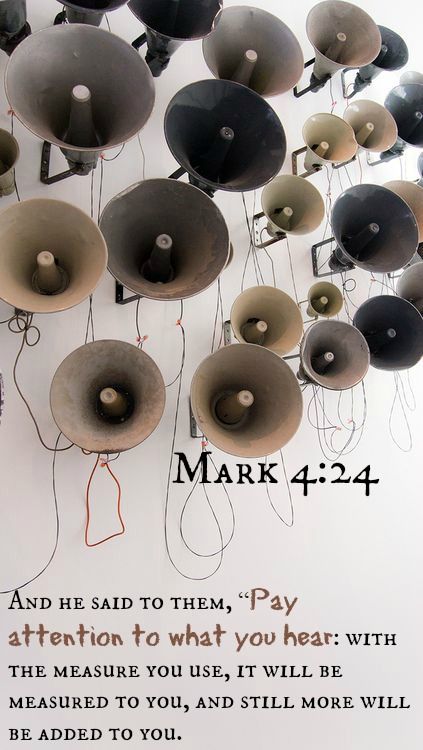
pay attentionDr. Emoto and his team observed that after the experiment very beautiful crystals had formed in some of the frozen water samples where the positive vibrational waves were directed. Dr. Emoto then exposed water samples to music from Mozart, Beethoven, and other classical composers and found that beautiful crystal shapes formed in these samples as well.
He also experimented with people saying things like “you fool,” “I will kill you,” and other unpleasant phrases using a harsh tone. Dr. Emoto found that ugly, incomplete, and malformed crystals were formed in the water samples exposed to these negative expressions and tones.


Dr. Emoto concluded that any sound is vibration, and vibrations such as music and other positive sounds including the human voice can be a form of healing energy.

Here is what I find fascinating: on a 3D level the body is more than 70% water. If crystals formed in water from sound vibrations, then it seems pretty clear that the sounds and words we hear impact our bodies. Think about your words and the tone used expressing these words. I think it is fair to say that the vibrations we make when we speak are either forming something beautiful or something ugly, incomplete or malformed in those who hear.

When you talk with your children, spouse, neighbours, clients or colleagues; what impact is the sound of your words having? Are they building up or tearing down?


Why Do You Work? Why Retire?

My last post created a great deal of interest because it dealt with the question: “Do you go to work or to a job?” One response received was, “In two weeks I will go to neither,” meaning the reader would be retiring.

This set me to thinking further about what I stated: “It is only when you do what you were born to do will you really find fulfillment.” In reality, you can be paid to do a job and once you complete it, then you either move on to something else and/or you retire. This is where I believe your work (what you were born to do) is different than your job (what you are paid to do). Why would you ever want to stop doing what brings you fulfillment? If you were born to do something, when should you cease doing it? In other words, why retire?

In some cases, it may make sense financially to retire. Maybe you qualify for a full pension and working longer is not necessarily increasing your retirement benefits anyway. So why continue working? When I started working, it was partially out of necessity. The need for income and supporting family is a valid reason. With my children raised, my reason for working has shifted; now work is more about purpose.  I know several people who can easily retire from their work, yet they choose to continue.

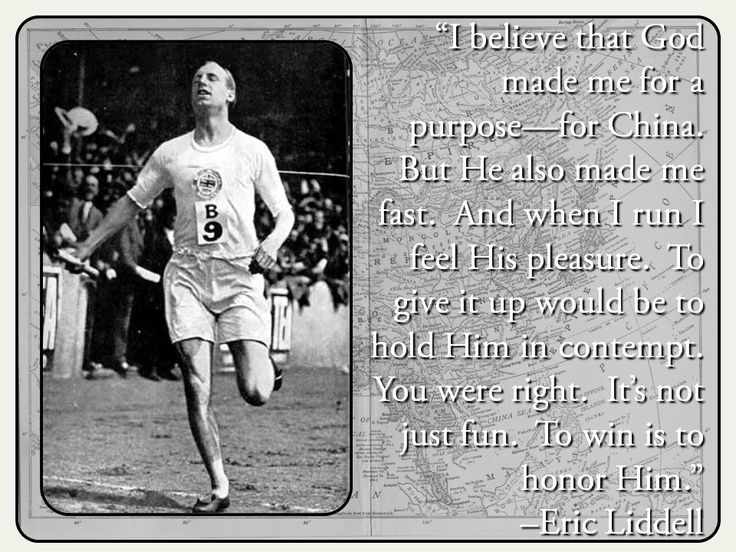
eric liddell

Consider the life of Eric Liddell, a devout Christian and missionary to China, who felt it a priority to run in the Olympic games. His sister felt that his training for the 1924 Olympics deterred him from returning to China. He said, “I believe God made me for a purpose, but he also made me fast! And when I run I feel His pleasure.” We usually would not class running or involvement in a sporting activity as spiritual, or God honouring, but more a physical activity. For Liddell, running wasn’t just a fun activity but a God honouring one.

You cannot argue with a person’s experience; Liddell was passionate about fulfilling God’s purpose for him (missionary to China) yet he ran to honour God and feel His pleasure. For Liddell, the line between secular and sacred was erased.

eric olympic gold

The mistake we often make is in categorizing our work as secular, separating it from the sacred, rather than sensing the pleasure of God in our work. Here is a great piece of advice: Whatever you do, do it enthusiastically, as something done for the Lord … (Col 3:23). The reality is that when we serve others (in our work), we are actually serving the Lord, not just men (Eph. 6:7). If we can say when we work we feel His pleasure, it will be most difficult to retire from that work.

Speaker and author of “The New Retire-mentality,” Mitch Anthony says, “Don’t retire from something but retire to something.” We are all born with purpose and if you are at the retirement stage, remember it can be a great opportunity to feel His pleasure!


Do You Go to Work, or to a Job?

This question is worth thinking about more than you may realize. Your job is what an employer pays you to do, your work is what you were born to do. There were times that I simply did not enjoy my job and I sought after another that would bring more fulfillment.

“The two most important days in your life are the day you are born and the day you find out why.” — Mark Twain

You may argue that a job and work are much the same because they can both provide a source of income, but I believe it is only when you do what you were born to do will you really find fulfillment.  Chuck Colson was once asked, “If there is one piece of advice you could share, what would it be?” His answer was: “Do only what YOU can do.”  That statement is worth some deeper thought and can make you realize that there is a creativity within all of us to do something unique.

Never work another day

Never working another day in your life is not just a dream then, but maybe it is discovering what only you can do. Your work is more than a job; it is actually more about purpose and utilizing your gifts.

Dallas Willard suggests some distinctions:

  1. Job: What I am paid to do, how I earn my living
  2. Work: The total amount of lasting goods that I will produce in my lifetime

“Lasting goods” is our impact on others, what we leave whether financial, spiritual, moral, emotional etc. What “lasting goods” is my life producing? This is the question that should help us in decisions regarding our work.  Interesting that Jesus acknowledged to the Father, “I glorified you on earth by finishing the work that you gave me to do” (Jn 17:4).  If you consider his time on earth, Jesus had a job as carpenter, but he recognized even as a child, that his work was to be about his father’s business (Lk 2:49).

It is easy to conclude then that his job was just how Jesus earned his living (likely from age 12-30), while his true work was his years of public ministry (just 3 years). My immediate thought from this verse is that Jesus glorified God in his ministry years, for the most part, especially by his sacrifice on the cross. However, do we make a mistake when we separate the years of his life like this? The fact is that Jesus glorified God on the earth, period. Dr. Klaus Issler concludes,”I think we can infer from his messianic work, that Jesus also gave this same kind of excellence to his job as a builder.”

My conclusion: you need to fulfill your work, and your job may help you do that.

Here is what Steve Jobs said: “Your work is going to fill a large part of your life, and the only way to be truly satisfied is to do what you believe is great work. And the only way to do great work is to love what you do. If you haven’t found it yet, keep looking.”

Leaving An Inheritance

inherit

As my wife and I went for a walk last evening, we spoke of our grandparents (all now deceased) and then our great-grandparents. In particular, we spoke of how little we know beyond two generations. We then talked about our grandchildren (not yet born) and great-grandchildren, wondering how much impact we will have on them.

Proverbs says, “A good man leaves an inheritance for his children’s children.”

On this subject, Larry Burkett wrote this: “If I had to identify the area of Christian finances that is least understood, it would be inheritance. Not only do people wreck their lives by hoarding, but they also wreck the lives of their children and grandchildren with abundant inheritance.”

In ancient times, an inheritance was often necessary for survival. Land being passed down was essential to provide food for the family. Today, an inheritance can be like winning the lottery or a windfall because, in many cases, children are making more money than their parents ever did and are often financially independent.

Ron Blue said, “Wealth never creates wisdom. Wisdom may create wealth. If you pass wisdom to your children, you probably can pass wealth to them. If they have enough wisdom, then they may not need your wealth.”

When we think about inheritance, we usually think wealth. In considering wealth and wisdom, which offers the most value? And which is most difficult to pass to the next generation? Since wisdom can create wealth, it seems logical that it is more valuable than wealth itself. Since wealth without wisdom has the ability to wreck the lives of our heirs, we must consider how best to pass on wisdom prior to passing on wealth.

All of our adult children are planning to be home for the Thanksgiving weekend. They will enjoy Mom’s home cooked meals and endure my Dad jokes while we play games, have a bike ride and go for a beautiful fall walk through the park. I cherish these times together, not just to make fond memories, but I am realizing these times are occasions for discussions where wisdom can be shared. So I am going to be deliberate and intentional about a family meeting in order to learn more about the basis of our values.

Having worked in the financial industry for 25 years, I know the conversation about finances is personal and private, yet these dialogues are so essential. I have some specific questions to ask that will probe deep into the hearts and minds of all of us. I plan to share these questions and the importance of a family meeting in my next blog.

Will you spend this long weekend with your family? What important discussions will you have with those you love?