Defining my relationship with money is not easy since I didn’t get much of an opportunity to get to know him when I was younger – he didn’t stay around very long. I’m relieved when he’s around – he can be very helpful when needed – life can be very challenging when he is absent.
He is the type that needs to be told what to do and where to go, otherwise he tempts me to see how I could use him in all sorts of ways. If I don’t use him properly, he diminishes or is unavailable. He even says, if you want more of me around, you need to work harder, longer and extend yourself or, borrow more of him to get things.
I understand that Money is spiritual and is the opposite of God. For God to increase, it is me that needs to decrease. Money wants me to increase, to think more highly about myself than I really ought to think. Money tries to convince me that my abilities and hard work are really what has increased wealth in my life. God, on the other hand, desires that I see that the abilities and talents I have to generate wealth are actually gifts from Him. God wants me to walk humbly through this life with him, while Money wants me to be proud of my accomplishments.
Money tries to convince me that he is here mainly for my personal benefit and I need to keep him around to secure my future. God, on the other hand, is my future; my eternity is in Him. He convinces me to “be generous and willing to share.” God prefers my security be in Him and use the wealth that He has blessed me with wisely. He knows that too much of Money might find a place in my heart – so much so that my dependence on Money grows and my dependence on Him shrinks. God calls me to be financially dependent (on Him).
Well the Labour Day weekend is upon us and for many, it marks the end of a season and shifts students back into the school year and those at work into a busy fall. Mark Twain helps me see
“The two most important days in your life are the day you are born and the day you find out why.”
Mark Twain
Finding your why is truly what makes your work significant. I have heard it said that your job is what an employer pays you to do; your work is what you were born to do. I’m convinced that when you discover your why, you truly live out your calling in life.
Ken Boa in his book, Conformed to His Image says:
“Our primary calling is to know and love God. Our secondary calling is to express this relationship in everything we do and with everyone we encounter.”
As a teenager, I felt a “call” on my life and the best way I could interpret it at the time was to become a pastor. However, the majority of my career has been in the financial services industry, providing insurance and investment advice. My perspective was that my work as a financial advisor was my job (secular) and I believed my “calling” to ministry was my true work (sacred). As the years passed, I questioned if I had “missed my calling” or did I choose the wrong profession?
My problem was that my secondary calling (my work as a financial advisor) was somehow disconnected from my primary calling (to know and love God). Ken Boa explains it this way:
“If the secondary is not related to the primary, we slip into the error of dichotomizing the “spiritual” and the “secular” when they should really be integrated. When this happens, our relationship with the Lord is disconnected from the everyday activities of our lives.”
I certainly felt I was serving the Lord in my business, but somehow the everyday activities of my work became disconnected from my calling. My focus as an advisor was on growing my business, developing relationships and serving clients. While that ethic was typical of this industry, my secondary calling lacked the perspective that only comes by incorporating my primary calling. My work as an advisor (secondary) needed to be an expression of my primary calling. Dr. Ken Boa explains it this way:
“Secular work becomes spiritual when done to the glory of God. Spiritual work becomes secular when done to please and impress men.”
My level of fulfillment through my work reached new heights when the secular and the sacred were merged. This seems so simple now as I reflect, but it required a shift in my perspective. Recognizing the opportunity to love and bring glory to God (primary calling) through my practice (secondary calling), transformed my work life and brought a fresh perspective. In essence, I was transformed into the person I was born to be and now Labour Day becomes important – not the day I was born, but a better understanding of “why” I was born. Dr. Ken Boa sums this up perfectly:
“When we keep our primary calling first and seek to express it in and through our secondary calling, we become more holistic in our thinking and practice.”
Following the US Thanksgiving holiday on Thursday comes “Black Friday” where consumers shop for great deals which is a great lead-up to the frantic shopping Christmas season. I’m sure you have received and have maybe even taken advantage of some of these deals.
The shopping frenzy typically goes through the weekend and even extends into “Cyber Monday” – more deals.
In response to all this spending comes “Giving Tuesday” which highlights the importance of not just spending our resources on ourselves or the people we love, but also on giving to those we may or may not even know.
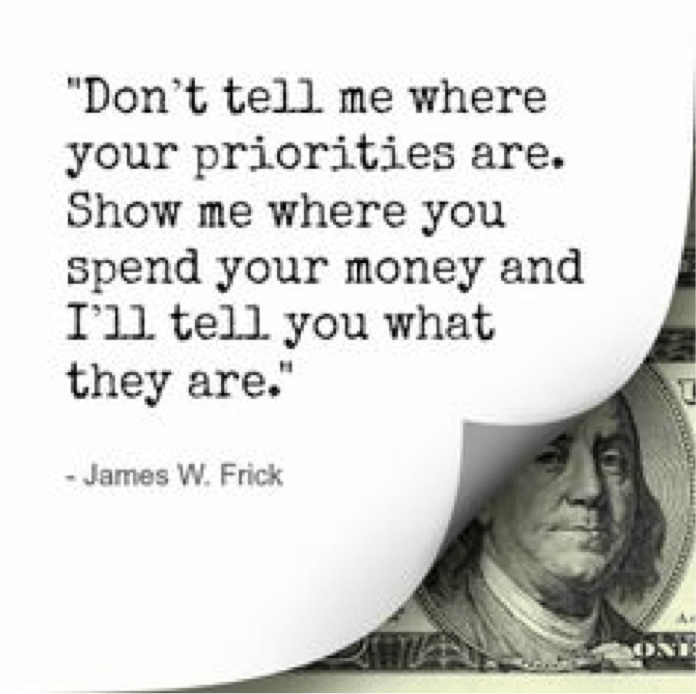
We have to set our priorities because all of these uses for our money are calling to us everyday! Honestly, I wish “Giving Tuesday” was a week earlier, before the big sales weekend.
The sequence of these days speaks to what is priority for most. There are typically only five places that money is directed:
Lifestyle – typically the top priority / when we get a raise or bonus we tend to increase our standard of living.
Owe – when we are not able to pay immediately for large purchases (house or vehicle), we often borrow for it, so in essence, debt is an extension of our lifestyle.
Owe – let’s not forget what else we owe – tax. Amounts for tax are deducted from our pay so the taxman makes tax our top priority since this deduction happens as we receive our pay.
Grow – “Pay yourself first” is a tag line used by many financial advisors to motivate you to save for your financial future.
Give – sadly, giving is often the lowest on the priority list.
Maybe it’s time we adjust our financial priorities: instead of focusing on our lifestyle first and giving out of what’s left, maybe we should adjust our priorities:
Give – Let this become our top priority / When we get a raise or bonus let’s increase our standard of giving (instead of our standard of living).
Owe – The bank and CRA sets this as a high priority for us anyway.
Grow – The wise save for the future while the fool spends whatever is received.
Live – Our lifestyle can be based on what remains which will mean some adjusting.
Rev. Billy Graham
When we set the right priorities, our spending habits and our attitude toward money will change. Billy Graham believed that our thinking toward money has a profound impact on the areas of our life.
I didn’t realize Billy Graham shared so much wisdom about how to use money:
“God has given us two hands, one to receive with and the other to give with.”
We would do well to “remember the words of the Lord Jesus, how He himself said, ‘It is more blessed to give than to receive.’” (Acts 20:35 ESV).
During this weekend, remember your priorities! Will you give on Tuesday based on what’s left after Black Friday and Cyber Monday? Or is Giving Tuesday more of a priority?
It’s been quite interesting to watch some of the Olympics this summer and now the paralympics begin. The display of talent in the closing ceremonies and the endurance and strength in the athletes is something that comes through discipline and training. What human beings are able to accomplish is astounding.
Thank you for making me so wonderfully complex! Your workmanship is marvelous—how well I know it.
Eric Liddell was a devout Christian and missionary to China, who felt it a priority to run in the Olympic games. His sister felt that his training for the 1924 Olympics deterred him from returning to China. He said, “I believe God made me for a purpose, but he also made me fast! And when I run I feel His pleasure.” We usually would not class running or involvement in a sporting activity as spiritual, or God-honouring, but more a physical activity. For Liddell, running wasn’t just a fun activity but a God-honouring one.
Word4Now Blog – June 2017
The Bible describes our bodies as temples and indicates that there is a greater purpose in everything we do, maybe even greater than we realize.
You are not your own, for you were bought with a price. So glorify God in your body.
Paul, 1 Cor. 6:20 ESV
Whatever you do, do it enthusiastically, as something done for the Lord, and not for men.
Paul, Col. 3:23 HCSB
The Apostle Paul made many references to sport like “running in a race” with the goal to “get the prize” and also referenced boxing and wrestling in his writings. This got me to wondering if he might have attended the Olympics. In my search I found this article titled: The Historical Background of Paul’s Athletic Allusions by Jerry M Hullinger which states:
The chief athletic contest in Greece was the Olympic games. Founded in 776 B.C., these games were held every four years.
Many other athletic contests were spawned from the Olympics and there was one held in Corinth. The Isthmian Games form the backdrop for 1 Corinthians 9:24-27.
Paul probably was in Corinth when the games of A.D. 49 or 51 were held. A further reason that lends weight to the idea that Paul attended these games is his profession as a tentmaker. At such occasions, large numbers of tents would be needed to provide shelter for the crowds of visitors …
Even if Paul were not, technically speaking, a tentmaker but rather a leatherworker, this would not have precluded his making or repairing tents or shelters.
It’s quite fascinating to think that Paul’s writings were influenced by these competitions because he was likely an eyewitness to many of these events.
24Don’t you realize that in a race everyone runs, but only one person gets the prize? So run to win! 25All athletes are disciplined in their training. They do it to win a prize that will fade away, but we do it for an eternal prize. 26So I run with purpose in every step. I am not just shadowboxing. 27I discipline my body like an athlete, training it to do what it should. Otherwise, I fear that after preaching to others I myself might be disqualified.
Paul, 1 Cor. 9:24-27 NLT
Some lessons Paul shared from these games:
Bring glory to God by using one’s strength and talent, not only in sport, but also in life’s work.
Apply the same sort of discipline and training in life as those in sport in order to obtain a crown (earned in the ancient games) or a medal in our modern day Olympics
To know your purpose you need to look up (beyond the sun).
Sometimes it’s easy to think that what we do on this earth lacks meaning and purpose and finding fulfilment can be exasperating. There is even a book in the Bible dedicated to “the Futility of All Endeavour” (Ecclesiates).
I have seen all the things that are done under the sun; all of them are meaningless, a chasing after the wind.
Solomon, Eccl. 1:14 NIV
It is natural to only look “under the sun” to discover our purpose. I recently read that the way to discover meaning is to look beyond the sun, into the heavenliness. That’s why Paul encouraged us “to work for the Lord” (rather than men) and this is to “win a prize that will not fade away.” Through the games, Paul was reminding us that our focus can so easily be on the wrong prize.
Paul stated in 1 Corinthians 9:25 that the reason he exerted himself in his ministry was so that he would obtain an incorruptible crown (στέφανος; cf. 2 Tim. 2:5; 4:8).
Paul’s references to the believer’s prize seem to be related to conflict in the spiritual life, a prize that can be won only if one throws himself and his resources entirely into the struggle.
Ethelbert Stauffer, “βραβεύω? in Theological Dictionary of the New Testament vol. 1 (1964), 638; and Smith, “Games,” 2:1173.
What a powerful statement: the prize can only be won by a complete investment of oneself and the resources that have been entrusted to our care. Are we putting all our energy and resources into what we have been called to do? Are we looking beyond the sun daily in order to walk in the work that God has prepared (in advance) for us to do (see Eph 2:10)?
Possessing this crown signified spiritual, emotional, financial, and social benefits. Yet as Paul wrote, as grand as this earthly attainment was, it paled in significance when compared to the heavenly reward for the faithful believer (1 Cor. 9:25).
Any recognition or reward for our efforts and accomplishments in the industry that we work in or sport in which we compete, will pale in comparison to the reward we can look forward to. This happens when we invest our lives with a perspective that’s beyond this world.
Just as a side note: My son, David completed some research and did a project using Legos to explore the history of the Olympics in a 7 minute video for one of his classes in university. Thought you might find it interesting.
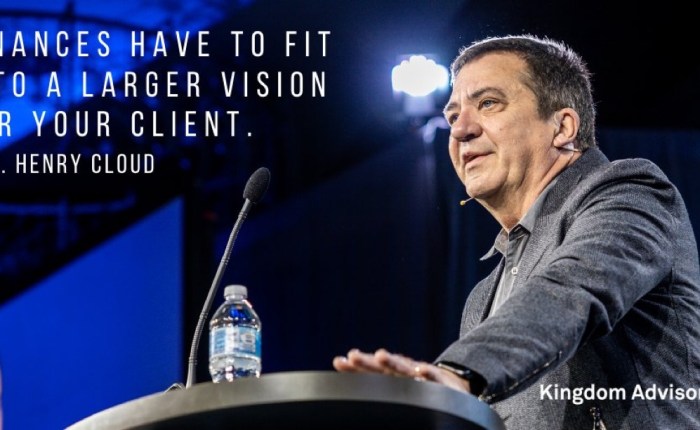
I was challenged at the 2020 Kingdom Advisors Conference! One of the highlights for me was the idea of having a vision, particularly as it relates to finances. Dr. Henry Cloud spoke about vision and pruning toward that vision. He talked of “pruning the good” in order for the best to be possible. Upon first hearing this, my thought was “I’m happy when my life bears good fruit, (rather than bad)” but the truth is that good is often the enemy of best. We must prune the good to allow the nourishment to be directed to the best.
As financial advisors, helping people accumulate money is certainly the norm and represents what is good. Clients desire to save tax efficiently and utilize TFSA’s or RRSP’s for short term or long term goals. When you meet with your financial advisor, particularly this time of year, the conversation usually goes toward saving enough to maintain the desired lifestyle for the rest of your life. That’s good, but is it the best?
Have you ever considered what your vision is for your finances? What is the ultimate purpose for the funds accumulated? Until my thinking was challenged, I never realized that a vision for finances was even worth my consideration.
We’ve probably all heard this proverb that references vision: “Where there is no vision, the people are unrestrained …” Or “Without revelation people run wild, but one who follows divine instruction will be happy” Prov. 29:18 CSB.It is often quoted from the KJV where it declares that “without vision, the people perish.”
The word means “to let loose” or “to ignore, reject” and in another sense “to let slip through the fingers.” If you make the connection to your finances, you begin to realize how important a vision is because without it, the discipline to manage finances is lacking. In other words “where there is no vision (revelation from God), ‘the people are undisciplined/get out of hand’.”
When the purpose for your wealth lacks vision, it becomes directionless and ends up going everywhere (like the example of hair in the wind). If you don’t have a vision for retirement, you won’t save in RRSP’s and money can slip through your fingers. On the other hand, when you want to make a major purchase (like a house), you begin to set aside funds for a down-payment, simply because you have a vision.
The natural thinking around money is that what you earn is for you and your family. In other words, you earn to provide for your family, which includes pleasure and enjoyment (vacation). I’m sure you would agree that this is good because your funds are being directed to align with your vision. However, is there a greater vision? Dr. Cloud challenged me deeply and now a year later, I’m still considering how I should “prune the good” so nourishment can flow to the best.
In Randy Alcorn’s book Money, Possessions & Eternity he tells this story:
At the end of the movie Shindler’s List, there’s a heart-wrenching scene in which Oskar Schindler – who bought from the Nazis the lives of many Jews – looks at his car and his gold pin and regrets that he didn’t give more of his money and possessions to save more lives. Schindler had used his opportunity far better than most. But in the end, he longed for a chance to go back and make better choices. This life is our opportunity.
Perhaps this is as good a time as any to take the advice of the Old Testament prophet:
Write down the vision and inscribe it clearly … so that the one who reads it may run. (Habakkuk 2:2 NASB)
Have you ever thought about the consequences of not having a financial vision?
Do we even understand what the word stewardship means? After all, it can have such a vast meaning. The dictionary defines a steward as “a person who looks after someone on a ship, aircraft or train.” It is also defined as an official who supervises a public event, or one who manages or looks after another’s property.
The final definition seems to be the most accurate. Think about it for a moment – what exactly does this mean for each of us? For many, the immediate thought is that we need to be better stewards over the earth. In other words, we must care for the environment.
Let’s make it even more personal than that. Think about what we have all been given daily to manage.
What We Are Given in Equal Measure – Time
We all have the same amount of time, 24 hours in every day. How well are we managing our use of time? If we are completely honest, we must admit that we are at times less productive than we could be because we have not invested our time as well as we would like.
What We Are Given in an Unequal Measure – Talent
I am amazed when I see the different interests and gifts in so many people. For some, the ability seems to be natural and God-given and can often be improved when developed further, like the gift of music, singing or dance. Sadly, rather than develop their talents, some people bury them, believing it’s really nothing special or unique.
What is Buried – Treasure
If you combine what we are given in equal measure (time) and use it to invest in what we have in unequal measure (talent), we will discover what is often buried (treasure or what we are meant to do). There is a quote that comes to mind about finding something you love to do and then you will never work a day in your life. The key is to “find something you love to do,” then your work won’t feel as much like work, but instead, it becomes your passion.
The Heart of a Steward
If the definition of a steward is managing another’s property, then the heart of a steward must be to know who the owner is and what that owner desires. For followers of Christ, God is the owner and life is about managing what we are entrusted with. Think about your life: aren’t you most fulfilled when you give your time to someone else? Isn’t your greatest pleasure felt when your talent is used for the benefit of another, when others are moved as a result of how you used your gifts?
If all we do is use our time and talent for ourselves, we are really missing what it means to be a steward. Time can be wasted, spent or invested. The same can be said for talent and treasure. If you invest it well, the owner is pleased and we are paid or rewarded for our use of each of these.
Our Mistake …
…is thinking that what we possess is ours to do with as we please. If you ask most Christians, “Does God own everything,” most will quickly agree, yet living this out proves to be more of a challenge.
The time we have been given needs to be managed well and the talent should be developed and utilized. When we use our time and talent to invest in others, we will discover true treasure. To invest in others, it also means you actually have to take some time for yourself. Your personal growth and development results in a greater ability to serve. Remember,we are managers, not owners, so things like time, talent and treasure are to be used for the interest of the owner (which benefits others).We make a mistake when we simply spend money, time or use our gifts without considering what the owner desires.
How well are you using the time each day? Do you feel your talent is under-utilized and is there a place that you could use your talent more? When you receive your paycheque, do you view it as your own to do with it as you please, or do you consult the owner before you make spending decisions?
This past month, Cathy and I celebrated 30 years of marriage. Over the years, we have gathered the family together for a specific purpose but in October, we had a meeting that focused on inheritance. This idea came from a book by Thomas Deans called Willing Wisdom, where he suggested a family should have this type of meeting every year. I saw this intentional time as an opportunity to pass wisdom to my heirs before the time of any type of wealth transfer.
It felt a little awkward at first and I figured that my kids would just see this as another of Dad’s crazy ideas. I have heard it said it is inevitable that there will be a family meeting where your financial affairs are discussed. However, it is up to you whether you will be alive to attend. I have determined to be there; the discussion time is valuable and the conversation will deepen if this happens yearly.
To begin, everyone was asked to share a word to describe our family and then an example of why that word was chosen. The answers received are a testament of our family dynamic: fun-loving, unique (in family discussions), accepting (it is ok if we disagree), supportive (of each other), in tune (connected to each other) and confident. Hearing these words was encouraging and a result of our investing in the lives of our children. It was like a reward for 30 years of marriage but we are not done yet. We must continue the family communication in order to finish well what we have started.
Keith Costello, president and CEO of the Canadian Institute of Financial Planning (CIFP) recently wrote about the great wealth transfer. He stated, “Baby boomers will inherit $750 billion over the next several years in the largest-ever transfer of wealth in Canada, estimates a recent report from Toronto-based Canadian Imperial Bank of Commerce (CIBC). Specifically, the report suggests that 2.5 million Canadians over the age of 75 have a total net worth of $900 billion or more — and the beneficiaries of this wealth will be Canadians aged between 50 and 75 years old.”
The most common approach for wealth transfer is to divide the inheritance equally among heirs but the challenge is to also ensure an appropriate distribution of wisdom to equip our heirs to properly manage this wealth. I recently spoke to some friends about my children having grown and matured. With sarcasm, I stated, “They grew up to have their own opinions that are not the same as mine.” The reality about our children is they will likely have different priorities than their parents, which is the reason family meetings are so important. Finishing well involves successful transfer of wisdom before any wealth transfer.
As a steward of all that has been entrusted to me, I feel responsible to prepare the next stewards to manage anything I may leave them. An annual family meeting where probing questions are posed can help the next generation connect with the values and plans that guide financial decisions.
Some examples of questions that will create discussion and reveal values are:
-What are your dreams? How would receiving an inheritance impact your dreams?
-What did you learn from your parents about money and generosity?
-How should each child be treated: equally or uniquely?
As my wife and I went for a walk last evening, we spoke of our grandparents (all now deceased) and then our great-grandparents. In particular, we spoke of how little we know beyond two generations. We then talked about our grandchildren (not yet born) and great-grandchildren, wondering how much impact we will have on them.
Proverbs says, “A good man leaves an inheritance for his children’s children.”
On this subject, Larry Burkett wrote this: “If I had to identify the area of Christian finances that is least understood, it would be inheritance. Not only do people wreck their lives by hoarding, but they also wreck the lives of their children and grandchildren with abundant inheritance.”
In ancient times, an inheritance was often necessary for survival. Land being passed down was essential to provide food for the family. Today, an inheritance can be like winning the lottery or a windfall because, in many cases, children are making more money than their parents ever did and are often financially independent.
Ron Blue said, “Wealth never creates wisdom. Wisdom may create wealth. If you pass wisdom to your children, you probably can pass wealth to them. If they have enough wisdom, then they may not need your wealth.”
When we think about inheritance, we usually think wealth. In considering wealth and wisdom, which offers the most value? And which is most difficult to pass to the next generation? Since wisdom can create wealth, it seems logical that it is more valuable than wealth itself. Since wealth without wisdom has the ability to wreck the lives of our heirs, we must consider how best to pass on wisdom prior to passing on wealth.
All of our adult children are planning to be home for the Thanksgiving weekend. They will enjoy Mom’s home cooked meals and endure my Dad jokes while we play games, have a bike ride and go for a beautiful fall walk through the park. I cherish these times together, not just to make fond memories, but I am realizing these times are occasions for discussions where wisdom can be shared. So I am going to be deliberate and intentional about a family meeting in order to learn more about the basis of our values.
Having worked in the financial industry for 25 years, I know the conversation about finances is personal and private, yet these dialogues are so essential. I have some specific questions to ask that will probe deep into the hearts and minds of all of us. I plan to share these questions and the importance of a family meeting in my next blog.
Will you spend this long weekend with your family? What important discussions will you have with those you love?









 This past month, Cathy and I celebrated 30 years of marriage. Over the years, we have gathered the family together for a specific purpose but in October, we had a meeting that focused on inheritance. This idea came from a book by Thomas Deans called Willing Wisdom, where he suggested a family should have this type of meeting every year. I saw this intentional time as an opportunity to pass wisdom to my heirs before the time of any type of wealth transfer.
 Lorne Robinson's Blog