
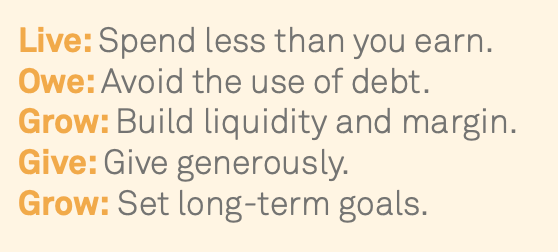
Working in the financial industry for just short of a quarter of a century (why didn’t I stay just one more year?) and now having worked with Christian financial professionals for the past 10 years, I have come to this conclusion: Our personal finances should not be complicated – just follow five simple principles:
- Spend less than you earn
- Avoid the use of debt
- Build liquidity / margin
- Give Generously
- Set Long-term Goals
Here’s the problem – any of these principles are far too easy to violate. Statistically, at least 34% of working Canadians violate the first principle. Specifically, 27% spend everything they earn, and 7% spend more than they take in, according to a Financial Wellbeing Index from LifeWorks. This situation is particularly prevalent among parents, who are twice as likely to report spending beyond their income. Furthermore, 1 in 6 Canadians (17%) have monthly spending that exceeds their income, and 1 in 4 (27%) borrow to cover essential expenses like food and daily necessities.
If we spend more than we earn, it leads to the violation of the second principle where borrowing becomes the means of acquiring the necessities in life. The rise in credit card debt among working Canadians is also significant, increasing from 29% in 2021 to 42% in 2022.
Here’s the reality – we are called to be stewards over everything placed in our hands. Is there one principle that trumps another? Or are each of these principles equal in importance?
For Christians, giving is a top priority, particularly when it comes to the teaching around the tithe (giving 10%). I’ve often said that giving is a way to invite God into our finances, but each of these principles is rooted in biblical wisdom, not just the principle of giving.
Here’s an example:
A faithful Christian couple is dedicated to Principle 4: Give Generously. However, they may have violated Principle 2 (Avoid the Use of Debt), when they borrowed to acquire rental properties. They borrowed when interest rates were low with a variable rate mortgage (not a fixed term); then the spike in interest rates has increased their payment beyond their rental income. This couple is now struggling financially and forced to violate Principle 1 (now spending more than they earn), with no ability to follow Principle 3: build liquidity.
How would you advise in this situation? Should they now suspend / pause their giving (at least for a time) to right their financial ship? What should they do to be better stewards.
What principle should be priority for this couple at this time? Is it”spend less than you earn” because it is the key provide the ability to abide by the other principles?
- Spending less than you earn will allow you to
- Avoid the use of debt and
- Build liquidity / margin and
- Give generously and
- Accomplish your long term goals.
Would you agree or disagree?

 Lorne Robinson's Blog