Proving Your Faith as a Financial Advisor

Proving Your Faith as a Financial Advisor

We all have aspirations in life that often mean we need to “prove” ourselves first. If you consider one’s experience to apply for a new position, we put together a resume to prove that we are qualified to do this job. Even more than that, we want to demonstrate that we are “the best” candidate to be hired for this role.

What exactly are we trying to prove? For financial advisors, many have set a goal to be the most trusted advisor – therefore attracting clients and business relationships to them. That seems to make sense but as a Christian professional, is this the best goal?

Since I read Matthew 3:8 a few weeks ago, I haven’t been able to get it out of my mind. John the Baptist, was preparing the way for Christ by giving this instruction:

“Prove by the way you live that you have repented of your sins and turned to God.”

John was really asking if they had any fruit in their lives that demonstrated that they were living a life surrendered to God.

In other words, is there proof in your practice that sets you apart or makes you unique from those who have no relationship with God? In your conversations, the way you use money, your business practices, your marriage and family relationships – all these should be positively impacted because you have “turned to God.”

John’s message and also that of Jesus, called people toward repentance – a change in thinking. When we change the way we think, the result is we change our behaviour – what we do. Here’s the big question: Is there proof in your life and your work that you have “turned to God?”

My question to Christian advisors many times is this: Is there any difference in your advice to clients because you are a Christian? Here’s how one advisor responded:

After going through the CKA material this past year and spending time with my cohort, I have learned a lot. The CKA® training and shared learning experience with my cohort has changed my perspective on my role in the financial business. I have been encouraged to practice these Biblical principles in my personal life and incorporate them into my business. 

When meeting with clients during their last review, I decided to add to the agenda a discussion about their legacy planning & giving goals.  I wasn’t sure how the clients would respond as this was out of my typical market based conversation (and personal comfort zone). Thankfully, the clients very much resonated with the agenda item and the questions I asked about their giving goals. We had a truly life giving conversation about their ministry passions, future opportunities to give, and how we can help them achieve these more personal goals. I believe the clients went from concerns about short term market trends (which are out of our control anyway) to a place of gratitude about how God has blessed them and excited about how God could use them (and their resources) to bless others. I hope and pray I can have more review meetings like this!   

For advisors in the cohort it has meant weekly meetings over five months with many hours of study to be prepared for the discussion times together. The result in the advisors words:

  • 1) a changed perspective on my role in the financial business
  • 2) life giving conversation(s) with clients
  • I added the “s” – I’m confident more life giving conversations will follow because of the changed perspective.

Therefore let your lives prove your change of heart

Weymouth New Testament Matthew 3:8

Discover Your Why: Fulfillment in Work and Life

Discover Your Why: Fulfillment in Work and Life

Well the Labour Day weekend is upon us and for many, it marks the end of a season and shifts students back into the school year and those at work into a busy fall. Mark Twain helps me see

“The two most important days in your life are the day you are born and the day you find out why.”

Mark Twain

Finding your why is truly what makes your work significant. I have heard it said that your job is what an employer pays you to do; your work is what you were born to do. I’m convinced that when you discover your why, you truly live out your calling in life.

Ken Boa in his book, Conformed to His Image says:

“Our primary calling is to know and love God. Our secondary calling is to express this relationship in everything we do and with everyone we encounter.”

As a teenager, I felt a “call” on my life and the best way I could interpret it at the time was to become a pastor. However, the majority of my career has been in the financial services industry, providing insurance and investment advice. My perspective was that my work as a financial advisor was my job (secular) and I believed my “calling” to ministry was my true work (sacred). As the years passed, I questioned if I had “missed my calling” or did I choose the wrong profession?

My problem was that my secondary calling (my work as a financial advisor) was somehow disconnected from my primary calling (to know and love God). Ken Boa explains it this way:

“If the secondary is not related to the primary, we slip into the error of dichotomizing the “spiritual” and the “secular” when they should really be integrated. When this happens, our relationship with the Lord is disconnected from the everyday activities of our lives.”

I certainly felt I was serving the Lord in my business, but somehow the everyday activities of my work became disconnected from my calling. My focus as an advisor was on growing my business, developing relationships and serving clients. While that ethic was typical of this industry, my secondary calling lacked the perspective that only comes by incorporating my primary calling. My work as an advisor (secondary) needed to be an expression of my primary calling. Dr. Ken Boa explains it this way:

“Secular work becomes spiritual when done to the glory of God. Spiritual work becomes secular when done to please and impress men.”

My level of fulfillment through my work reached new heights when the secular and the sacred were merged. This seems so simple now as I reflect, but it required a shift in my perspective. Recognizing the opportunity to love and bring glory to God (primary calling) through my practice (secondary calling), transformed my work life and brought a fresh perspective. In essence, I was transformed into the person I was born to be and now Labour Day becomes important – not the day I was born, but a better understanding of “why” I was born. Dr. Ken Boa sums this up perfectly:

“When we keep our primary calling first and seek to express it in and through our secondary calling, we become more holistic in our thinking and practice.”

Our Relationships Don’t Belong to Us!

Our Relationships Don’t Belong to Us!

I read this statement in a devotional recently and was challenged with the thought. Paul David Tripp writes that:

Fellowship is God caring enough to put people in your life to encourage, rebuke and comfort you.

New Morning Mercies, Paul David Tripp (Aug. 19)

I’ve been in relationship with some people for many years now, which begs the question: “Why are these people (or this person) in my life?”

Tripp explains it this way:

“We cannot allow ourselves to have an owner’s view of our relationships, as if they exist for the sole purpose of our happiness. Our relationships don’t belong to us – They belong to God for his use, for his purpose.”

This changes our perspective – if we don’t own these relationships and they are not “about us” solely, there must be a reason, a deeper purpose. The unseen part of relationship is how they came to be and also why they came to exist.

If we take the “owner’s view” it means either we or the person we are in relationship with took the initiative to establish contact. This easily excludes God’s part in this relationship and means we can miss seeing his purpose.

My wife and I met while we were attending the same college. We take for granted our chance meeting at an airport in late April 1985 and then meeting again the following weekend in her hometown. This was the only weekend she was home because she was between semesters while attending university. That chance weekend meeting clinched my decision to attend the same university that summer where our relationship began to develop. The rest, as they say, is history.

Was this simply a series of coincidences, where each of us initiated our relationship to spend time together? Or was God more involved than we often give Him credit for?

I choose to believe that my relationships are an example of God caring enough to infuse people into my life for His use and His divine purpose.

One of the other life-changing experiences for me was joining the community of Christian financial professionals, known as Kingdom Advisors. It was a game-changer when it became clear that I didn’t have to separate my faith from my work as a financial advisor.

Here’s the advice from Kingdom Advisors:

“Don’t spend another day feeling divided between your faith and your career. Get certified by Kingdom Advisors and fully integrate your faith into your financial practice.”

I’m looking forward to connecting with advisors in a cohort this fall (meeting weekly starting Sept. 4th) to walk with advisors through 20 Modules of Core Training. This journey together will be a key to fully integrate your faith into your financial practice and continue to build God-ordained relationships.

When You Don’t Run Alone: 1924 & 2024

When You Don’t Run Alone: 1924 & 2024

I did have opportunity to watch some of the Olympics that just concluded and one of my highlights was Canada running in the men’s 4×100 Relay race. This was quite a surprise as the announcer shared: “They got the baton around the track faster than anybody else! With four men who didn’t have the individual clock speed here at these games. What a reversal of fortune for these men here tonight.” They did not medal in the individual races they ran, yet had the best time when they ran the relay.

You can watch the video here: https://www.cbc.ca/player/play/video/9.6476926

The key to their success is how they worked together as a team and were able to win the gold medal, which they were unable to accomplish when running alone.

This reminded me of the Olympics 100 years earlier – 1924, long before I was born, but I have read and previously written about Eric Liddell. He was a devout Christian and missionary to China, who felt it a priority to run in the Olympic games. His sister felt that his training for the 1924 Olympics deterred him from returning to China as a missionary. I’m confident she saw his calling and work in life was being a missionary, not running. However, Liddell said, “I believe God made me for a purpose, but he also made me fast! And when I run I feel His pleasure.”

But when the timetable for the Games was released, the 100m heats were on a Sunday and Eric Liddell dropped a stunning revelation. The Christian Sabbath was the Lord’s Day and there was nothing in this world that could persuade him to run.
Liddell’s decision meant he had to give up on his strongest event and switch his focus to the 400m. Instead of a straight dash to the finish line, this event required the stamina to maintain the pace around a full lap of the track, described at the time as the quarter-mile race.

https://www.bbc.com/culture/article/20240705-olympics-hero-eric-liddell-and-the-real-story-behind-chariots-of-fire

Fellow Scottish athlete Tom Riddell said this longer distance exposed Liddell’s idiosyncrasies, but he could still rely upon that electrifying pace. Riddell told the BBC he had asked Liddell about his tactical approach: “In his own words he said, ‘Well, when the gun goes, I go as fast as I can, and I trust to God that I’ll have the strength to do the second half.’ And I think he really did.”

The truth is Liddell was running an individual race but he was not running alone!

We usually would not class running or involvement in a sporting activity as spiritual, or for God, but simply a physical activity. For Liddell, running wasn’t just a fun activity but a God honouring one.

The mistake we often make is in categorizing our activities, whether it’s exercising or working as a non-spiritual activity. We view our walking, running, or cycling as a physical activity and our work as secular. In doing so, we separate it from what is sacred, rather than sensing the pleasure of God in that activity.

Here is a great piece of advice: Whatever you do, do it enthusiastically, as something done for the Lord … (Col 3:23). The reality is that when we serve others (in our work), we are actually serving the Lord, not just men (Eph. 6:7). If we can say when we walk or work that “we feel His pleasure,” God is truly walking and working with us and through us. This adds a brand new energy to our efforts. When you work, you are not working alone.

It’s not original to me but here’s a great question and the best advice:

Don’t you realize that in a race everyone runs, but only one person gets the prize? So run to win!

The Apostle Paul – 1 Corinthians 9:24 NLT

Where Are You?

Have you ever asked a question even though you knew the answer? This is a common technique used when engaging with children or grandchildren. It’s a great way to help them think about a situation they find themselves in and how they ended up there.

Similarly, sometimes we ask the question “Where are you?” even though the answer seems obvious.

In life, we all have moments where we wish we could make a different decision. Maybe you’ve been there too.

When God asked Adam and Eve, “Where are you?” it wasn’t about their physical location but rather their proximity to Him! It wasn’t about making them feel guilty for their mistakes, or even how their choices was a failure to trust Him when tempted.

It’s easy to get stuck dwelling on our past mistakes and the resulting consequences. But what’s the point of that? The mistake is behind us, and we can’t change it. Instead, we should focus on where we are now and where we want to go. After all, mistakes are just detours on the journey to our true purpose. Let’s not allow them define us or hold us back.

I am reading through the Bible this year and just finished the story of Joseph. If anyone in life was shifted off course, it was Joseph. Having a dream (at age 17), being sold by his brothers, then elevated to a position of authority only to be falsely accused of sexual misconduct, thrown in jail and eventually becoming the second in command in all of Egypt (when he was 30). Where was Joseph? That’s 13 years of utter turmoil when Joseph went from a pit to prison, yet had success even in the darkest times.

Where are you? This simple question has a deeper meaning than just location. It’s an invitation to reflect on where you are in life and where you are meant to be. Taking time to reflect on your relationship with God and your life’s purpose can lead to powerful transformations. Don’t underestimate the power of this question and the impact it can have on your life.

Can you just imagine the scene where Joseph’s brothers meet him 15 years later after causing so much pain and disruption in his life? He is now in a position of authority above all of them. This turn of events likely left them in shock and fear.

What amazes me is “where” Joseph was … not in his position, but in his perspective. Joseph explains to his brothers that yes, “you sold me here” but more significant is the fact that “God sent me before you to preserve life” (Gen. 45:5). Joseph recognized that every difficult situation he faced had a greater purpose than he realized at the time. His story reminds us that our perspective can be more significant than our position.

So, where are you right now? Instead of just naming a place or position, we should consider our proximity to God and the work that He has prepared for us to do. Let’s focus on our perspective and trust that every step we take, even in difficult times, is leading us towards a greater purpose.

Christmas Gratitude

Christmas Gratitude

At this time of year I feel extremely grateful – Serving as the National Director for Kingdom Advisors in Canada is not only a privilege but a living out of one’s calling. To be able to connect with so many high quality and generous financial professionals across this country is humbling – I could never have imagined this 10 years ago. 

I just glanced on LinkedIn this morning and saw posts from two of our Kingdom Advisors Champions – between them 1200 families were provided food for ChristmasThat’s just two of more than 200 generous Kingdom Advisors in Canada! Why is this happening? I recently watched a message by John Rinehart, who shared how “Those whose hearts were stirred freely gave” (Exod. 35:21). He explained that the greatest ingredient in generosity is the Spirit’s stirring of our hearts.

There is a difference between God’s economy and man’s economy: the first is about giving and receiving, while the latter is more about buying and selling. It’s exciting to work with Christian financial professionals across Canada and see the transformational work of God moving them toward a focus on His economy. This is where the goal of our work and business goes beyond making money to loving and glorifying God by serving others with the gifts and talents He has given to us.

If you are stirred to help us continue to grow and engage more advisors with the life-changing truths of biblical financial advice, you can donate to Kingdom Advisors in Canada using this linkA big thank you to those who have already given this year!

Seeing The Eternal in Queen Elizabeth II

Seeing The Eternal in Queen Elizabeth II

I married into a family that certainly had a healthy appreciation for the Royal family. The Annual Christmas Message from the Queen was one my wife never wanted to miss. We watched the Netflix series called “The Crown” which chronicled the life of the Royals, particularly Queen Elizabeth II.

We may never know if some of the scenes or words spoken are perfectly accurate, but the advice Winston Churchill gave the young Queen was very powerful. As she was leaving on a flight to tour some countries in the Commonwealth, he instructed her, “Never let them see the real Elizabeth Windsor. The cameras, the television; never let them see that carrying the crown is often a burden. Let them look at you but let them see only the eternal.”

From the Netflix Series “The Crown”

Churchill was telling her that although people wanted to see the Queen, she must determine what she would allow them to see. In essence, the Queen needed to represent the crown more than herself. Her priority was to put the interest of the crown ahead of her own delight. This entailed self-denial, sacrifice and service for the higher purpose of the crown. Churchill instructed the Queen to display the eternal, or higher calling.

We are seen everyday by others, but what do we let them see?

1926 – 2022

While we may not live the life of a Royal, we all have choices to make about how we are seen by others. We all have opportunities to “let them see only the eternal.” We put our best forward when we have an important meeting, but are we motivated by who we represent? For the Queen, she was called to represent the crown, something that existed before she was even born.

The fact is eternity is set within the heart of each of us, even commoners, and whether we recognize it or not, we are all representing something greater than ourselves that existed before we were born. That also means there is a much grander purpose in the conversations we have than we realize.

For we are His creation, created in Christ Jesus for good works, which God prepared ahead of time so that we should walk in them.

Ephesians 2:10 HCSB

At times, I felt my life lacked meaning and purpose. However, I now know that those were the times that I failed to recognize the eternal in my day-to-day life. It is too easy for us to become focused only on the routine of the day and overlook the opportunities to have a significant influence on others. Consider the words you share and the advice you provide to others. In many cases, it has a greater impact that only eternity may reveal.

A tribute to Her Majesty’s 90th birthday

Churchill’s advice to the Queen is good for all of us: “Let them look at you, but let them see only the eternal.”

Queen Elizabeth II had an eternal perspective that guided her leadership. A tribute for Her Majesty’s 90th birthday was aptly titled: “The Servant Queen and the King she serves.” Well done, Ma’am!

As it is in Heaven

As it is in Heaven

As I awoke this morning, my thoughts went to the line in the Lord’s Prayer where it speaks about “His will be done on earth just as it is in heaven” (my paraphrase). I guess that summarizes a deep inner desire within each of us: to live out what God’s will is today, just as God already planned it in heaven.

I believe a person would have a greater level of fulfillment if they believed their activity and work somehow had its origin in a divine purpose for their lives. In essence, knowing God’s will for us (in heaven), and then living it out.

The problem: heaven is not typically our focus. We haven’t been there, so how can we know or connect the plans in heaven with what happens on earth? To be clear, from the very time of creation, earth is separate from heaven. When we fly, we get a little sense of be separated from the earth; It’s like we are shifted into a different realm.

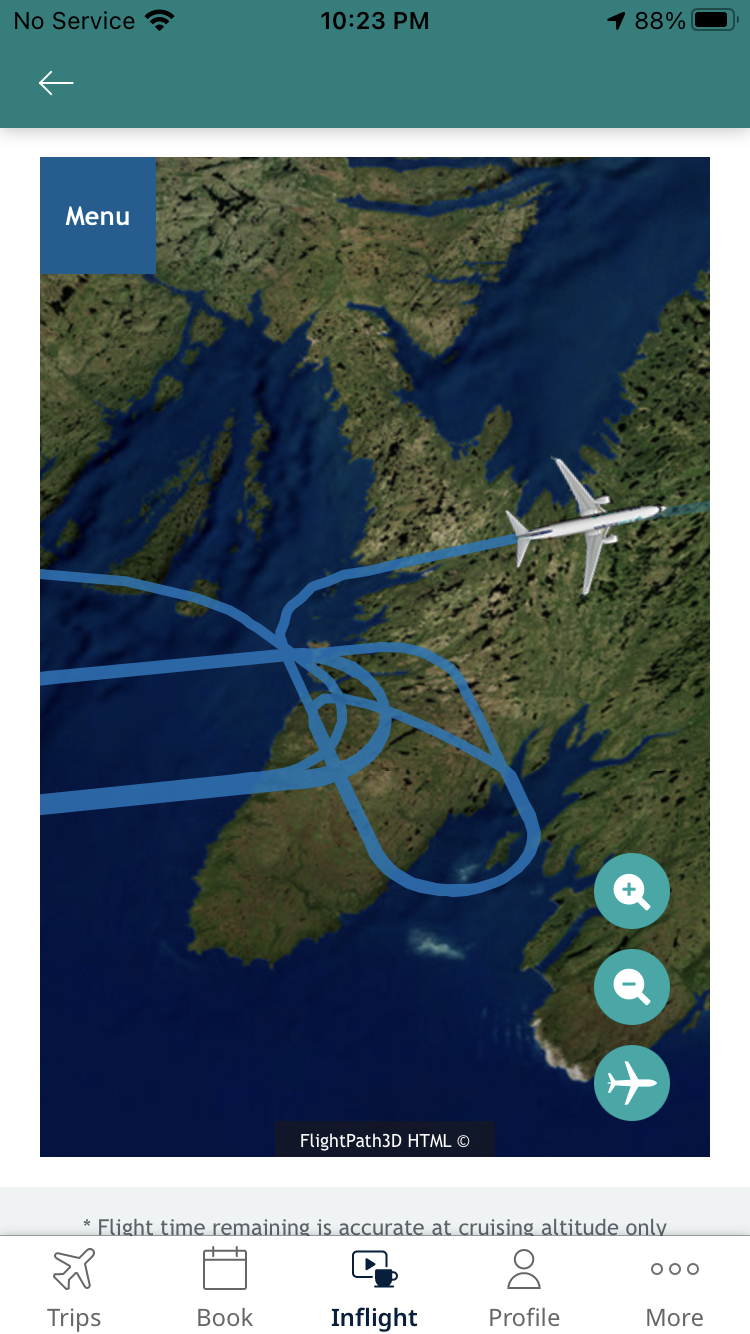
Screenshot of flight path

In August 2021, we flew to St. John’s, Newfoundland. As we approached our destination, the pilot announced that we were unable to land because the runway lights were not working due to a power outage. We didn’t think much of it, but looked at the airplane app and took a few screenshots of the plane circling. Then after about an hour, we began to descend below the clouds into the darkness and rain.

We discovered that the storm had caused a power outage. Until we landed, we had no idea there was even a storm because we were circling above it.

Maybe the Lord’s prayer is telling us that even in the midst of the storms (on earth), we can live out God’s purpose because our perspective is based on being above the storm (in heaven). Maybe that’s why Paul instructed us to set our mind on the things that are above!

Here’s where many people unfortunately find themselves:

“Yet when I surveyed all that my hands had done and what I had toiled to achieve, everything was meaningless, a chasing after the wind; nothing was gained under the sun.”

Ecclesiastes 2:11

Saying that everything is meaningless brings you down (pun intentional), but we must understand Solomon’s point of view.

“I have seen all the things that are done under the sun; all of them are meaningless, a chasing after the wind.”

Ecclesiastes 1:14

The key phrase is under the sun, which is repeated throughout the book. Solomon is sharing an earth-bound perspective. He is only considering life “under the sun”; that is, a human life lived to the exclusion of any consideration of God. From that godless perspective, everything is indeed “meaningless.”

https://www.gotquestions.org/everything-is-meaningless.html

Here’s a prayer that was written by Ken Boa:

Dear Lord, where would I be without Your Word? What would guide me and teach me the answers to the fundamental questions of origin, purpose, and destiny? Human speculation is utterly inadequate for this task, because the answers to these and other questions require a word from without, a revelation that is not under the sun but from above the sun. Teach me to treasure Your Word, and give me the wisdom to read, meditate on, and memorize Your revealed truths—this is the sure foundation upon which to live and flourish. May I be different from the corrupt culture in which I live and value the things that have eternal rather than passing worth. Then I will order my steps with wisdom, prudence, discernment, and good counsel. I want Your Word to make a difference in my life and to be evident to all.

Ken Boa, Reflections Ministries

A Child is Born!

A Child is Born!

Christmas Day, December 25th has become a day focused on gift-giving and receiving. On Christmas Day 2019, our granddaughter, Eleanor was born which has changed Christmas Day for our family into her birthday celebration.

Queen Elizabeth said it well in her Christmas message:

In the birth of a child there is a new dawn with endless potential.

Queen Elizabeth, Dec. 25, 2021

When a child (or grandchild) is born, it brings about significant change in the family dynamic. You become more centred on someone new rather than on yourself. Before children (35 years ago), we were newly-weds and the focus was on each other as a young married couple. We were transformed into parents and the years since brought further transformation – We became grand-parents! Christmas Day 2021 was delayed until Boxing Day because our focus intentionally shifted.

Photo taken on Dec. 27, 2019

The process of transformation often involves painful experiences. Here is how the Apostle Paul described it:

I feel as if I’m going through labor pains for you again, and they will continue until Christ is fully developed in your lives.

Galatians 4:19 (NLT)

While we celebrate Christ being born on a specific day, we have continued the celebrations from a single day to a full season. Paul said he was experiencing labour pains which “will continue until Christ is fully developed.” It is not just the experience of Christ being made alive in our hearts but also that He continues to develop in our lives. Children grow and parents grow with them so each can be brought to maturity and that is the journey of life.

When I think about Christmas, it’s about a child being born but also about that child becoming “fully developed in our lives.” What this means is the focus of life and yes, even our business, is changed forever so that Christ becomes the centre.

There is much in our world that draws our attention away from what is truly important. Often the influences that impact our daily decisions are so subtle that we are completely unaware of them. Make no mistake the goal is to shift our focus away from what is essential. The context of Paul’s statement about labour pains is that there are competing voices that are “zealous to win you over” with the ultimate goal of distraction so that we “would pursue them” (Gal. 4:17).

There is always a competing voice – one that is louder than the whisper of truth! The truth is that we are on this earth to complete the work that was prepared for us and to bring glory to God. The louder voice calls us to focus on other things in our business like products and sales targets. While these are a necessary elements for our success in business, the focal point is to bring glory to God by completing the work given to us.

For every industry, there are “best practices” to follow to be successful. When Christ is fully developed in us, the “best practices” will naturally flow through us into our lives and businesses.

It’s quite interesting that “the glory of God” is something we have all fallen short of (Rom. 3:23) whether in life personally or in business. We have all missed opportunities but the object of our hope is the glory of God (Rom. 5:2).

So as we wrap up another Christmas and journey into another year,

I am sure of this, that he who began a good work in you will bring it to completion!!

Philippians 1:6 ESV

A Pastor’s Legacy

A Pastor’s Legacy

It’s been a month now since the tragic accident and loss of Ralph Benson. Today, June 10th is Ralph’s birthday. Despite not being that close, I have thought of him, the church he pastored and his family every day since receiving the shocking news of his sudden passing. I’ve been considering the legacy he has left his congregation and family.

Some of his own words that were shared at his funeral made me realize just how significant an impact he had. What he told his grandchildren is deeply insightful: “Poppy is never going to die.” What a counter-cultural thing to say. Thousands watched his funeral while his family and church had to come to grips with the immense loss. There seems to be a clear contradiction here between what he told his grandchildren and what happened on May 9, 2021. We all need to understand this more clearly.

Do you Really Believe John 3:16?

The most recognized verse in the Bible reveals significant truth that is so easy to overlook.

For this is how God loved the world: He gave his one and only Son, so that everyone who believes in him will not perish but have eternal life.

John 3:16 NLT

Will not perish” – that’s the truth Ralph told his grandchildren, but the fact of his death has been established. So how are we to reconcile the fact of death and the truth that he would “not perish?” Many believers understand that you have to die (this life must end) and then your eternal life begins. Or is life a continuation and we simply transition from life on earth to life in eternity? The real question is when do we receive eternal life – when we believe on Christ, or when we die physically? Our perspective is more important than we might realize. It is pretty clear from Ralph’s words to his grandchildren that he had already received eternal life and death was not part of his future. Ralph lived most of his life based on a biblical worldview and had received eternal life in his twenties.

June 10, 2020

Think about birth for a moment. You had life in the womb months before your date of birth and after your birth, life continued in a different realm outside the womb. I believe Ralph understood that his death would be similar in some fashion to his birth – death was not the end of his life but rather, like another birth into a different realm. Ralph revealed his eternal perspective when he said “Poppy is never going to die.” Let’s face it, most Christians don’t speak with an eternal perspective like he did. Most would say something like, “Poppy is going to die, but then he is going to heaven.” This statement is a half-truth and has some sense of eternity but contradicts the words of John 3:16 (shall not perish). We have eternal life now and we are not going to die – we are simply being birthed into a new realm.

Is your Tombstone Accurate?

Think about it for a moment: a tombstone records the date of your birth into this world and your exit from this world (for Ralph Benson June10, 1955 – May 9, 2021). The truth is that you existed before your date of birth and your belief in Christ means you continue to exist after your date of death (based on John 3:16). Having an eternal perspective matters and how we communicate this is more significant than we realize. Ralph communicated an eternal perspective to his grandchildren because he was a steward of eternal truth. We are all called to be stewards of truth!

We are called to live as citizens of heaven!

Here’s what Jesus said in the parable he told about the unrighteous steward:

The rich man had to admire the dishonest rascal for being so shrewd. And it is true that the children of this world are more shrewd in dealing with the world around them than are the children of the light. Here’s the lesson: Use your worldly resources to benefit others and make friends. Then, when your possessions are gone, they will welcome you to an eternal home.

Luke 16:8-9 NLT

If you read the complete parable, this manager is being fired because he did not steward well what was given to him to manage. Since he is losing his job as steward (like when our life on earth comes to a close), with his time remaining, he quickly decides to use the relationships that he has for his own interest by making deals that favour the people owing the master. He reduces the amount each of them owe which serves to secure his own future. They would treat him favourably by “welcoming him into their homes.” The shock of the parable is the master praises this steward even when he comes to understand that he will now receive less from these people. Why?

It is important to note that “the actions of the steward are not upheld as models in the parable.” He acted with his own self-interest in mind and is still referred to as “the unrighteous manager” yet he is “more shrewd than the children of light.” This explains why he was praised: he acted according to his worldview. We are citizens of heaven and therefore, should live with an eternal perspective in view, but we often communicate only as citizens of the earth. Ralph communicated a biblical worldview by telling his grandchildren he would not die. At this point, it seems very confusing but he communicated the truth of John 3:16 in a way that many Christians fail to understand: Ralph Benson did not perish.

The Legacy

The legacy Ralph left is the challenge we face daily: to live as stewards of biblical truth and treat others according to this worldview! The message of this parable is encouraging us to align our speaking and our management of relationships and resources with the interest of the owner in mind. This is the task of the children of light.

The unrighteousness manager’s actions were consistent with his worldview more than the actions of most followers of Jesus are consistent with their worldview. The instruction of Jesus is “store up treasures for yourselves in heaven” and we can do this in our present day by the way we use our “worldly resources.” Let’s not limit the stewarding of our worldly resources to our finances only, but understand that how we communicate with others on a daily basis will result in praise from the Master (or not).

How are we doing at managing and communicating our biblical worldview? Have we, as children of light,” become more shrewd in the use of our worldly resources to benefit others? Are we living and communicating based on an eternal perspective?