Financial Principles to Practice

Financial Principles to Practice

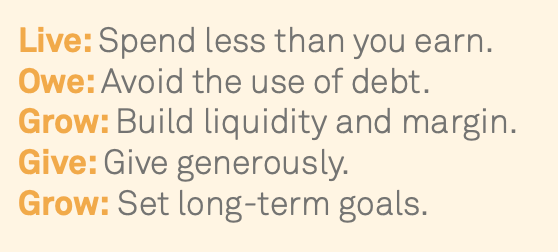
Working in the financial industry for just short of a quarter of a century (why didn’t I stay just one more year?) and now having worked with Christian financial professionals for the past 10 years, I have come to this conclusion: Our personal finances should not be complicated – just follow five simple principles:

  1. Spend less than you earn
  2. Avoid the use of debt
  3. Build liquidity / margin
  4. Give Generously
  5. Set Long-term Goals

Here’s the problem – any of these principles are far too easy to violate. Statistically, at least 34% of working Canadians violate the first principle. Specifically, 27% spend everything they earn, and 7% spend more than they take in, according to a Financial Wellbeing Index from LifeWorks. This situation is particularly prevalent among parents, who are twice as likely to report spending beyond their income. Furthermore, 1 in 6 Canadians (17%) have monthly spending that exceeds their income, and 1 in 4 (27%) borrow to cover essential expenses like food and daily necessities.

If we spend more than we earn, it leads to the violation of the second principle where borrowing becomes the means of acquiring the necessities in life. The rise in credit card debt among working Canadians is also significant, increasing from 29% in 2021 to 42% in 2022. 

Here’s the reality – we are called to be stewards over everything placed in our hands. Is there one principle that trumps another? Or are each of these principles equal in importance?

For Christians, giving is a top priority, particularly when it comes to the teaching around the tithe (giving 10%). I’ve often said that giving is a way to invite God into our finances, but each of these principles is rooted in biblical wisdom, not just the principle of giving.

Here’s an example:

A faithful Christian couple is dedicated to Principle 4: Give Generously. However, they may have violated Principle 2 (Avoid the Use of Debt), when they borrowed to acquire rental properties. They borrowed when interest rates were low with a variable rate mortgage (not a fixed term); then the spike in interest rates has increased their payment beyond their rental income. This couple is now struggling financially and forced to violate Principle 1 (now spending more than they earn), with no ability to follow Principle 3: build liquidity.

How would you advise in this situation? Should they now suspend / pause their giving (at least for a time) to right their financial ship? What should they do to be better stewards.

What principle should be priority for this couple at this time? Is it”spend less than you earn” because it is the key provide the ability to abide by the other principles?

  1. Spending less than you earn will allow you to
  2. Avoid the use of debt and
  3. Build liquidity / margin and
  4. Give generously and
  5. Accomplish your long term goals.

Would you agree or disagree?

Who to Trust in These Times

Who to Trust in These Times

It seems that everyone is talking about President Trump these days. Some are fearing what seems to be inevitable now – a recession, while others see Trump’s aggression on Canada as a threat to its sovereignty as a nation. Politicians are searching for ways to negotiate or strike back against the imposed tariffs. There are more questions than answers, right now. One thing is certain, things have become extremely uncertain.

As Christians, we often quote this very familiar verse about trust from Proverbs that says “Trust in the Lord with all your heart and lean not on your own understanding.” At times of uncertainty like our world is facing right now, the tendency is to lean more on ourselves and try to understand, which is not real trust. My experience tells me it is much easier to say “I trust the Lord,” but much more difficult to really live a life trusting Him. The tendency is to lean and begin to trust what we understand.

“Trust Me”

Canada is in the middle of a leadership transition and therefore, not in a strong bargaining position. In the coming days, each of these leaders will try and position themselves as the best person and the best party to stand for the interests of Canada. In essence, they are saying, “Trust me.”

It’s difficult to understand what the end game might be for President Donald Trump in regards to Canada. It is also a challenge to determine who can be trusted most to lead Canada through these challenging times. Maybe our focus is completely wrong. Maybe this is the perfect opportunity to trust God!

The fact is this: when we do not understand, we can so easily spiral into anxious thoughts about our future – job insecurity, higher cost of living, etc. When we focus on our understanding or lack of understanding, the result is the same which is the opposite of rest.

Trust Yourself

Compare Proverbs 3:5 to a much less familiar verse in Proverbs that uses a similar word for “understanding:”


Do not wear yourself out to get rich;

do not trust your own cleverness (emphasis mine).

Proverbs 23:4 NIV

The pursuit of wealth is so easily connected with an individual’s own cleverness. The NASB says we should not exhaust ourselves to gain wealth; in fact we should “Cease from the consideration (or understanding) of it.” What exactly are we to cease from? Surely the instruction is not to stop considering how we ought to earn income, after all, we are also instructed to provide for our family (1 Tim 5:8).

It’s pretty clear: Proverbs instructs us to seek wisdom and understanding (Prov. 4:1-9). Consider King Solomon who had the unique opportunity to ask God for anything (1 Kings 3:5) … his request was to have an understanding mind. “And God gave Solomon wisdom and understanding beyond measure” (1 Kings 4:29). God not only gave Solomon wisdom, but also added an extra bonus by giving him what he did not ask for: “both riches and honour” (1 Kings 3:13). So he was granted wisdom and wealth, but the choice before him is the choice we all must make: where to lean.

Consider the Source

Clearly, Scripture is teaching us that the source of wisdom and understanding matters. When we look at Solomons’s life and leadership we can see how he drifted from the source of wisdom.

It’s far too easy to think we are the source of any wealth we have accumulated and lean on our own cleverness for more wealth. Where we lean affects our heart, often without us even realizing it. Maybe that’s why the Israelites were reminded to remember that the Lord your God gives you the power to gain wealth (Deut 8:18).

In the same way, political leaders around the world can naturally lean on their own understanding or cleverness to resolve issues that affect millions of citizens. Take a look at these verses as it relates to the King of Tyre:

Your wisdom has certainly made you rich, because you have storehouses filled with gold and silver. You’re a clever businessman and are extremely wealthy, but your wealth has led to arrogance! Ezekiel 28:4-5 CEV (Emphasis mine)

When one possesses wealth and wisdom and sees themselves as the source of what they have, it can lead to arrogance and pride.

When you set your eyes on wealth, it is [suddenly] gone. For wealth certainly makes itself wings Like an eagle that flies to the heavens. Do not eat the bread of a selfish man, Or desire his delicacies; for he is like one who is inwardly calculating. “Eat and drink!” he says to you, but his heart is not with you.

Proverbs 23:5-6 AMP, 7 ESV

Why would someone who is trying to impress you by offering a meal be “inwardly calculating” the cost of that meal? Maybe it is because when someone sees themselves as the source of this wealth, it is natural to think about how much this generosity costs.

Trust the Lord

When you recognize that any wealth you have is from another source other than yourself, you begin to understand that you are a steward, therefore you are not the true source. Then, where you lean shifts to the true source of the wealth (Deut 8:18). At this point, our own ability to gain wealth shifts to a source that is much great than ourselves.

This is a significant heart shift – this shift means that what we “treasure” also shifts (see Matt. 6:21) because our heart now has a different focus – one where giving is a greater priority, greater than the cost of generosity or how this amount will be replaced. The heart of the steward has trust in a higher source than their own “cleverness” to generate wealth. The steward has clarity about money that was previously missing: wealth is now seen as a tool rather than just a resource to be stored.

The End Game is trust!

Discover Your Why: Fulfillment in Work and Life

Discover Your Why: Fulfillment in Work and Life

Well the Labour Day weekend is upon us and for many, it marks the end of a season and shifts students back into the school year and those at work into a busy fall. Mark Twain helps me see

“The two most important days in your life are the day you are born and the day you find out why.”

Mark Twain

Finding your why is truly what makes your work significant. I have heard it said that your job is what an employer pays you to do; your work is what you were born to do. I’m convinced that when you discover your why, you truly live out your calling in life.

Ken Boa in his book, Conformed to His Image says:

“Our primary calling is to know and love God. Our secondary calling is to express this relationship in everything we do and with everyone we encounter.”

As a teenager, I felt a “call” on my life and the best way I could interpret it at the time was to become a pastor. However, the majority of my career has been in the financial services industry, providing insurance and investment advice. My perspective was that my work as a financial advisor was my job (secular) and I believed my “calling” to ministry was my true work (sacred). As the years passed, I questioned if I had “missed my calling” or did I choose the wrong profession?

My problem was that my secondary calling (my work as a financial advisor) was somehow disconnected from my primary calling (to know and love God). Ken Boa explains it this way:

“If the secondary is not related to the primary, we slip into the error of dichotomizing the “spiritual” and the “secular” when they should really be integrated. When this happens, our relationship with the Lord is disconnected from the everyday activities of our lives.”

I certainly felt I was serving the Lord in my business, but somehow the everyday activities of my work became disconnected from my calling. My focus as an advisor was on growing my business, developing relationships and serving clients. While that ethic was typical of this industry, my secondary calling lacked the perspective that only comes by incorporating my primary calling. My work as an advisor (secondary) needed to be an expression of my primary calling. Dr. Ken Boa explains it this way:

“Secular work becomes spiritual when done to the glory of God. Spiritual work becomes secular when done to please and impress men.”

My level of fulfillment through my work reached new heights when the secular and the sacred were merged. This seems so simple now as I reflect, but it required a shift in my perspective. Recognizing the opportunity to love and bring glory to God (primary calling) through my practice (secondary calling), transformed my work life and brought a fresh perspective. In essence, I was transformed into the person I was born to be and now Labour Day becomes important – not the day I was born, but a better understanding of “why” I was born. Dr. Ken Boa sums this up perfectly:

“When we keep our primary calling first and seek to express it in and through our secondary calling, we become more holistic in our thinking and practice.”

Setting Financial Priorities

When you receive your income on a weekly, bi-weekly or monthly basis, it is important to set priorities around the use of these funds. In my study of biblical financial principles I have discovered there are only five things that you can do with money. These are listed here based on rhyme rather than priority:

  1. Live (lifestyle varies depending on personal decisions around spending)
  2. Give (determine to live a generous life)
  3. Owe – repay what we have borrowed which is really an extension of our lifestyle
  4. Owe – taxes (for most, this is an automatic deduction from pay)
  5. Grow – saving for a future goal (education, major purchase, retirement, etc.)

As a simple budget practice, it is helpful to calculate the percentage amount that goes to each of these five areas; however, the big question becomes, “In what order should funds be allocated?” What is the foundation for setting these priorities?

For the Christian, the Bible is to be our guide in life and there are 2350 verses referencing money and possessions. Thankfully, many have researched these truths and can help us determine what our financial priorities ought to be.

In his book, Financial Discipleship for Families, author Brian Holtz shares five priorities based on biblical wisdom.

Priority 1 – Giving Generously: Righteousness is associated with generosity in Psm. 37:21 which states, “The wicked borrows but does not repay, but the righteous is generous and gives!” Jesus emphasizes in His Sermon on the Mount to, “Seek first the kingdom of God and his righteousness, and all these things will be added to you” (Matt 6:33 ESV). Do we seek His kingdom first in our financial decisions? Or are we more focused on adding the the things?

Priority 2 – Providing for Family Needs: The Apostle Paul instructs readers in 1 Tim. 5:8 to “provide for their own family and especially for a member of their household …” (CEB). This directive to care for our loved ones tends to come naturally, and for many it is the top priority.

Priority 3 – Meeting Financial Obligations: Again, the Apostle Paul in Romans 13:7-8 gives the instruction: “pay your taxes and government fees and … owe nothing to anyone – except for your obligation to love one another” (NLT). Holtz says, “After giving and providing for the basic needs of our family, we need to prioritize the various financial obligations we have made.” Paying taxes with gratitude for the income earned can be challenging at tax time and paying off debt can feel burdensome, but is an obligation.

Priority 4 – Saving for the Future: Proverbs 21:20 gives clear guidance to save for future needs which maybe unseen or unknown in the present. It reads, “The wise have wealth and luxury, but fools spend whatever they get.”

Priority 5 – Enjoying God’s Abundant Blessings: When Paul mentored Timothy, he told him to “Instruct the rich… not to be conceited or fix their hope on the uncertainty of riches, but on God, who richly supplies us with all things to enjoy.” Clearly, it is God who gives us these things with purpose – enjoyment being one, but this is not necessarily the top priority. He continues the instruction reiterating priority 1, which is to use what we have been given “to do good, to be rich in good works, to be generous and ready to share” (1 Tim. 6:17-18 NASB).

Our natural tendency is to order our financial priorities like this:

  • Priority 2 – Providing for Family Needs
  • Priority 5 – Enjoying God’s Abundant Blessings
  • Priority 3 – Meeting Financial Obligations
  • Priority 4 – Saving for the Future
  • Priority 1 – Giving Generously

The Kingdom Advisors theme for February focuses on priority 1 and the giving process. Chris Gabriel says, “Giving is a superhighway to the soul. Christian advisors can be agents of redemption in the area of generosity and giving.” As agents of redemption, we are called disciple and help others shape their financial priorities based on biblical financial wisdom.

Questions to consider:

  • Have you ever calculated what percentage of your income goes to each of the five uses of money?
  • Are the financial priorities for Christians any different than non-Christians?
  • How would you personally rank these five priorities?
  • Which of these priorities presents the greatest challenge for you?
  • Do you need to make adjustments to your financial priorities?