

Last weekend was a little frustrating at our house since the kitchen sink would not drain. My first instinct was there must be something clogging the pipes directly below the sink. I purchased a 15-foot long snake or auger that I could put into the 1 1/2 inch line. I was feeling confident that this would solve the issue. After using the auger, we ran the water and there was absolutely no change; the sink still did not drain. I plunged the sink several times but with no success. With the pipe being more than 25 feet long, I reluctantly decided to cut the line, use the 15-foot auger in either direction which would, no doubt, reach the blockage. A joiner could be used to reconnect the line.
I knew this was going to be messy! I cleared the area, put down plastic and had a few buckets on hand. I began the cut knowing the line was filled with water that was bound to spill from where I was cutting. I’m sure a plumber would have been able to do this more efficiently but I was determined to solve this problem myself. As I cut the line, the water began to squirt out and as the cut went deeper the smell and food particles coming out was absolutely gross.
Sure enough, as I put the auger into the line, I could feel the resistance; the line was clogged right at the very end. The line had a very gradual slope over the last 14 feet which would easily cause debris to build up. Time to rejoin the line and hope for the best! Run the water; how could this be? It still was not draining! After a few plunges and to my great relief, the line opened up and the water began to flow freely. What a satisfying sense of accomplishment.
That got me to thinking about the purpose of that pipe; it was to have the water from the sink drain flow through it. The clogged line defeated the purpose of the pipe! We are all meant to be like a pipe or conduit where things flow through. In other words, what comes to us like gifts and talents, wealth and resources are meant to flow through rather than be stored up. The more we hold things and keep them for ourselves, the more there is an opportunity to have our pipes become clogged. Just this week, there was a financial need that we became aware of and I thought about that pipe; we could choose to keep the money in our account or we could help someone else by giving.
Think about the Dead Sea and compare it to the Sea of Galilee (which is just North of the Dead Sea).
Both the Sea of Galilee and the Dead Sea receive their water from the river Jordan. And yet, they are very, very different. Unlike the Dead Sea, the Sea of Galilee is pretty, resplendent with rich, colourful marine life. There are lots of plants. And fish too. In fact, the sea of Galilee is home to over twenty different types of fish.
The river Jordan flows through the Sea of Galilee but the Dead Sea has no outlet!
The Dead Sea takes the same water from river Jordan as the Sea of Galilee; and just holds it. It does not give; and hence, there is no life there at all.
The moral… Life is not just about receiving. It is about receiving and giving.
Randy Alcorn in his book, Money Possessions & Eternity describes the purpose of the church this way:
Whereas the Old Testament temple was a storehouse, the New Testament church was a clearinghouse, a conduit of gifts to help the needy and reach the lost.
It is so easy to focus only on ourselves and think that what comes into our hands is meant only for ourselves (for vacations, pleasure or retirement) and not for others. As I reflect on my clogged pipe, I do not want my life to become clogged where nothing is flowing through.
Money is a blessing, but it is also a burden when we’re given more than we need. Giving produced freedom 100 percent of the time – freedom to be a conduit of blessing to others.
Why did my pipe get clogged? I suspect because there is not a sufficient slope for that length of pipe and the water is not flowing as well as it should. Compare that to money flowing to us, the question becomes, “How much is flowing through us?”
Canada Helps did a study of giving levels from 2006 to 2016 and determined that higher income earning families saw the sharpest declines in giving (in these 11 years). It seems that the higher the income, the less the money flows through or there is more likely to be a clog in the line. Here’s what I found interesting from the study:
The lower income families that do make donations have increased the amount of their income spent on donations from 3.3% to 5.5% in the past 11 years. In the meantime, families making $250K or more has consistently given around 2% of their income over the past 11 years.
One of our goals is to increase the percentage of giving each year going forward. The reason, as I reflect on the clogged drain, is to avoid that clog from happening in our personal financial affairs. Author John Piper put it this way:
The issue is not how much a person makes. Big industry and big salaries are a fact of our times, and they are not necessarily evil. The evil is in being deceived into thinking that a $100,000 salary must be accompanied by a $100,000 lifestyle. God has made us to be conduits of his grace.
May I suggest that as your income increases, consider increasing your standard of giving instead of your standard of living. As Randy Alcorn so aptly put it, “Giving is the safety valve that releases the excess pressure of wealth.” Are you releasing the build-up that wealth brings?

 She is fun-loving and loves to lift the spirits of people. One of her favourite Bible verses states that a merry heart is good like a medicine. Truth is, she doesn’t need a mask to do that; it really is who she is.


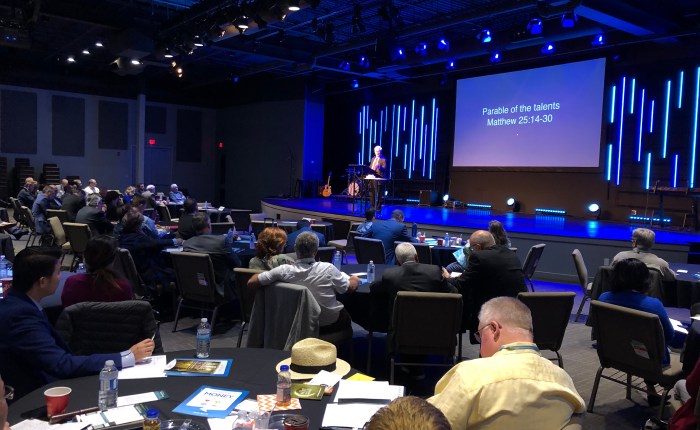
 The majority of these advisors have figured out why they do what they do and surprisingly, it’s not just for the career, the money or the position. It’s because they feel called and that calling is usually defined by some life experience. After the conference, I was intrigued to read an article about one of our speakers,





 General Ann Dunwoody was walking down the street when she saw a soldier in uniform walking with his hands in his pockets. Anyone who’s spent time in the military knows that this is a big no-no. Dunwoody could have literally walked by the mistake and not addressed it. It’s something small, it wasn’t impacting anyone at the time, and the kid probably just forgot. It wasn’t anything overtly heinous. As a general, though, she knew that if she didn’t correct the error, she would be, by the sin of omission, setting a new lower standard for that soldier. So rather than letting it slide, she approached him, kindly addressed the problem (rather than yelling at and demeaning the young guy), and reinforced the ideas of discipline and attention to detail.
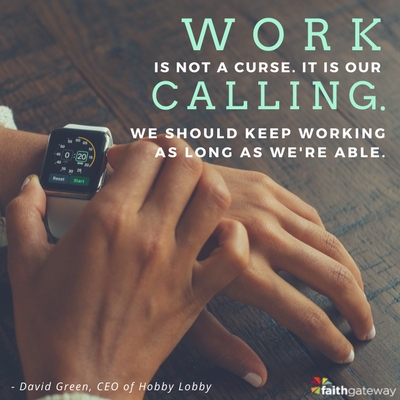 We usually make the same mistake when we categorize our work (or business) as secular, separating it from the sacred (calling). Rather than sensing the pleasure of God through our work, we often consider our work less than God’s calling. It seems that David Green felt like a black sheep because the rest of his family were “ministers” while he was in business. However, when we serve others (in our work), we are actually serving the Lord, not just men (Eph. 6:7) and can fulfill the call God has placed on our lives. Here is a great piece of advice: Whatever you do, do it enthusiastically, as something done for the Lord … (Col 3:23).
 The part that I found most interesting is the corporate structure of Hobby Lobby, where the shares are owned by a trust rather than by family members. This speaks to the fact that the Green’s are stewards of the company and the corporation is actually held in trust. This means if the company was to be sold, 90% of the value would go to a foundation and subsequently distributed to the Lord’s work. Typically, a business is passed down to the next generation, then the next, but in the case of Hobby Lobby, the family cannot actually touch the assets. Since these assets are seen as under God’s ownership, the corporate structure reflects that and is actually referred to as a “stewardship trust.”
  Lorne Robinson's Blog