Financial Principles to Practice

Financial Principles to Practice

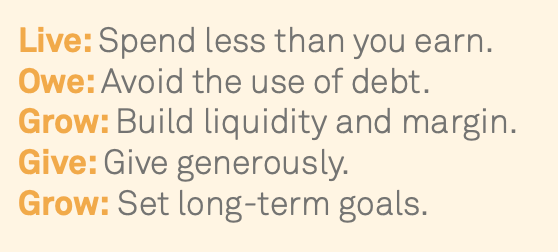
Working in the financial industry for just short of a quarter of a century (why didn’t I stay just one more year?) and now having worked with Christian financial professionals for the past 10 years, I have come to this conclusion: Our personal finances should not be complicated – just follow five simple principles:

  1. Spend less than you earn
  2. Avoid the use of debt
  3. Build liquidity / margin
  4. Give Generously
  5. Set Long-term Goals

Here’s the problem – any of these principles are far too easy to violate. Statistically, at least 34% of working Canadians violate the first principle. Specifically, 27% spend everything they earn, and 7% spend more than they take in, according to a Financial Wellbeing Index from LifeWorks. This situation is particularly prevalent among parents, who are twice as likely to report spending beyond their income. Furthermore, 1 in 6 Canadians (17%) have monthly spending that exceeds their income, and 1 in 4 (27%) borrow to cover essential expenses like food and daily necessities.

If we spend more than we earn, it leads to the violation of the second principle where borrowing becomes the means of acquiring the necessities in life. The rise in credit card debt among working Canadians is also significant, increasing from 29% in 2021 to 42% in 2022. 

Here’s the reality – we are called to be stewards over everything placed in our hands. Is there one principle that trumps another? Or are each of these principles equal in importance?

For Christians, giving is a top priority, particularly when it comes to the teaching around the tithe (giving 10%). I’ve often said that giving is a way to invite God into our finances, but each of these principles is rooted in biblical wisdom, not just the principle of giving.

Here’s an example:

A faithful Christian couple is dedicated to Principle 4: Give Generously. However, they may have violated Principle 2 (Avoid the Use of Debt), when they borrowed to acquire rental properties. They borrowed when interest rates were low with a variable rate mortgage (not a fixed term); then the spike in interest rates has increased their payment beyond their rental income. This couple is now struggling financially and forced to violate Principle 1 (now spending more than they earn), with no ability to follow Principle 3: build liquidity.

How would you advise in this situation? Should they now suspend / pause their giving (at least for a time) to right their financial ship? What should they do to be better stewards.

What principle should be priority for this couple at this time? Is it”spend less than you earn” because it is the key provide the ability to abide by the other principles?

  1. Spending less than you earn will allow you to
  2. Avoid the use of debt and
  3. Build liquidity / margin and
  4. Give generously and
  5. Accomplish your long term goals.

Would you agree or disagree?

An Eye Exam

An Eye Exam

I recently had an eye exam and there was no significant change in my prescription. This reminded me of the words of Jesus in the famous Sermon on the Mount. I googled the verse of interest and immediately received this AI generated overview:

The Bible verse “If your eyes are healthy, your whole body will be full of light,” is found in Matthew 6:22. It essentially means that if your mind and heart are focused on good things, your whole life will be filled with light and positivity. If your “eye” (representing your inner self) is not focused on God, the truth, and good things, your whole life will be filled with darkness. 

Is Your Eye Healthy?

That certainly seems to be a reasonable explanation, but is that really the extent of what Jesus was saying here? To fully understand, might I suggest we need more SI (Spiritual Insight), since AI (Artificial Intelligence) has its limits. Maybe a quick look at the context of this verse might give us a clue.

Matt. 6:20 talks about treasure and the places it can be stored (heaven or earth). The next verse connects our heart with where we place our treasure. Inserted here are two verses about having a healthy or clear eye vs. an evil or unhealthy eye which results in darkness. This is followed by the reference to two masters and the inability to serve both with the simple conclusion: “You cannot serve God and money.” Then, the instruction to not worry about the things needed in life, like food and drink and clothes – some of the things we purchase with money.

With this context in mind, why does Jesus speak about the eye being good or evil, bringing light or darkness? Could the health of the eye be a reference to our attitude about our financial resources?

Is Your Eye Envious?

This is not the only time Jesus referenced the eye. In Matthew 20, He spoke about “the kingdom of heaven” being like a landowner who hired workers for his vineyard. These individuals were hired at different times during the day – some early morning, others at 9 am, others at noon, then others at 3 pm and more at 5 pm. At the end of the workday, the workers were called to receive their pay, “beginning with the last ones hired and going on to the first” (v. 8). Naturally, the people who worked the entire day expected to be paid more than those who started work at 3 or 5 pm and this led to complaints.

The story concludes with a few questions:

“Is it not lawful for me to do what I wish with what is my own? Or is your eye envious because I am generous?”

In this story, Jesus was illustrating that the darkness on the inside of these workers was due to a desire for more (an amount above the original agreed amount). All day these workers knew what they were going to be paid but this focus shifted when they saw that others who worked less were being paid the same (meaning their hourly wage was less than those hired later). There was an immediate discontentment when they compared themselves with people who were hired 8 hours later. Comparison is the enemy of contentment.

Let’s assume you or I were hired at the start of the day – would we be any different? If we worked 10 -12 in the day and others worked only two hours, it would be natural to expect more pay, wouldn’t it?

Is Your Eye Clear?

The point Jesus is making here is that the eye is not clear and greed enters the heart through our eyes. How would you define greed? Maybe it’s as simple as the desire for more. AI says it is characterized by a strong, often selfish, yearning for more than what is needed or deserved. Greed is often associated with materialism, envy, and a focus on self-interest. 

Here’s how Tim Keller spoke about the eye and greed:

Greed is different than other sins. This is why Jesus says this is an eye sin. This darkens your eye spiritually. Jesus did not say to anybody, “Watch out, you might be committing adultery.” If you’re committing adultery; you know you’re committing adultery. You don’t say, “Oh, you’re not my wife!” It doesn’t happen. But Jesus has to say, Watch out, you might be greedy. Greed hides itself. It blinds you in a way that adultery doesn’t. Over the years as a pastor, I’ve had people come in to talk to me about sins, but I don’t remember anybody coming to me to confess the sin of greed.

https://www.plough.com/en/topics/faith/discipleship/watch-out-you-might-be-greedy

It’s such a challenge to recognize this darkness or even know it has found a place in our hearts. In fact, “The heart is deceitful above all things and beyond cure. Who can understand it?” (Jer. 17:9)

Jesus said that “from within, out of the heart proceed …” a long list which includes coveting and envy (Mark 7:21, 22). The word envy is literally “an evil eye.”

Tim Keller explained how easy it is for us to not even consider the possibility that we might be materialistic with this realistic example:

Materialism has the power to get you to choose a job, not one that you love, not one that you’re good at, not one that helps people, but one that makes you money. You do it because it will get you to a certain status in life. You choose the job on the basis of that. For five to ten years the adrenaline can keep you going, but after a while you find yourself empty inside. Why did you choose the job? Your eye was dark.

https://www.plough.com/en/topics/faith/discipleship/watch-out-you-might-be-greedy

Is Your Eye Focused?

When your eye is dark it is easier to refuse to help someone who has a genuine need (Deut. 15:9) than to truly have compassion and help them. Our response to others is determined by what is in our heart and Jesus is saying the entrance into the heart is through the eye. The instruction in the verse that follows is pretty clear:

Give generously to the poor, not grudgingly, for the LORD your God will bless you in everything you do.

Deut. 15:10 NLT

So what did Jesus mean when he spoke about a clear eye? It wasn’t just focusing on good things (as AI suggests), so your life will be filled with positive things. It was about having the right perspective – shifting your focus away from greed and discontentment which is the darkness. Instead, the light brings generosity and contentment into view. A clear eye means we view the resources we have differently, we begin to ask why we have these resources.

The “evil eye” focuses on getting more while the “good eye” focuses on giving more.

Let me wrap this up with Proverbs 22:9:

“He who is generous will be blessed, For he gives from his food to the poor.”

The newer translations just use the word generous here, but that word refers to one who “has a good eye” – the KJV translates it as one with a bountiful eye.

Consider this in light of what Jesus said:

“When your eye is healthy, your whole body is filled with light.”

The healthy or “bountiful eye” speaks of generosity that flows from an abundance mindset and is not restricted at all by scarcity thinking.

Do You Need Corrective Lenses?

In a 2012 study published in Science, behavioural economists Mullainathan and Shafir discovered something remarkable:

When we perceive scarcity (even if it doesn’t match reality), our brain undergoes a measurable shift. Our mental bandwidth narrows, focusing intensely on what we might lose while becoming blind to potential gains.

https://breakingbank.media/ca/breaking-the-scarcity-cycle-a-guide-for-smarter-wealth-management/?ref=sadeyemi&utm_source=email&utm_medium=email+marketing

This confirms what the Sermon on the Mount stated more than 2000 years earlier:

But when your eye is unhealthy (perceiving scarcity), your whole body is filled with darkness (your mental bandwidth narrows). And if the light you think you have is actually darkness, how deep that darkness is!

A scarcity mindset negatively limits our ability to be generous, which is a dark place. Lord, open our eyes to Your light and deliver us from the dark. For my physical eyes, I need corrective lenses and I use them every day. Do we not need the same discipline to wear our spiritual lenses daily? How else can we have “a bountiful eye?”

Who to Trust in These Times

Who to Trust in These Times

It seems that everyone is talking about President Trump these days. Some are fearing what seems to be inevitable now – a recession, while others see Trump’s aggression on Canada as a threat to its sovereignty as a nation. Politicians are searching for ways to negotiate or strike back against the imposed tariffs. There are more questions than answers, right now. One thing is certain, things have become extremely uncertain.

As Christians, we often quote this very familiar verse about trust from Proverbs that says “Trust in the Lord with all your heart and lean not on your own understanding.” At times of uncertainty like our world is facing right now, the tendency is to lean more on ourselves and try to understand, which is not real trust. My experience tells me it is much easier to say “I trust the Lord,” but much more difficult to really live a life trusting Him. The tendency is to lean and begin to trust what we understand.

“Trust Me”

Canada is in the middle of a leadership transition and therefore, not in a strong bargaining position. In the coming days, each of these leaders will try and position themselves as the best person and the best party to stand for the interests of Canada. In essence, they are saying, “Trust me.”

It’s difficult to understand what the end game might be for President Donald Trump in regards to Canada. It is also a challenge to determine who can be trusted most to lead Canada through these challenging times. Maybe our focus is completely wrong. Maybe this is the perfect opportunity to trust God!

The fact is this: when we do not understand, we can so easily spiral into anxious thoughts about our future – job insecurity, higher cost of living, etc. When we focus on our understanding or lack of understanding, the result is the same which is the opposite of rest.

Trust Yourself

Compare Proverbs 3:5 to a much less familiar verse in Proverbs that uses a similar word for “understanding:”


Do not wear yourself out to get rich;

do not trust your own cleverness (emphasis mine).

Proverbs 23:4 NIV

The pursuit of wealth is so easily connected with an individual’s own cleverness. The NASB says we should not exhaust ourselves to gain wealth; in fact we should “Cease from the consideration (or understanding) of it.” What exactly are we to cease from? Surely the instruction is not to stop considering how we ought to earn income, after all, we are also instructed to provide for our family (1 Tim 5:8).

It’s pretty clear: Proverbs instructs us to seek wisdom and understanding (Prov. 4:1-9). Consider King Solomon who had the unique opportunity to ask God for anything (1 Kings 3:5) … his request was to have an understanding mind. “And God gave Solomon wisdom and understanding beyond measure” (1 Kings 4:29). God not only gave Solomon wisdom, but also added an extra bonus by giving him what he did not ask for: “both riches and honour” (1 Kings 3:13). So he was granted wisdom and wealth, but the choice before him is the choice we all must make: where to lean.

Consider the Source

Clearly, Scripture is teaching us that the source of wisdom and understanding matters. When we look at Solomons’s life and leadership we can see how he drifted from the source of wisdom.

It’s far too easy to think we are the source of any wealth we have accumulated and lean on our own cleverness for more wealth. Where we lean affects our heart, often without us even realizing it. Maybe that’s why the Israelites were reminded to remember that the Lord your God gives you the power to gain wealth (Deut 8:18).

In the same way, political leaders around the world can naturally lean on their own understanding or cleverness to resolve issues that affect millions of citizens. Take a look at these verses as it relates to the King of Tyre:

Your wisdom has certainly made you rich, because you have storehouses filled with gold and silver. You’re a clever businessman and are extremely wealthy, but your wealth has led to arrogance! Ezekiel 28:4-5 CEV (Emphasis mine)

When one possesses wealth and wisdom and sees themselves as the source of what they have, it can lead to arrogance and pride.

When you set your eyes on wealth, it is [suddenly] gone. For wealth certainly makes itself wings Like an eagle that flies to the heavens. Do not eat the bread of a selfish man, Or desire his delicacies; for he is like one who is inwardly calculating. “Eat and drink!” he says to you, but his heart is not with you.

Proverbs 23:5-6 AMP, 7 ESV

Why would someone who is trying to impress you by offering a meal be “inwardly calculating” the cost of that meal? Maybe it is because when someone sees themselves as the source of this wealth, it is natural to think about how much this generosity costs.

Trust the Lord

When you recognize that any wealth you have is from another source other than yourself, you begin to understand that you are a steward, therefore you are not the true source. Then, where you lean shifts to the true source of the wealth (Deut 8:18). At this point, our own ability to gain wealth shifts to a source that is much great than ourselves.

This is a significant heart shift – this shift means that what we “treasure” also shifts (see Matt. 6:21) because our heart now has a different focus – one where giving is a greater priority, greater than the cost of generosity or how this amount will be replaced. The heart of the steward has trust in a higher source than their own “cleverness” to generate wealth. The steward has clarity about money that was previously missing: wealth is now seen as a tool rather than just a resource to be stored.

The End Game is trust!

Setting Financial Priorities

When you receive your income on a weekly, bi-weekly or monthly basis, it is important to set priorities around the use of these funds. In my study of biblical financial principles I have discovered there are only five things that you can do with money. These are listed here based on rhyme rather than priority:

  1. Live (lifestyle varies depending on personal decisions around spending)
  2. Give (determine to live a generous life)
  3. Owe – repay what we have borrowed which is really an extension of our lifestyle
  4. Owe – taxes (for most, this is an automatic deduction from pay)
  5. Grow – saving for a future goal (education, major purchase, retirement, etc.)

As a simple budget practice, it is helpful to calculate the percentage amount that goes to each of these five areas; however, the big question becomes, “In what order should funds be allocated?” What is the foundation for setting these priorities?

For the Christian, the Bible is to be our guide in life and there are 2350 verses referencing money and possessions. Thankfully, many have researched these truths and can help us determine what our financial priorities ought to be.

In his book, Financial Discipleship for Families, author Brian Holtz shares five priorities based on biblical wisdom.

Priority 1 – Giving Generously: Righteousness is associated with generosity in Psm. 37:21 which states, “The wicked borrows but does not repay, but the righteous is generous and gives!” Jesus emphasizes in His Sermon on the Mount to, “Seek first the kingdom of God and his righteousness, and all these things will be added to you” (Matt 6:33 ESV). Do we seek His kingdom first in our financial decisions? Or are we more focused on adding the the things?

Priority 2 – Providing for Family Needs: The Apostle Paul instructs readers in 1 Tim. 5:8 to “provide for their own family and especially for a member of their household …” (CEB). This directive to care for our loved ones tends to come naturally, and for many it is the top priority.

Priority 3 – Meeting Financial Obligations: Again, the Apostle Paul in Romans 13:7-8 gives the instruction: “pay your taxes and government fees and … owe nothing to anyone – except for your obligation to love one another” (NLT). Holtz says, “After giving and providing for the basic needs of our family, we need to prioritize the various financial obligations we have made.” Paying taxes with gratitude for the income earned can be challenging at tax time and paying off debt can feel burdensome, but is an obligation.

Priority 4 – Saving for the Future: Proverbs 21:20 gives clear guidance to save for future needs which maybe unseen or unknown in the present. It reads, “The wise have wealth and luxury, but fools spend whatever they get.”

Priority 5 – Enjoying God’s Abundant Blessings: When Paul mentored Timothy, he told him to “Instruct the rich… not to be conceited or fix their hope on the uncertainty of riches, but on God, who richly supplies us with all things to enjoy.” Clearly, it is God who gives us these things with purpose – enjoyment being one, but this is not necessarily the top priority. He continues the instruction reiterating priority 1, which is to use what we have been given “to do good, to be rich in good works, to be generous and ready to share” (1 Tim. 6:17-18 NASB).

Our natural tendency is to order our financial priorities like this:

  • Priority 2 – Providing for Family Needs
  • Priority 5 – Enjoying God’s Abundant Blessings
  • Priority 3 – Meeting Financial Obligations
  • Priority 4 – Saving for the Future
  • Priority 1 – Giving Generously

The Kingdom Advisors theme for February focuses on priority 1 and the giving process. Chris Gabriel says, “Giving is a superhighway to the soul. Christian advisors can be agents of redemption in the area of generosity and giving.” As agents of redemption, we are called disciple and help others shape their financial priorities based on biblical financial wisdom.

Questions to consider:

  • Have you ever calculated what percentage of your income goes to each of the five uses of money?
  • Are the financial priorities for Christians any different than non-Christians?
  • How would you personally rank these five priorities?
  • Which of these priorities presents the greatest challenge for you?
  • Do you need to make adjustments to your financial priorities?

Conformed or Transformed?

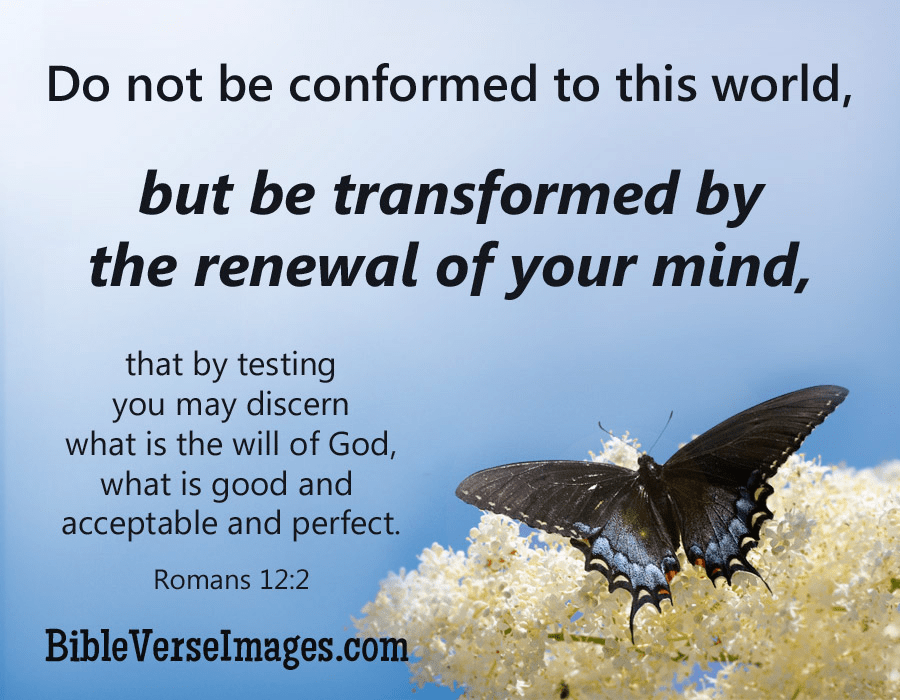
As we start another year, the Apostle Paul offers very clear instruction:

“Do not be conformed to this age, but be transformed by the renewing of your mind, so that you may discern what is the good, pleasing, and perfect will of God.”

Romans 12:2 HCSB

Written so long ago – how do we apply this in our day? No doubt it is much easier to conform to this age because it takes more of an effort to be transformed. It takes intentionality to be transformed because what comes naturally is being conformed to what is around us (this age or the world around us).

The renewal of the mind is the key, meaning we must intentionally have things enter our mind to bring transformation. This begs the question: what is entering our minds? What we read, listen to, watch or in essence, what we consume on a regular basis shapes our thinking.

A deeper question then becomes: What is the source of the things we consume (what we read, hear and watch)? Clearly what Paul is saying here is that the source of what we consume is more important than we might realize because it determines if we are conforming to this age or being transformed! Transformation happens only when the mind is renewed by a source other than “this age.”

Butterflies undergo a complete metamorphosis. Each stage looks completely different and serves a different purpose in the life of the insect.
https://www.floridamuseum.ufl.edu/educators/resource/butterfly-life-cycle

It is vital for every Christian to “be transformed” because it is only then we become capable of discerning “what is the will of God, what is good and acceptable and perfect” in every aspect of our lives.

Let’s practically apply this in our finances: If you receive an increase in your annual pay for the next year, what will you do with that increase?

The most natural response is to increase your lifestyle, since you can now afford it a little better. You can also choose to pay down debt, or save this amount for a short or long term goal. Another option would be to give some or all of this pay increase to a charity of choice. I’ve listed these in this order based on two things: the first being my experience with clients as a financial advisor, but secondly on “this age” which typically shapes our financial decision making. You will likely agree that it is “this age” that influences the choices we make.

Let me echo the instruction of Paul here: “Do not be conformed to this age” or as it relates to our finances, do not increase your standard of living, “but be transformed by the renewing of your mind,” meaning our thinking is changed, even reversed, so we choose to increase our standard of giving.

God prospers me not to raise my standard of living, but to raise my standard of giving.

Randy Alcorn

Christmas Gratitude

Christmas Gratitude

At this time of year I feel extremely grateful – Serving as the National Director for Kingdom Advisors in Canada is not only a privilege but a living out of one’s calling. To be able to connect with so many high quality and generous financial professionals across this country is humbling – I could never have imagined this 10 years ago. 

I just glanced on LinkedIn this morning and saw posts from two of our Kingdom Advisors Champions – between them 1200 families were provided food for ChristmasThat’s just two of more than 200 generous Kingdom Advisors in Canada! Why is this happening? I recently watched a message by John Rinehart, who shared how “Those whose hearts were stirred freely gave” (Exod. 35:21). He explained that the greatest ingredient in generosity is the Spirit’s stirring of our hearts.

There is a difference between God’s economy and man’s economy: the first is about giving and receiving, while the latter is more about buying and selling. It’s exciting to work with Christian financial professionals across Canada and see the transformational work of God moving them toward a focus on His economy. This is where the goal of our work and business goes beyond making money to loving and glorifying God by serving others with the gifts and talents He has given to us.

If you are stirred to help us continue to grow and engage more advisors with the life-changing truths of biblical financial advice, you can donate to Kingdom Advisors in Canada using this linkA big thank you to those who have already given this year!

The Impact of Your Lifestyle

The Impact of Your Lifestyle

There are so many places that our money can be directed so it is important to set our priorities. One priority already set for the majority is tax, since the income tax act requires that taxes are deducted at source before we receive our pay. The more one makes, the more gets deducted.

One of the more challenging areas is our lifestyle because we always seem to want a larger lifestyle. We like to have a newer car, the latest cell phone, another toy and the list goes on. For this reason, limiting our lifestyle spending is never easy.

It has been said that lifestyle spending accounts for 40-70% of where our money goes. Please note that lifestyle spending is different than “living expenses” because lifestyle is about what we want, not just what we need to live.

Have you ever calculated how much of your monthly expenditures is directed toward lifestyle and these other areas? There is a simple tool in the form of a pie chart that I have used to determine the percentage of money that goes to each piece of the pie.

Taken from the Kingdom Advisors Educational Program

Your tax return can provide some of this data: start with your gross income, then subtract the tax you pay, then take off the amount you save (if it’s in your RRSP, you can find this on your tax return) and subtract your charitable giving (also on your tax return if given to a registered charity). Finally, subtract what you pay annually in debt (which typically is an extension of your lifestyle). What remains is your lifestyle. (Income – tax – debt – saving – giving = lifestyle).

In the Kingdom Advisors Study Group this month, Founding Director, Ron Blue shares the story of a couple who desired to give more than 10%. Might that be a goal for you?

This couple was spending 52% on lifestyle and 15% was going to pay on the debt. The reason for the debt was paying off things like an RV, motorcycles, boats – the toys or the extras. The toys are great to have but maybe not used as much as when first purchased.

This couple made the decision to sell the toys (for what they were worth – less than the purchase price) and eliminate the debt. They allocated this 15% to their giving, so they now gave 25%! This in turn reduced their taxes by 10% – that’s a definite win! This 10% allowed them to boost their savings and even add to their lifestyle boosting it to 59%.

Just think about that result for a minute: paying 10% less in tax, saving 3% more, giving 15% more and spending 7% more on lifestyle; who can argue with that? Most importantly, this couple was more content than they were previously. It came by eliminating the debt.

As a couple, we have calculated this in the past few years and have found it extremely useful, because like this couple, we were not 100% content and wanted to make some adjustments in our pie chart. In particular: decrease (or eliminate) debt, give more and pay less in tax.

How about you? If you would like to calculate your own, you can download the tool here: https://ronblueinstitute.com/tools/#budgeting_tools

Revisit your own pie and priorities on an annual basis. Maybe some adjustment might be exactly what you need!

Not Just a 100 km Ride

Not Just a 100 km Ride

July 24th was special in 2021, not because I went on a 100 kilometre bike ride, but because of “why” I did that bike ride. It was a “Ride to Thrive” in order to raise funds for International Missions. For my ride, I was so thankful to have friends and family who donated from BC, AB, ON, QC & NL.

On the Quebec side with Parliament Hill in the background

It helped me realize that there are all sorts of ways to give. The riders all gave their time and energy to ride for almost 4 hours. Volunteers gave their time to meet us at the halfway point and provide us with drinks to fuel us for the last half of the ride. They also volunteered to do a BBQ for us hungry riders at the end. Then there are others, like some reading this post, who chose to support financially. We all contributed to a great cause.

I have been cycling now for 15 years and I have learned a few things when riding:

1) It’s easier to ride when you have someone directly in front of you and

2) Stay as close as possible to the back wheel of those riders.

There’s a great life lesson here: stay close and ride with someone on this journey of life.

This reminded me of when I did the cycling portion of the Iron Man triathlon in Corner Brook back in July 2008. (My average speed for that race was 29.8 kph). The difference in that race and this ride is that the triathlon was an individual race. You had to keep your distance from the rider in front of you or pass that rider; you could not ride in another’s slip stream. That was not the case in our Ride to Thrive journey. It was a joy to be able to take advantage of someone else’s strength, even when your own strength is wavering.

“If we live by the Spirit, let us also keep in step with the Spirit.”

Galatians 5:25 ESV

The cycling journey exemplifies this truth. The energy you gain by being close to someone else is more valuable than you realize. You can go at a faster pace for a longer time than you can on your own. “In step with the Spirit” means you get the advantage of the Spirit’s activity in your life and you can go further and accomplish more than you ever can on your own. If however, you are out of step, the effort becomes more of your own and you end up accomplishing a whole lot less than you might desire.

Notice the distance gap between the front 3 riders

Ottawa is friendly to cyclists and the McDonald Parkway is closed to traffic on Saturday’s and Sunday’s during the summer to give bikers the road. On the ride back, I watched two of the stronger riders in our group begin to accelerate and I realized quickly that I needed to get on the wheel of the second rider or I would be gapped and left behind. The speed began to increase from 32 kph to 36, to 40, then 42 until we had to slow for a stop light. It felt good to exert that energy and keep pace with those riders (believe me, I was not always able to do that).

If you are not attentive on a ride, these gaps can form and you can be distanced. That happened at one point with Murray Cornelius, the Executive Director for Missions with the PAOC and ride organizer. He shared with me after that he was able to catch us, but was not able to maintain the speed because he had exerted so much energy to reach us. He did keep up with us for the rest of the ride but for that short time, he ended up being gapped.

I’m reminded of this verse:

I have not yet reached my goal, and I am not perfect. But Christ has taken hold of me. So I keep on running (cycling) and struggling to take hold of the prize.

Philippians 3:12 Contemporary English Version

Keeping attentive to the working of the Spirit will ensure that we are not gapped. Even Christ Himself, while on this earth, kept a-tune to the will of His Father. We can know how the Spirit is directing us day-by-day and feel the strength of being in His slip-stream.

Just like in 2008, I finished the course completing the 100 km ride. Thanks again for all those who donated.

Recorded July 24, 2021 – Gloucester, Ontario

10% or 90% – What Concerns God Most?

10% or 90% – What Concerns God Most?

In most cases when you hear a sermon on the topic of money, the message is about giving, which which tends to focus on the 10%. The tithe (10%) was part of the law in the OT, and there is even a reference to it before the law.

Probably the most quoted portion of scripture for this topic is from Malachi 3:7-10 where the instruction is clear: “Bring the whole tithe into the storehouse …(vs.10)” A closer examination of what comes before and after this verse reveals more than I had previously considered.

7Ever since the days of your ancestors, you have scorned my decrees and failed to obey them. Now return to me, and I will return to you,” says the LORD of Heaven’s Armies.“

But you ask, ‘How can we return when we have never gone away?’

8“Should people cheat God? Yet you have cheated me! “

But you ask, ‘What do you mean? When did we ever cheat you?’

“You have cheated me of the tithes and offerings due to me.

Malachi 3:7-8 NLT

9You are suffering under a curse, yet you — the whole nation — are still robbing me. 

10Bring the full tenth into the storehouse so that there may be food in my house. Test me in this way,” says the Lord of Armies. “See if I will not open the floodgates of heaven and pour out a blessing for you without measure. 

11I will rebuke the devourer for you, so that it will not ruin the produce of your land and your vine in your field will not fail to produce fruit,” says the Lord of Armies. 

12“Then all the nations will consider you fortunate, for you will be a delightful land,” says the Lord of Armies.

Malachi 3:9-12 CSB

What Comes Before:

The context of this verse is about drifting away from God without even recognizing that we have done so. The “drift away” is demonstrated in finances. The question is posed: “Will a man rob God?” and immediately answered: “Yet you have cheated me!” Then a more specific question follows: “How have you robbed me?” We know God owns everything so if we believe this to be true, how exactly can we rob God? The answer seems clear enough: “By not making the payments of the tenth and the contributions” (Mal. 3:8 CSB). However, we need to consider more fully what is being robbed from God.

What Comes After:

What follows the return and “bringing the tithe” is the promise of

  • Heaven being opened
  • The rebuke of the devourer
  • Your fields will not fail to produce
  • Every nation will talk about how God has blessed you and about your wonderful land.

Why would these things happen? The results are directly connected to our returning to God and more importantly, His return to us. It seems our drifting away, as evidenced by our lack of giving, keeps God from returning to us. This reminds me of the parable Jesus shared about the prodigal son. The father was waiting for the son’s return and was unable to bless the son until he returned.

How We Rob God

God is describing how he desires to bless his people and is saying that his people are robbing him of that opportunity. We put the emphasis of these verses on the giving of 10% (we rob God by withholding the 10%). In fact, the robbery is actually more about the 90% (or better still, the blessing of 100%). When we give we are learning to trust God, so these verses are about the whole of our financial well-being.

Another word for rob is to defraud which means “to take something illegally from a person or to prevent someone from having something that is legally theirs by deceiving them.” Is it possible that our financial decisions are legally preventing God from opening heaven? Without the 10%, God and heaven are being hindered from acting on our behalf and therefore, God is robbed. The robbery then, is not only of the finances that we may choose to keep for ourselves (10%) but of how God might be prevented to “pour out a blessing for you without measure.”

Where Jesus focused – How did Jesus talk about money?

Jesus seems to confirm the importance of the 10% but clearly rebukes the religious leaders because they have neglected some of the more important matters of this life.

23“Woe to you, scribes and Pharisees, hypocrites! You pay a tenth of mint, dill, and cumin, and yet you have neglected the more important matters of the law — justice, mercy, and faithfulness. These things should have been done without neglecting the others. 

Jesus – Matthew 23:23 CSB

Considering the matter of faithfulness and finances, it is required that a steward be found faithful in their management of all.

Now it is required that those who have been given a trust must prove faithful.

Paul – 2 Corinthians 4:2 NIV

Two Parables About Money

Jesus told many parables and at least a third of them involved money. Money played a significant role in the story of the prodigal son, but not 10% only. The parable that follows (in Luke 16) is the about the dishonest manager who is being fired for his mismanagement of the owner’s assets, not 10% only, but 100% of what he managed. The word “squander” is used in both these parables. The son wanted ownership so he could make his own decisions. The manager did not have ownership but was empowered to make financial decisions. Upon the shock of being fired, the realization hits the manager that the financial books are now going to be audited and he is losing his respectable job.

Maybe the foundational principle to understand is simply that we are “managers or stewards” rather than owners. We must treat everything that we receive as a sacred trust, but the sad reality is that it is far too easy to “squander” what comes into our hands (as both parables illustrate). When it comes to our finances, the starting point for the Christ-follower should be this: God owns it all.

It’s easy to focus on the 10% as an obligation, feeling guilt if we do not give to that level, rather than seeing giving as an opportunity to act in the interest of the owner of the 100% that has been entrusted to us. When we act in the interest of the owner, the owner is then positioned to act in the interest of the steward.

Here is the lesson for our lives: one day our management of the resources entrusted to us will come to an end and the books will be audited. What we do with the 10% is important but when the books are audited, it is the 100% that will be reviewed. Will we hear this statement?Well Done …

Eternal Perspective Ministries with Randy Alcorn

2020 Vision – Do You Have a Clear Eye?

2020 Vision – Do You Have a Clear Eye?

At the beginning of this year, many referenced 2020 using the analogy of 20/20 eyesight – an ability to see clearly. In hindsight, did anyone see what the year would actually bring?

It’s interesting that two people can view the same circumstance yet, have two very different perspectives. Even reflecting on the US election in November, it has shown a nation that is divided by so many issues whether political, racial or religious. Without a mind shift, we are typically unable to see or understand a different perspective. The fact is our vision is often not as clear as we might think.

Jesus made this statement:

The lamp of the body is the eye; if therefore your eye is clear, your whole body will be full of light.”

Jesus – Matt. 6:22

The context of this verse is about storing up treasures in heaven, and not storing up treasures on the earth (Matt 6:19-24). The reference to “the eye” (in verses 22 & 23) almost seems to be out of place and off the topic of storing up treasure, whether on the earth or in heaven. If we examine more closely, we will see more clearly.

The word clear can be translated healthy or generous which helps us understand better what Jesus meant. He was really saying that generosity (or lack of generosity) is more impactful than we realize. He was helping us make a connection between what we do with our money here on earth so it can help us store up treasure in heaven. If our eye is generous, we have a longer term perspective.

Jesus described the kingdom of heaven in Matthew 20 by explaining how a landowner hired labourers for his vineyard. He hired them for an agreed amount for the entire day and also hired others throughout the day, meaning they worked less hours than those hired in the morning. The landowner paid all of them a denarius (equivalent of a days wage). Those who were hired first then complained when they discovered that others who worked less hours received the same pay as they did for working the entire day. After hearing the grumbling, the response of the landowner is most interesting:

“Is it not lawful for me to do what I wish with what is my own? Or is your eye envious because I am generous?”

Jesus – Matt. 20:15

In other words, Jesus was saying your eye is not healthy or generous, but rather jealous. Why did Jesus reference the eye? Take a look at Proverbs 28:22, “A man with an evil eye hastens after wealth …” which explains what Jesus was referencing when he shared this story. He said they had “an evil eye” or were jealous because of their perceived wage discrepancy. Through this story, Jesus was teaching that having a generous heart is preferred, rather than a heart focused on greed. None of us would be quick to admit we are guilty of greed, but the message of the kingdom of heaven is always toward generosity. “He who is generous (has a good eye) will be blessed …” (Prov. 22:9).

Regarding the phrase in Matthew 6:22, “your whole body will be full of light,” means that if your eye is generous:

“all (your) actions will be influenced by this noble principle;
(your) whole life will be illuminated, guided and governed by it;
(your) mind will be cheerful and pleasant, and
(your) estate and condition will be prosperous and successful.”

Gill’s Exposition of the Entire Bible

Generosity extends beyond finances.

When considering social media, it is not difficult to find an “evil eye” or lack of generosity when it comes to our words and interactions with one another. I’ve read how one person accused another of being like an ostrich with their head stuck in the sand as it relates to a particular issue. These people have never met, yet, the words are anything but generous toward the other and the exchange does not focus on trying to understand the other person’s perspective.

Back to the story of the landowner; it ends with: “the last shall be first, and the first shall be last. In the kingdom of heaven, the focus is on generosity, on putting others ahead of ourselves, the opposite of greed or an evil eye. Proverbs 22:9 says, “He who has a good eye will be blessed, for he gives some of his food to the poor.” A bountiful or generous eye is the great differentiator!

I read a post that said, “Our Lord describes the eye as a lamp which lights the entire body. Our eyes are the entrance to our hearts and minds and, as such, they provide a doorway to our very souls.” It goes on to say “The Bible tells us that Satan disguises himself as an angel of light. That’s his great deception—to make people think they’ve found the light when in fact it’s the darkness of false light (2 Corinthians 11:14). His intention is to blind us to truth and corrupt our minds, and he uses our eyes to gain entrance to our hearts.”

Photo by: Terry Grimes (Reminds me of the star of Bethlehem or the Christmas star)

The goal of Jesus telling this story is to expose the darkness that is often present in our hearts. One of the reasons we celebrate Christmas at this time of the year is because it is literally one of the darkest times of the year (the shortest days of the year are in December). Light is most visible in the darkest of times. We can be a source of light to those around us if there is a light that is within us. We can only share what we possess.

“The lamp of the body is the eye …”

May we display that light when others look into our eyes. When people look into your eyes, do they see light or darkness? When others read your posts on social media, do they see generosity or not? Are we focused on the accumulation of wealth here on earth or riches toward God?

These are very sobering questions and the answers reveal that “where your treasure is, there will your heart be also.”