Proving Your Faith as a Financial Advisor

Proving Your Faith as a Financial Advisor

We all have aspirations in life that often mean we need to “prove” ourselves first. If you consider one’s experience to apply for a new position, we put together a resume to prove that we are qualified to do this job. Even more than that, we want to demonstrate that we are “the best” candidate to be hired for this role.

What exactly are we trying to prove? For financial advisors, many have set a goal to be the most trusted advisor – therefore attracting clients and business relationships to them. That seems to make sense but as a Christian professional, is this the best goal?

Since I read Matthew 3:8 a few weeks ago, I haven’t been able to get it out of my mind. John the Baptist, was preparing the way for Christ by giving this instruction:

“Prove by the way you live that you have repented of your sins and turned to God.”

John was really asking if they had any fruit in their lives that demonstrated that they were living a life surrendered to God.

In other words, is there proof in your practice that sets you apart or makes you unique from those who have no relationship with God? In your conversations, the way you use money, your business practices, your marriage and family relationships – all these should be positively impacted because you have “turned to God.”

John’s message and also that of Jesus, called people toward repentance – a change in thinking. When we change the way we think, the result is we change our behaviour – what we do. Here’s the big question: Is there proof in your life and your work that you have “turned to God?”

My question to Christian advisors many times is this: Is there any difference in your advice to clients because you are a Christian? Here’s how one advisor responded:

After going through the CKA material this past year and spending time with my cohort, I have learned a lot. The CKA® training and shared learning experience with my cohort has changed my perspective on my role in the financial business. I have been encouraged to practice these Biblical principles in my personal life and incorporate them into my business. 

When meeting with clients during their last review, I decided to add to the agenda a discussion about their legacy planning & giving goals.  I wasn’t sure how the clients would respond as this was out of my typical market based conversation (and personal comfort zone). Thankfully, the clients very much resonated with the agenda item and the questions I asked about their giving goals. We had a truly life giving conversation about their ministry passions, future opportunities to give, and how we can help them achieve these more personal goals. I believe the clients went from concerns about short term market trends (which are out of our control anyway) to a place of gratitude about how God has blessed them and excited about how God could use them (and their resources) to bless others. I hope and pray I can have more review meetings like this!   

For advisors in the cohort it has meant weekly meetings over five months with many hours of study to be prepared for the discussion times together. The result in the advisors words:

  • 1) a changed perspective on my role in the financial business
  • 2) life giving conversation(s) with clients
  • I added the “s” – I’m confident more life giving conversations will follow because of the changed perspective.

Therefore let your lives prove your change of heart

Weymouth New Testament Matthew 3:8

Our Relationships Don’t Belong to Us!

Our Relationships Don’t Belong to Us!

I read this statement in a devotional recently and was challenged with the thought. Paul David Tripp writes that:

Fellowship is God caring enough to put people in your life to encourage, rebuke and comfort you.

New Morning Mercies, Paul David Tripp (Aug. 19)

I’ve been in relationship with some people for many years now, which begs the question: “Why are these people (or this person) in my life?”

Tripp explains it this way:

“We cannot allow ourselves to have an owner’s view of our relationships, as if they exist for the sole purpose of our happiness. Our relationships don’t belong to us – They belong to God for his use, for his purpose.”

This changes our perspective – if we don’t own these relationships and they are not “about us” solely, there must be a reason, a deeper purpose. The unseen part of relationship is how they came to be and also why they came to exist.

If we take the “owner’s view” it means either we or the person we are in relationship with took the initiative to establish contact. This easily excludes God’s part in this relationship and means we can miss seeing his purpose.

My wife and I met while we were attending the same college. We take for granted our chance meeting at an airport in late April 1985 and then meeting again the following weekend in her hometown. This was the only weekend she was home because she was between semesters while attending university. That chance weekend meeting clinched my decision to attend the same university that summer where our relationship began to develop. The rest, as they say, is history.

Was this simply a series of coincidences, where each of us initiated our relationship to spend time together? Or was God more involved than we often give Him credit for?

I choose to believe that my relationships are an example of God caring enough to infuse people into my life for His use and His divine purpose.

One of the other life-changing experiences for me was joining the community of Christian financial professionals, known as Kingdom Advisors. It was a game-changer when it became clear that I didn’t have to separate my faith from my work as a financial advisor.

Here’s the advice from Kingdom Advisors:

“Don’t spend another day feeling divided between your faith and your career. Get certified by Kingdom Advisors and fully integrate your faith into your financial practice.”

I’m looking forward to connecting with advisors in a cohort this fall (meeting weekly starting Sept. 4th) to walk with advisors through 20 Modules of Core Training. This journey together will be a key to fully integrate your faith into your financial practice and continue to build God-ordained relationships.

Christian Financial Professionals Needed in Canada

Christian Financial Professionals Needed in Canada

I’ve been looking at some stats as part of a research project to determine the need for financial advice that aligns with the values and priorities of Christian consumers in Canada.

Financial Advisors in Canada

Firstly, what is the total number of financial advisors in Canada? According to an Advocis report released in 2012 there were just over 90,000 financial advisors.

In 2020, the Mutual Fund Dealers Association (MFDA) released a client research report, which stated the total number of advisors had grown to 136,000 as of January 2019. (The Investment Industry Regulatory Organization of Canada (IIROC) is the pan‑Canadian self‑regulatory organization that oversees all investment dealers and trading activity on Canada’s debt and equity marketplaces). 

In a Sept. 29, 2022 press release, IIROC announced that MFDA & IIROC “have passed a special resolution approving the amalgamation of the two self-regulatory organizations (SROs). Effective January 1, 2023, subject to the conditions outlined in the Combination Agreement, the MFDA and IIROC will become one organization that will temporarily be known as the New Self-Regulatory Organization of Canada (New SRO).” This release stated that the approximate number of MFDA approved persons are 76,695 plus another 32,000 registered employees with IIROC. This means the New SRO will have 108,695 total advisors serving the Canadian public.

Financial Wealth in Canada

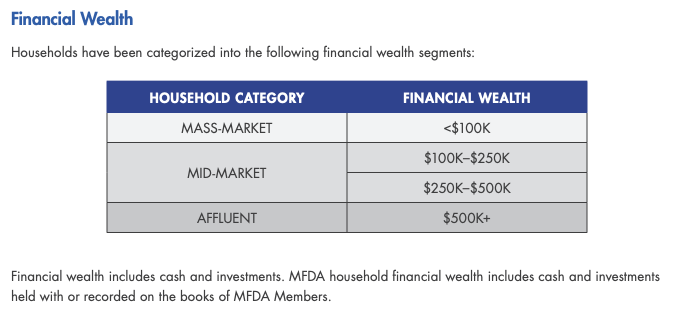
Next, it’s important to understand the level of wealth held by Canadian households. The MFDA Client Research Report also revealed that there are 16.2 Million Canadian households holding 4.4 Trillion in financial wealth.

Most households in Canada (79%) are mass-market households who own $100,000 or less in financial wealth (not exactly the target market for financial advisors). However, mass-market households only own 4% of the $4.4 trillion in financial wealth in Canada. Conversely, affluent households represent only 10% of all households in Canada but own 86% of the $4.4 trillion in financial wealth. Mid-market households represent 11% of all Canadian households and own 10% of total Canadian household financial wealth.

Wealth held by Christians

According to Pew Research published July 2019, 55% of the Canadian population consider themselves Christian. This would mean 2.42 Trillion of financial wealth is in the hands of Christians among 8.9 million households.

The research further shows that 33% of Canadians say that belief in God is essential to have good values. It is quite natural for clients to work with an advisor who shares their values. This would mean that over 5.3 million households in Canada would prefer to work with a Christian advisor; one having values based on a belief in God.

In the Investment Executive’s 2021 Dealers’ Report Card: The average advisor reported serving 206 households. This means that 26,500 advisors would be needed to serve the 5.3 million Christian households.

However, not all of these households are the ideal clients for advisors. The MFDA report showed that 79% of these households are mass-market, meaning they have less than 100k to invest and are therefore not the target market for advisors. The remaining 21% are mid-market (100K – 500k) or affluent (500k+), which is the target market for financial advisors (or 3.4 million households). This would mean that 1.87 million would identify as Christian (55%) and 1.12 million households (33%) would have values driven by their belief in God.

How many Christian advisors are needed to serve these 1.12 million households who say their values are driven by their belief in God? If we take the average advisor serving 200 households – a minimum of 5,600 Christian financial professionals are needed in Canada. To serve those who identify as Christian (55%), 9350 financial professionals are needed. (As a side note: it has been debated whether an advisor has the capacity to adequately serve 200 households effectively – the number is probably closer to 100 families, thus increasing the need for Christian advisors).

Certified Kingdom Advisors are Needed

The Christian market segment has specific financial planning and decision-making differentiators that are important in their selection of a financial advisor, based on their  religious/faith paradigms including: planning areas and common language, financial stewardship, debt, lifestyle, investing, charitable giving, estate planning and wealth transfer, generosity, and retirement planning.

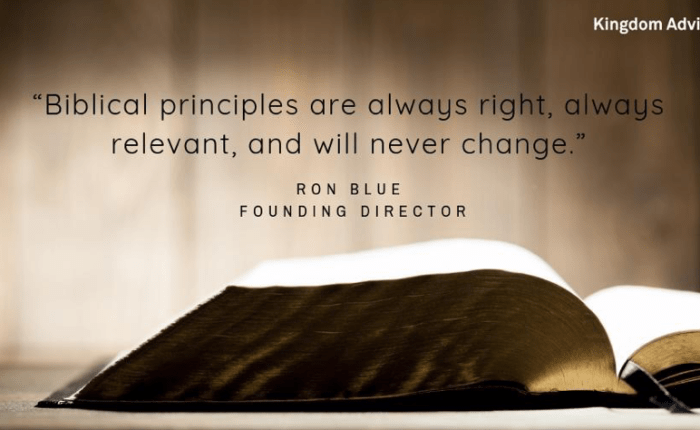
One of my mentors, Ron Blue, who is also the Founder of Kingdom Advisors, believes that “everybody’s advice and counsel comes from a value system. What I learned as a CPA and a Christian is that good advice has its roots in wisdom that is thousands of years old. I am applying this wisdom to decision making regarding money.” He also says, “There is a big difference between a Christian who is a financial advisor and a ‘Christian financial advisor.’ A Christian financial advisor integrates their faith into their professional advice.”

The CKA® designation is designed to build on an advisor’s base of technical competency and experience as evidenced by an approved industry designation, or a minimum of 10 years full-time experience in a specific financial discipline. The earning of the designation is a pathway for a Christian who is an advisor to become a Christian financial advisor. There is a significant need for sound financial wisdom in Canadian households, which can come through trained Christian financial advisors.

Financial advisors can learn more here: https://kingdomadvisors.com/

We Are All Discipled By Someone

We Are All Discipled By Someone

Bruxy Cavey, a teacher at The Meeting House recently said, “We are all discipled by someone,” and it really made me consider the truth of that statement, especially as it relates to my work in the financial industry. The sources of media that we subject ourselves to play such a significant role in shaping who we are as individuals and professionals.

Almost 30 years ago, in the Spring of 1991, I entered the financial industry. By the mid 1990’s, it was clear to me that if I was to build a career in this industry, further education would be important and I began the journey toward my Certified Financial Planner® designation. Continuing Education (CE) is a requirement in many professions today, and rightfully so, because things are constantly changing.

In order to maintain my CFP® designation, I have to earn a minimum of 25 CE hours annually. In essence, this means that my profession, or my designation, compels me to keep my knowledge current. The CE hours obtained means I fulfill my annual education requirement but, more importantly, it also means that I am being discipled by someone!

The Kingdom Advisors 2021 Annual Conference offers 18 hours of CE to financial professionals

Thus far in 2021, the instruction in the following verse has been challenging me:

Set your minds on things above, not on earthly things.

Colossians 3:2 CSB

The instruction in the previous verse is to “Seek the things above,” yet, we are living on this earth and we must stay current with the industry of which we are a part. We all choose the “someone” who disciples us; the twelve disciples accepted Christ’s offer. Today, as Christ-followers, we must choose who will disciple us.

I am so grateful for Kingdom Advisors because it exposes me to the “Christian Financial Industry” where I can choose to earn my required industry CE in the context of my faith! This helps me “set my mind” based on the “wisdom that comes from above” rather than “earthly wisdom” (James 3:15-17). When it comes to financial planning, much of the wisdom shared by professionals is earthly, even if they happen to be Christian. Earthly wisdom is defined by James as “unspiritual, based on selfish ambition…including envy” (3:15-16). The dictionary defines envy as “a feeling of discontent or resentful longing aroused by someone else’s possessions.” Catering to selfish desires is one of the easiest traps to fall into.

What I am instructed to do as a follower of Christ is to seek the things above and set my mind there. That’s not an easy task and will not happen without intentionality. When I do this, the result is that my advice will be based on the wisdom that comes from above –

“pure, peace-loving, gentle, willing to yield to others, full of mercy and good deeds, showing no favouritism and always sincere.”

James 3:17 NLT

Are you a Christian Financial professional? If so, where are you finding your required industry CE? Does it include wisdom that comes from above? Do you realize that where you obtain your CE actually disciples you?

I will earn 18 hours of industry CE by attending the Kingdom Advisors Annual Conference on Feb. 17-19 and the greatest bonus of these hours is the “wisdom from above.”

Register now for the KA Annual Conference because that wisdom is priceless!

Please use CONF21CANADA discount code when you register for 10% off.