The right word at the right moment is the Word4Now
Author: Lorne Robinson
I possess more than 30 years of progressive experience in public relations and serving others. In my present role as National Director at Kingdom Advisors, I have opportunities to engage with Christian financial professionals across Canada. My passion is to help people find a deeper purpose in their financial dealings and contentment with their lifestyle.
I read this statement in a devotional recently and was challenged with the thought. Paul David Tripp writes that:
Fellowship is God caring enough to put people in your life to encourage, rebuke and comfort you.
New Morning Mercies, Paul David Tripp (Aug. 19)
I’ve been in relationship with some people for many years now, which begs the question: “Why are these people (or this person) in my life?”
Tripp explains it this way:
“We cannot allow ourselves to have an owner’s view of our relationships, as if they exist for the sole purpose of our happiness. Our relationships don’t belong to us – They belong to God for his use, for his purpose.”
This changes our perspective – if we don’t own these relationships and they are not “about us” solely, there must be a reason, a deeper purpose. The unseen part of relationship is how they came to be and also why they came to exist.
If we take the “owner’s view” it means either we or the person we are in relationship with took the initiative to establish contact. This easily excludes God’s part in this relationship and means we can miss seeing his purpose.
My wife and I met while we were attending the same college. We take for granted our chance meeting at an airport in late April 1985 and then meeting again the following weekend in her hometown. This was the only weekend she was home because she was between semesters while attending university. That chance weekend meeting clinched my decision to attend the same university that summer where our relationship began to develop. The rest, as they say, is history.
Was this simply a series of coincidences, where each of us initiated our relationship to spend time together? Or was God more involved than we often give Him credit for?
I choose to believe that my relationships are an example of God caring enough to infuse people into my life for His use and His divine purpose.
One of the other life-changing experiences for me was joining the community of Christian financial professionals, known as Kingdom Advisors. It was a game-changer when it became clear that I didn’t have to separate my faith from my work as a financial advisor.
Here’s the advice from Kingdom Advisors:
“Don’t spend another day feeling divided between your faith and your career. Get certified by Kingdom Advisors and fully integrate your faith into your financial practice.”
I’m looking forward to connecting with advisors in a cohort this fall (meeting weekly starting Sept. 4th) to walk with advisors through 20 Modules of Core Training. This journey together will be a key to fully integrate your faith into your financial practice and continue to build God-ordained relationships.
I did have opportunity to watch some of the Olympics that just concluded and one of my highlights was Canada running in the men’s 4×100 Relay race. This was quite a surprise as the announcer shared: “They got the baton around the track faster than anybody else! With four men who didn’t have the individual clock speed here at these games. What a reversal of fortune for these men here tonight.” They did not medal in the individual races they ran, yet had the best time when they ran the relay.
The key to their success is how they worked together as a team and were able to win the gold medal, which they were unable to accomplish when running alone.
This reminded me of the Olympics 100 years earlier – 1924, long before I was born, but I have read and previously written about Eric Liddell. He was a devout Christian and missionary to China, who felt it a priority to run in the Olympic games. His sister felt that his training for the 1924 Olympics deterred him from returning to China as a missionary. I’m confident she saw his calling and work in life was being a missionary, not running. However, Liddell said, “I believe God made me for a purpose, but he also made me fast! And when I run I feel His pleasure.”
But when the timetable for the Games was released, the 100m heats were on a Sunday and Eric Liddell dropped a stunning revelation. The Christian Sabbath was the Lord’s Day and there was nothing in this world that could persuade him to run. Liddell’s decision meant he had to give up on his strongest event and switch his focus to the 400m. Instead of a straight dash to the finish line, this event required the stamina to maintain the pace around a full lap of the track, described at the time as the quarter-mile race.
Fellow Scottish athlete Tom Riddell said this longer distance exposed Liddell’s idiosyncrasies, but he could still rely upon that electrifying pace. Riddell told the BBC he had asked Liddell about his tactical approach: “In his own words he said, ‘Well, when the gun goes, I go as fast as I can, and I trust to God that I’ll have the strength to do the second half.’ And I think he really did.”
The truth is Liddell was running an individual race but he was not running alone!
We usually would not class running or involvement in a sporting activity as spiritual, or for God, but simply a physical activity. For Liddell, running wasn’t just a fun activity but a God honouring one.
The mistake we often make is in categorizing our activities, whether it’s exercising or working as a non-spiritual activity. We view our walking, running, or cycling as a physical activity and our work as secular. In doing so, we separate it from what is sacred, rather than sensing the pleasure of God in that activity.
Here is a great piece of advice: Whatever you do, do it enthusiastically, as something done for the Lord … (Col 3:23). The reality is that when we serve others (in our work), we are actually serving the Lord, not just men (Eph. 6:7). If we can say when we walk or work that “we feel His pleasure,” God is truly walking and working with us and through us. This adds a brand new energy to our efforts. When you work, you are not working alone.
It’s not original to me but here’s a great question and the best advice:
Don’t you realize that in a race everyone runs, but only one person gets the prize? So run to win!
As I went for a bike ride, my mind began to wonder about what I should celebrate, particularly on this Canada Day weekend!
It made me think about a question that was posed to me back in 2014, around the time I was making a very significant decision. I was a financial advisor with an established practice in Newfoundland, but was asked if I would consider working with Christian advisors across Canada. The question went something like this: “Is God calling you to work with your clients (in your home province) or is He calling you to work with financial professionals across the country?” We moved to Ontario in 2015, so that answers that question.
Two flags fly on my back deck, one from the province we still call “home” and the other is the country where I get to serve financial professionals who are interested in incorporating biblical wisdom in their advice to clients.
Seven things Kingdom Advisors can Celebrate in Canada:
The 113 Members of Kingdom Advisors who have been personally and professionally enriched by completing the Kingdom Advisors Core Training.
The 95 Financial Professionals who earned the Certified Kingdom Advisor® designation.
The 82 Active CKA®s in Canada searchable by Christians desiring to be served by an advisor who aligns with their personal values.
The 22 Champions – an exclusive subset of our members who are passionate about the advancement of this industry and are committed to investing their time, influence, and resources to accelerate its growth and development.
The 186 Active Members of Kingdom Advisors.
The 135 Redeeming Money Conference Attendees in 2024.
Living a Legacy
These are some of the numbers but what thrills me most is seeing advisors finding fulfillment and opportunities for ministry in their work. Let me highlight one of our CKA®s from Edmonton, AB. John Kok has shared his wisdom in a dozen churches (based on his recent newsletter). He recognizes the CKA® designation sets him apart as a financial professional, who has pursued faith/work integration to the highest credentialed level in the financial advising world. John shared at our Regional Event in Calgary this May and will lead the Charting Your Legacy Study starting Sept. 24, 2024.
John invited another advisor to the KA Regional Event this May and he already completed the training. Here’s Craig Jensen‘s feedback about the training:
“The one area of takeaway was the focus on prayer before every meeting. There were occasions when I would pray before meetings, but through this training, I have understood now on a higher level the importance of a prayer for every meeting and follow-up prayer. So, focused prayer is the biggest take away for me. I feel very blessed to have been introduced to Kingdom Advisors through John and I look forward to adding what I’ve learned to my ongoing discipleship with others.”
Advice for the Summer
Tim Jenkins is a CKA® from Peterborough, ON who published a blog entitled : Don’t Miss the Season to Create Exceptional Wealth. I would summarize it this way: The summer season presents the ideal conditions for creating (relational) wealth! Summer is when we take time off and our loved ones and relationships are not usurped by busyness. Let’s be intentional to become more wealthy this summer!
This is a significant month in my history – Nine years ago in April 2015, at the peak of my earning years, I left my role as a financial planner after 24 years.
In my last blog, I explained how God multiplied my business significantly in less than five years. A logical question is, why would I ever consider leaving a business that God had obviously blessed?
Journey
I find it so interesting how God uses little things to nudge us along the way. In April 2012, we visited our daughter in Calgary, AB. We attended Centre Street Church, then the book store after the service. There I discovered the NIV Stewardship Study Bible. I briefly looked through it and saw there was so much alignment with the Kingdom Advisors Core Training that I had studied in 2011. I decided to purchase it (USD $39.99) and proceeded to the cashier. I waited in line, then laid the Bible on the counter and took out my wallet to pay.
The cashier simply said, “That’s yours!” I responded by saying, “No, I just picked this up and am here to pay for it.”
She then explained how someone had donated this Bible with the understanding that whoever expressed an interest in it – it was to be a gift to them! I was completely shocked but couldn’t help believing that God was working through this somehow.
Interestingly, about one year earlier a pastor shared something with me (a “word from the Lord”) that I sincerely questioned. For me, this was one of those things that needed to be tested and confirmed, but I decided that rather than reject it, I would park it, then wait and see. It went something like this: “You are to leave the old word and God will give you a new word that He wants you to share.” The question that I struggled with was that I love God’s word so much; how could I leave any word that was God-given and so meaningful?
The Word – Stewardship
That first evening I had gotten my Stewardship Bible, I opened it to Genesis 50 and read such a powerful story. It illustrated even deeper what Joseph meant when he said to his brothers (in vs. 20),
“You intended to harm me, but God intended it for good to accomplish what is now being done, the saving of many lives.”
Immediately across from this verse was a story that came from the province that I was born and raised in and where I was practicing as an advisor for more than 20 years.
God Meant It For Good
Good things can come out of bad beginnings. The story of a fishing fleet that left a small harbour in Newfoundland and was caught in a terrible storm illustrates this point. The ships, caught in a storm, did not return home when expected, and during the night, the mothers, wives, and children of the fishermen, walked along the shore looking for some sign of their loved ones and praying for their safe return. That same night, one of the homes in the village caught fire and burned to the ground. When morning dawned, the entire fleet of ships sailed back into the harbour. Everyone rejoiced except the woman whose house had burned. She approached her husband in grief and said, “We are ruined! Our house and everything we had was destroyed by fire.” Her husband shook his head. “Thank God for the fire. It was the light of our burning home that guided the whole fleet into port.”
Ronald E. Vallet
Was it a coincidence that we were in Calgary and just happened to into the bookstore that day? What are the chances of walking into a Christian bookstore that exists to sell products and be given such a gift? Was God involved and using this event to lead me toward “a new word” which was clearly stewardship?
Living as a Steward!
I remember the day well. It was the end of my work day – I sat alone in the waiting area and just looked around at the reception area, my office, then the filing cabinet which represented my clients and the assets under management (AUM). I started to pray (out loud) and surrendered my business to God. “This is yours, Lord. It’s not my business, I surrender it to you. Please use this business for your glory.”
The overriding purpose of Christian stewardship is glorifying God. God was transforming my thinking – I was no longer the owner, I was only the steward. I was overcome with gratitude as I recognized how God had been active in my business to help me build meaningful relationships.
Today, as I continue to read my Stewardship Bible, I see how King David was “overcome with gratitude. His natural inclination was to give back to God and he longs to build a house for the Lord. But Nathan shuts down David’s enthusiasm” with a message from God:
“God reminds David that he has never asked for a house. In fact, God turns David’s offer on its head, announcing the he (God) will instead build David a house, establishing his throne forever.”
The Stewardship Bible, How We Give to God, p. 504
Reading this made me realize that what David desired was quite different than what God intended. It’s less about what we want to do for God and more about what He wants to do for us! When we completely surrender our business to God, our deepest desire shifts to running that business for God’s glory. Interestingly, it seems God turns our offer to Him on its head! Our work becomes an opportunity for God; He (God) works to build a business for us.
That my friend is the real key to business success!
In the past several weeks I have had multiple conversations with self-employed entrepreneurs who have expressed the urgency to focus on growing their business.
I completely understand the urgency and have been in the exact situation myself - fully focused on growing the business with little time for anything else. Based on my own experience, as long as my sole focus remained on growing the business, I was working hard and striving for success. I was doing all the right things like marketing myself, networking, asking for referrals and in general, working hard. None of these are really secrets to success, are they? They are simply the necessary elements we would immediately think about and without implementing, success would be extremely unlikely. All of these efforts gave me only a measure of success as a financial advisor.
However, it was only when I focused on incorporating God into my business that I truly came to reach a level of success that I desired and at a rate of growth that I had never thought possible. In the last 5 years that I was a practicing advisor, my business grew by more than 1200%.
As I look back, this business success happened only when I began to invest some of my time away from the typical business opportunities. I started a training course that gave me a different perspective, namely that God was more interested and involved in my business success than I realized. Somehow, I was convinced that my own efforts had brought me this success, but then again, I wasn’t the first to come to that conclusion. God reminded the Israelites how He fed them manna and cared for them in the wilderness because He knew they might want to take the credit for their prosperity.
You may say to yourself, “My power and the strength of my hands have produced this wealth for me.” But remember the LORD your God, for it is he who gives you the ability to produce wealth, and so confirms his covenant, which he swore to your ancestors, as it is today.
Deut. 8:17-18 NIV
Despite this verse being underlined in my Bible, it was far too easy for me to emphasize the part I played in this success, and in so doing, diminish the role that God played in it. Sure, my ability played a part, but who gave me the ability? While my training, education, sales skills had to be developed, ultimately it was God who had positioned me in this role to start with. He had opened the opportunity to be trained in this field and I certainly would not have chosen this path on my own.
The global financial crisis of 2008/2009 was a time of profound soul searching for me but was very pivotal in my journey. It led me to a deeper study to earn my CKA® (Certified Kingdom Advisor®) designation which helped me understand God’s activity in my business.
The result: first, surrendering the ownership of my business to Him, then second, my striving diminished as He grew the business. Maybe that’s exactly what John meant when he said, “He must increase but I must decrease” (John 3:30).
For the record, the S&P 500 did increase in value from 2010 – 2015 by 92%, so this does account for some of the growth in business. The remaining 1100% growth that occurred in less than 5 years is much more than I could have ever accomplished unless I decreased and He increased.
When you receive your income on a weekly, bi-weekly or monthly basis, it is important to set priorities around the use of these funds. In my study of biblical financial principles I have discovered there are only five things that you can do with money. These are listed here based on rhyme rather than priority:
Live (lifestyle varies depending on personal decisions around spending)
Give (determine to live a generous life)
Owe – repay what we have borrowed which is really an extension of our lifestyle
Owe – taxes (for most, this is an automatic deduction from pay)
Grow – saving for a future goal (education, major purchase, retirement, etc.)
As a simple budget practice, it is helpful to calculate the percentage amount that goes to each of these five areas; however, the big question becomes, “In what order should funds be allocated?” What is the foundation for setting these priorities?
For the Christian, the Bible is to be our guide in life and there are 2350 verses referencing money and possessions. Thankfully, many have researched these truths and can help us determine what our financial priorities ought to be.
In his book, Financial Discipleship for Families, author Brian Holtz shares five priorities based on biblical wisdom.
Priority 1 –Giving Generously: Righteousness is associated with generosity in Psm. 37:21 which states, “The wicked borrows but does not repay, but the righteous is generous and gives!” Jesus emphasizes in His Sermon on the Mount to, “Seek first the kingdom of God and his righteousness, and all these things will be added to you” (Matt 6:33 ESV). Do we seek His kingdom first in our financial decisions? Or are we more focused on adding the the things?
Priority 2 – Providing for Family Needs: The Apostle Paul instructs readers in 1 Tim. 5:8 to “provide for their own family and especially for a member of their household …” (CEB). This directive to care for our loved ones tends to come naturally, and for many it is the top priority.
Priority 3 – Meeting Financial Obligations: Again, the Apostle Paul in Romans 13:7-8 gives the instruction: “pay your taxes and government fees and … owe nothing to anyone – except for your obligation to love one another” (NLT). Holtz says, “After giving and providing for the basic needs of our family, we need to prioritize the various financial obligations we have made.” Paying taxes with gratitude for the income earned can be challenging at tax time and paying off debt can feel burdensome, but is an obligation.
Priority 4 – Saving for the Future: Proverbs 21:20 gives clear guidance to save for future needs which maybe unseen or unknown in the present. It reads, “The wise have wealth and luxury, but fools spend whatever they get.”
Priority 5 – Enjoying God’s Abundant Blessings: When Paul mentored Timothy, he told him to “Instruct the rich… not to be conceited or fix their hope on the uncertainty of riches, but on God, who richly supplies us with all things to enjoy.” Clearly, it is God who gives us these things with purpose – enjoyment being one, but this is not necessarily the top priority. He continues the instruction reiterating priority 1, which is to use what we have been given “to do good, to be rich in good works, to be generous and ready to share” (1 Tim. 6:17-18 NASB).
Our natural tendency is to order our financial priorities like this:
Priority 2 – Providing for Family Needs
Priority 5 – Enjoying God’s Abundant Blessings
Priority 3 – Meeting Financial Obligations
Priority 4 – Saving for the Future
Priority 1 – Giving Generously
The Kingdom Advisors theme for February focuses on priority 1 and the giving process. Chris Gabriel says, “Giving is a superhighway to the soul. Christian advisors can be agents of redemption in the area of generosity and giving.” As agents of redemption, we are called disciple and help others shape their financial priorities based on biblical financial wisdom.
Questions to consider:
Have you ever calculated what percentage of your income goes to each of the five uses of money?
Are the financial priorities for Christians any different than non-Christians?
How would you personally rank these five priorities?
Which of these priorities presents the greatest challenge for you?
Do you need to make adjustments to your financial priorities?
Have you ever asked a question even though you knew the answer? This is a common technique used when engaging with children or grandchildren. It’s a great way to help them think about a situation they find themselves in and how they ended up there.
Similarly, sometimes we ask the question “Where are you?” even though the answer seems obvious.
In life, we all have moments where we wish we could make a different decision. Maybe you’ve been there too.
When God asked Adam and Eve, “Where are you?” it wasn’t about their physical location but rather their proximity to Him! It wasn’t about making them feel guilty for their mistakes, or even how their choices was a failure to trust Him when tempted.
It’s easy to get stuck dwelling on our past mistakes and the resulting consequences. But what’s the point of that? The mistake is behind us, and we can’t change it. Instead, we should focus on where we are now and where we want to go. After all, mistakes are just detours on the journey to our true purpose. Let’s not allow them define us or hold us back.
I am reading through the Bible this year and just finished the story of Joseph. If anyone in life was shifted off course, it was Joseph. Having a dream (at age 17), being sold by his brothers, then elevated to a position of authority only to be falsely accused of sexual misconduct, thrown in jail and eventually becoming the second in command in all of Egypt (when he was 30). Where was Joseph? That’s 13 years of utter turmoil when Joseph went from a pit to prison, yet had success even in the darkest times.
Where are you? This simple question has a deeper meaning than just location. It’s an invitation to reflect on where you are in life and where you are meant to be. Taking time to reflect on your relationship with God and your life’s purpose can lead to powerful transformations. Don’t underestimate the power of this question and the impact it can have on your life.
Can you just imagine the scene where Joseph’s brothers meet him 15 years later after causing so much pain and disruption in his life? He is now in a position of authority above all of them. This turn of events likely left them in shock and fear.
What amazes me is “where” Joseph was … not in his position, but in his perspective. Joseph explains to his brothers that yes, “you sold me here” but more significant is the fact that “God sent me before you to preserve life” (Gen. 45:5). Joseph recognized that every difficult situation he faced had a greater purpose than he realized at the time. His story reminds us that our perspective can be more significant than our position.
So, where are you right now? Instead of just naming a place or position, we should consider our proximity to God and the work that He has prepared for us to do. Let’s focus on our perspective and trust that every step we take, even in difficult times, is leading us towards a greater purpose.
As we start another year, the Apostle Paul offers very clear instruction:
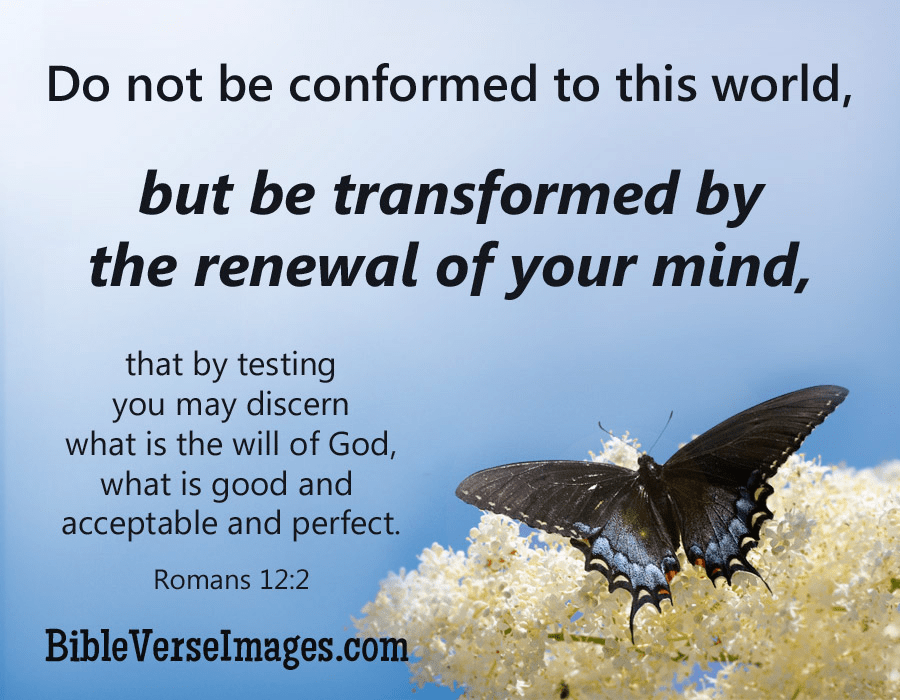
“Do not be conformed to this age, but be transformed by the renewing of your mind, so that you may discern what is the good, pleasing, and perfect will of God.”
Romans 12:2 HCSB
Written so long ago – how do we apply this in our day? No doubt it is much easier to conform to this age because it takes more of an effort to be transformed. It takes intentionality to be transformed because what comes naturally is being conformed to what is around us (this age or the world around us).
The renewal of the mind is the key, meaning we must intentionally have things enter our mind to bring transformation. This begs the question: what is entering our minds? What we read, listen to, watch or in essence, what we consume on a regular basis shapes our thinking.
A deeper question then becomes: What is the source of the things we consume (what we read, hear and watch)? Clearly what Paul is saying here is that the source of what we consume is more important than we might realize because it determines if we are conforming to this age or being transformed! Transformation happens only when the mind is renewed by a source other than “this age.”
It is vital for every Christian to “be transformed” because it is only then we become capable of discerning “what is the will of God, what is good and acceptable and perfect” in every aspect of our lives.
Let’s practically apply this in our finances: If you receive an increase in your annual pay for the next year, what will you do with that increase?
The most natural response is to increase your lifestyle, since you can now afford it a little better. You can also choose to pay down debt, or save this amount for a short or long term goal. Another option would be to give some or all of this pay increase to a charity of choice. I’ve listed these in this order based on two things: the first being my experience with clients as a financial advisor, but secondly on “this age” which typically shapes our financial decision making. You will likely agree that it is “this age” that influences the choices we make.
Let me echo the instruction of Paul here: “Do not be conformed to this age” or as it relates to our finances, do not increase your standard of living, “but be transformed by the renewing of your mind,” meaning our thinking is changed, even reversed, so we choose to increase our standard of giving.
God prospers me not to raise my standard of living, but to raise my standard of giving.
At this time of year I feel extremely grateful – Serving as the National Director for Kingdom Advisors in Canada is not only a privilege but a living out of one’s calling. To be able to connect with so many high quality and generous financial professionals across this country is humbling – I could never have imagined this 10 years ago.
I just glanced on LinkedIn this morning and saw posts from two of our Kingdom Advisors Champions – between them 1200 families were provided food for Christmas! That’s just two of more than 200 generous Kingdom Advisors in Canada! Why is this happening? I recently watched a message by John Rinehart, who shared how “Those whose hearts were stirred freely gave” (Exod. 35:21). He explained that the greatest ingredient in generosity is the Spirit’s stirring of our hearts.
There is a difference between God’s economy and man’s economy: the first is about giving and receiving, while the latter is more about buying and selling. It’s exciting to work with Christian financial professionals across Canada and see the transformational work of God moving them toward a focus on His economy. This is where the goal of our work and business goes beyond making money to loving and glorifying God by serving others with the gifts and talents He has given to us.
If you are stirred to help us continue to grow and engage more advisors with the life-changing truths of biblical financial advice, you can donate to Kingdom Advisors in Canada using this link. A big thank you to those who have already given this year!
One of the highlights for me this summer was to do something that I hadn’t done for many years – perform the wedding ceremony of Kyle & Natalie – a most meaningful event for any young couple starting on their life journey together.
As part of the ceremony, I read from Ecclesiastes 4:9-12
Two people are better off than one, for they can help each other succeed. If either of them falls down, one can help the other up. Though one may be overpowered, two can defend themselves. A cord of three strands is not quickly broken.
Eccl. 4:9-12 NLT
The focus of these verses demonstrates the benefit of two people being together, which is a great image of marriage. The end of the reference is adjusted to three when it refers to a cord or rope of “three strands” being not easily broken. This too, is a beautiful picture of marriage because it includes God – clearly adding extra strength to the bond.
At the ceremony, I shared how a rope of three strands is 50% stronger than a double stranded rope of the same diameter. It is also much better at resisting shock. In reality, life can throw us some curve balls so having one another and God will help sustain us whatever comes our way.
This ultimately illustrates that when we enter into the marriage covenant by saying “I do,” God truly enters into covenant with us!
About a month before the wedding ceremony, I read a devotional by Paul David Tripp which did not refer to marriage specifically but defined how God covenants with his people. I thought it was quite appropriate to share this during the ceremony:
Today you covenant with one another before God, but on this day God also makes a covenant promise to you that is sure & reliable!
Words to Kyle & Natalie on August 12, 2023
You have been granted all that you need, to be what God has called you to be and to do the things that God has called you to do in the place where he has put you.
So here’s how it works. God has promised to supply and empower; your job is to follow him by faith where you live every day. You don’t wait for provision before you move. God has not promised that you will see it beforehand. You don’t try to figure out what God is going to do next and how he will meet your needs; you move forward in the certainty that he is with you, for you and in you. This God of awesome power will grant you power to do what is needed. This is his sure and reliable promise to you.
Paul David Tripp, New Morning Mercies, July 6
It was my privilege to be the first to introduce Mr. & Mrs. Kyle & Natalie Davis.








 Lorne Robinson's Blog