An Investment That Sets a Course

My great friend, Brad recently posted this comment regarding a youth event I had organized: “25 YEARS AGO…probably the first youth camp at which I taught in the mornings. I was 21. The investment in me back then set me on course for where I am today. Thanks Lorne.” Wow, reading this makes me realize that you should never underestimate the impact you can have on a person’s life, at times without even realizing it.

Foundation '92 Poster copy

The impact of holding a Christian Music Festival in Newfoundland was far reaching and maybe only eternity will reveal its true significance.

At that time, I felt like I was living two separate lives; one where I was starting my career in the financial services industry, the other referenced above, was more ministry focused. My goal was always to do my best to fulfill “the call” and purpose in life. Believe me, I thought much about “the call” to be a pastor, and many who have heard me speak have said, “You missed your calling” (because I am not a pastor now). Consider this: a calling is more about who we are to become rather than a particular job we do. Allow me to explain: I always considered 2 Timothy 4:2, “preach the word, be ready in season and out” as “my call.” Naturally, that meant becoming a pastor/preacher. However, it is important to consider the phrases that follow: endure hardship and fulfill your ministry. So during those years, I, in fact, endured difficult challenges and actually fulfilled my ministry by proclaiming biblical principles when in my office or a client’s home without even realizing it many times.  My job title (financial planner) did not limit my ability to fulfill my call but actually created different opportunities that I otherwise would not have had.

Ken Boa writes, “Here’s one of the biggest paradoxes of the Christian faith … being is more important than doing and must precede it.” So the doing, (of our work in life) must flow out of our being (character).  Don’t compartmentalize your life by separating who you are from what you do. When I viewed my life like this, I was most miserable.

It is always interesting to walk with someone on their journey in life. If you fast-forward to the present, I have now been able to merge my background as a financial advisor and ministry into my role as the National Director (Canada) for Kingdom Advisors. It is very exciting to find financial professionals who sense a call to the work they do everyday with their clients.

We are all on a journey toward significance. I could never have realized at the time that investing in Brad’s life would yield such dividends.  He has since been instrumental in the lives of hundreds, maybe thousands, so the investment is worthwhile.  It is important to realize that no matter what career you may be in, that sense of calling is key because it will help you seek out opportunities to invest in others and fulfill your ministry.


Sacred Call to a Secular Work

There are so many choices and opportunities when it comes to a career. It seems that “calling” is required to be a pastor or missionary, but not necessarily for a businessman,  fireman, teacher, lawyer, doctor, etc.

Let my experience provide some deeper insight: As a teenager, I felt a “call” on my life and the best way I could interpret it at the time was to become a pastor. My response was to attend Bible College and I recall during my first year having my Bible open to 2 Timothy 4 and I read daily, “Preach the word; be ready in season and out of season … endure hardship, do the work of an evangelist, fulfill your ministry.”  I entered full time ministry in 1986 and felt like I was living out the sacred call on my life. Just 3 years later, I was invited to be youth pastor in a church, but never had the opportunity to do so since that church split! This was a major crisis for me (maybe the part of my call to endure hardship), which eventually led to my accepting a job selling life insurance (a secular work). My passion was to continue serving in church ministry but I needed an income, so the job provided financially.  I continued volunteering in church ministry which led people to draw a comparison to Paul making tents while his “calling” was to declare the gospel.

In my last blog I stated, “The mistake we often make is in categorizing our work as secular, separating it from the sacred, rather than sensing the pleasure of God in our work.”

missed callMy perspective was that my work as a financial advisor was not necessarily a “calling” but just a job (secular), while my “calling” as pastor was my true work (sacred). Can you sense the inner turmoil I was feeling? Had I missed my “calling” or was it possible that I could actually live it out by being a financial advisor? Did I have the wrong perspective to start with? Should I have even separated the two – the sacred and the secular?
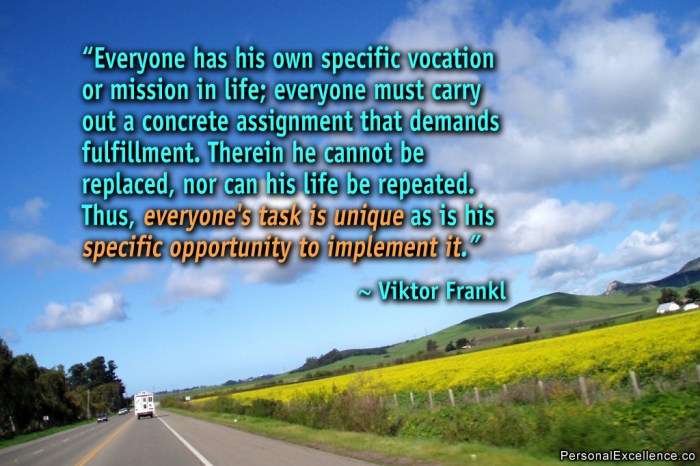
Reflecting back on the 2 Timothy 4 reference, as a financial advisor, I certainly felt “out of season” when it came to being able to “preach the word.” However, another translation (HCSB) instructs “proclaim the message” which sheds a different light on that phrase.  The reality is I had many opportunities in my secular work to fulfill the sacred call. The “proclaiming” was different than I ever thought it would be because life was not the way I had planned it.

One client later confirmed, “You have more of a ministry here in this office (as a financial advisor) than you could ever have in a pulpit (as a pastor).” This helped me realize that the calling I felt was not limited to a particular role that I would have in life.

Calling QuoteSo whether I do the work of a pastor, financial advisor, director, bus driver, or teacher, you get the picture, the important thing is to be a good steward and be true to that call.
The right perspective: Your secular work is definitely connected to your calling and becomes the perfect opportunity to “fulfill your ministry!”

Have you made the mistake of separating the secular from the sacred? Are you fulfilling the uniqueness of your calling?


Why Do You Work? Why Retire?

My last post created a great deal of interest because it dealt with the question: “Do you go to work or to a job?” One response received was, “In two weeks I will go to neither,” meaning the reader would be retiring.

This set me to thinking further about what I stated: “It is only when you do what you were born to do will you really find fulfillment.” In reality, you can be paid to do a job and once you complete it, then you either move on to something else and/or you retire. This is where I believe your work (what you were born to do) is different than your job (what you are paid to do). Why would you ever want to stop doing what brings you fulfillment? If you were born to do something, when should you cease doing it? In other words, why retire?

In some cases, it may make sense financially to retire. Maybe you qualify for a full pension and working longer is not necessarily increasing your retirement benefits anyway. So why continue working? When I started working, it was partially out of necessity. The need for income and supporting family is a valid reason. With my children raised, my reason for working has shifted; now work is more about purpose.  I know several people who can easily retire from their work, yet they choose to continue.

eric liddell

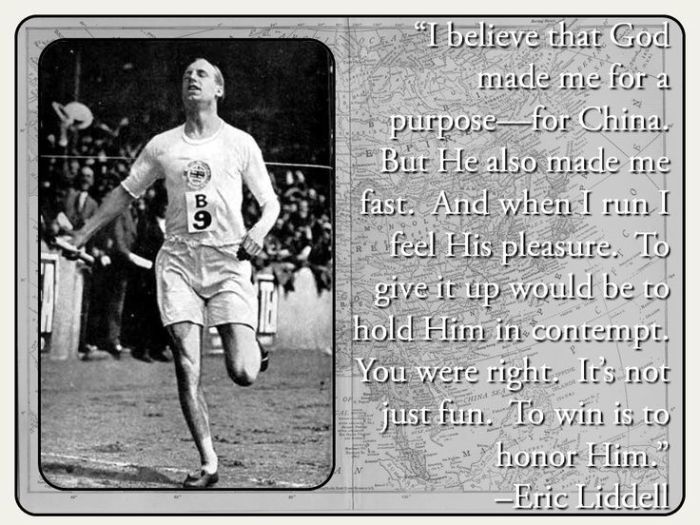
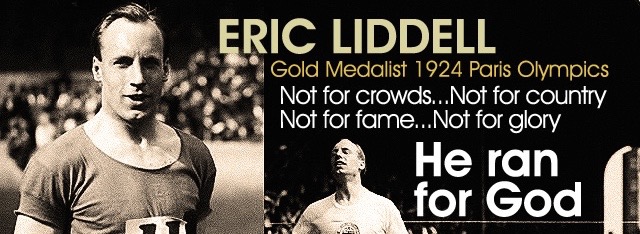
Consider the life of Eric Liddell, a devout Christian and missionary to China, who felt it a priority to run in the Olympic games. His sister felt that his training for the 1924 Olympics deterred him from returning to China. He said, “I believe God made me for a purpose, but he also made me fast! And when I run I feel His pleasure.” We usually would not class running or involvement in a sporting activity as spiritual, or God honouring, but more a physical activity. For Liddell, running wasn’t just a fun activity but a God honouring one.

You cannot argue with a person’s experience; Liddell was passionate about fulfilling God’s purpose for him (missionary to China) yet he ran to honour God and feel His pleasure. For Liddell, the line between secular and sacred was erased.

eric olympic gold

The mistake we often make is in categorizing our work as secular, separating it from the sacred, rather than sensing the pleasure of God in our work. Here is a great piece of advice: Whatever you do, do it enthusiastically, as something done for the Lord … (Col 3:23). The reality is that when we serve others (in our work), we are actually serving the Lord, not just men (Eph. 6:7). If we can say when we work we feel His pleasure, it will be most difficult to retire from that work.

Speaker and author of “The New Retire-mentality,” Mitch Anthony says, “Don’t retire from something but retire to something.” We are all born with purpose and if you are at the retirement stage, remember it can be a great opportunity to feel His pleasure!


Do You Go to Work, or to a Job?

This question is worth thinking about more than you may realize. Your job is what an employer pays you to do, your work is what you were born to do. There were times that I simply did not enjoy my job and I sought after another that would bring more fulfillment.

“The two most important days in your life are the day you are born and the day you find out why.” — Mark Twain

You may argue that a job and work are much the same because they can both provide a source of income, but I believe it is only when you do what you were born to do will you really find fulfillment.  Chuck Colson was once asked, “If there is one piece of advice you could share, what would it be?” His answer was: “Do only what YOU can do.”  That statement is worth some deeper thought and can make you realize that there is a creativity within all of us to do something unique.

Never work another day

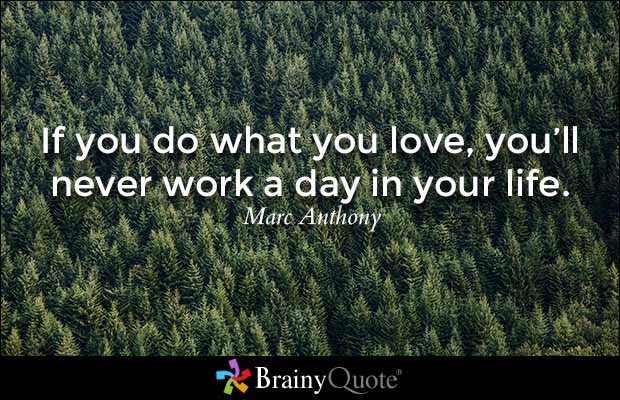
Never working another day in your life is not just a dream then, but maybe it is discovering what only you can do. Your work is more than a job; it is actually more about purpose and utilizing your gifts.

Dallas Willard suggests some distinctions:

  1. Job: What I am paid to do, how I earn my living
  2. Work: The total amount of lasting goods that I will produce in my lifetime

“Lasting goods” is our impact on others, what we leave whether financial, spiritual, moral, emotional etc. What “lasting goods” is my life producing? This is the question that should help us in decisions regarding our work.  Interesting that Jesus acknowledged to the Father, “I glorified you on earth by finishing the work that you gave me to do” (Jn 17:4).  If you consider his time on earth, Jesus had a job as carpenter, but he recognized even as a child, that his work was to be about his father’s business (Lk 2:49).

It is easy to conclude then that his job was just how Jesus earned his living (likely from age 12-30), while his true work was his years of public ministry (just 3 years). My immediate thought from this verse is that Jesus glorified God in his ministry years, for the most part, especially by his sacrifice on the cross. However, do we make a mistake when we separate the years of his life like this? The fact is that Jesus glorified God on the earth, period. Dr. Klaus Issler concludes,”I think we can infer from his messianic work, that Jesus also gave this same kind of excellence to his job as a builder.”

My conclusion: you need to fulfill your work, and your job may help you do that.

Here is what Steve Jobs said: “Your work is going to fill a large part of your life, and the only way to be truly satisfied is to do what you believe is great work. And the only way to do great work is to love what you do. If you haven’t found it yet, keep looking.”

Remember This Bic Pen?


Bic Pen

When I see a pen like this I can’t help but think about the unforgettable trip to the Newfoundland ferry with my youth group in the early 1990’s. I was a youth Pastor at the time and responsible for the youth in the 4 car convoy on the road that night en route to a youth conference in Nova Scotia. Until that night I had no idea how impactful the uniqueness of a Bic pen could be.

The lead car drove over a large chunk of ice that had fallen from a  tractor trailer and the car was lifted with the impact.  This resulted in a break in the fuel line, and gasoline started to pour from the severed line at an alarming rate. The fear of running out of gas was immediate as the gauge quickly moved toward empty. With little time to spare before the scheduled ferry crossing, sure enough, the car ran out of gas, but fortunately we were very near a service station. 

The empty tank was no longer an issue because gas was now available at the station, but at that hour there was no mechanic to repair the leaking gas line.  After analyzing the situation, the gas attendant took a Bic pen, removed the refill, and fastened this between the break in the gas line, allowing the gas to flow through, temporarily stopping the leak.  Wow! This was definitely thinking outside the box. We made it to the ferry on time and made the permanent repair the next day after the overnight ferry crossing.

It is logical to assume that the purpose of the pen is to write, to have ink flow through it on to a document. We have all used a pen in this manner, maybe to sign a legal document or to write a letter. 

There were several pens on the countertop that night; one was used for me to sign making payment for the gas and the temporary fix. Up to that point, the Bic pen was the same as any other that was in the service station, but on that night, this pen served a purpose that not one of us could have actually imagined.  Ink is what flowed from the pen up to that point, but on that night gas flowed through it. The pen served the role of gas line temporarily, a completely unique function for a pen.

I realized something about purpose that night: What flows through you really defines you and determines your destiny. We are all made unique with a specific part to play in the lives of others. How important is it for you to fulfill what you were meant to do in this life? What is flowing through you that helps to bring you meaning?

Proverbs 19:21 speaks about purpose this way:  You can make many plans, but the LORD’s purpose will prevail.

The Value of a Birthday

The Value of a Birthday
lorne6
In Baie Verte, NL (Age 6)

When I awoke this morning, I first checked my messenger app, awaiting a message from my son when in fact, there was a message from an acquaintance that I normally do not communicate with at all. It was a prayer request regarding ISIS who has taken over Quaragosh, the largest Christian city in Iraq. Hundreds of men, women and children are being beheaded. I pray for those caught in the middle of this terrible atrocity.

Then I went to my twitter account and looked at the top story of the year from LifeSiteNews and was intrigued by the headline: He performed 1,200 abortions. In new viral video, he wants you to see what abortion really looks like.

“Well it’s time to shave and get on with the day,” I said to myself. As I looked in the mirror,  I could not help but think of the value of life and reflect on my own life, especially with this being the last day of another year, and another birthday for me. As I removed the stubble from my face, I recall my parents telling the story of my bout with meningitis when I was 5 and the doctor’s warning that if I survived, I would have permanent brain damage. My Dad told how he stood in the corner and prayed todickjane God that he could never preach again a message of healing if I did not survive. After being told it was no point to return to see me for 48 hours due to the medication, they returned the next day anyway and were told by the nurses that there seemed to be a miracle. I had come out of my unconscious state and had to be restrained due to my activeness. I knew my parents and could read all about “Dick and Jane” in my Kindergarten reader.  

I grew up believing my life had meaning and purpose, beyond just getting a job and making money. Life for me was more about impacting others. Jesus said, “I must preach the kingdom of God … for I was sent for this purpose.” Not that I could ever compare my accomplishments to Christ, but all of our lives have significant purpose.

Back to Twitter – Ken Boa tweeted: “As we develop an eternal perspective we treasure the passing opportunities of this life and become more alive to the moment, not less.”

As we enter 2017, may we all realize that we were given days on this earth and opportunities in every day. Here is my prayer: “Let the favour of the Lord our God be upon us; and (give permanence to) confirm for us the work of our hands” Psalm 90:17.

The Value of Community

As the National Director of Kingdom Advisors in Canada, one of my goals is to bring Christian financial professionals into membership. With this drive for memberships before the end of the year, I have been talking much about the benefits. These include new study group content monthly, regular teleconferences, Core training to equip advisors with biblical financial advice and wisdom in practice management.

Last week, I had a conversation with a long time friend, Melvin, about his membership renewal and he talked at length about his 2-year-old granddaughter Isla. She was diagnosed with cancer a year ago, had recently been doing well after lengthy chemo treatment, but last week took a turn for the worse.

islaAfter more testing and scans, it was discovered she had two tumours on her brain. This past Thursday, just as Melvin was arriving home, his son Michael (also his partner in his practice) called saying,“Isla may not make it through the night.” Michael asked his Dad if he could call as many as possible to prayer. Within an hour, more than 100 had gathered to pray at the church. Isla did make it through the night, is now back on chemotherapy, and Melvin told me, the tumours are shrinking. This has been a roller coaster ride for them.

Back to his membership, Melvin said,“I just do not have the time right now to be engaged with Kingdom Advisors, but I would like to continue membership because I want to be connected to people who pray.” So the value Melvin feels he has received is through prayer support, not the tools and resources I was promoting, at least not right now.

It has made me realize that one of the greater values of Kingdom Advisors, or any organization for that matter, is Community. We can support one another, not just with great ideas, but also by simply being supportive of one another. Prayer is a means of connecting with a higher source and having at least two or three agree is truly important.

There are likely other members of Kingdom Advisors and other persons that we are presently in community with that are facing a similar challenge this Christmas. Let us pray one for another. I would like to take this time to wish everyone a blessed Christmas season. May the peace that passes all understanding be yours!


How Churchill Advised The Queen

How Churchill Advised The Queen

the-crown-netflixWe recently watched the new series “The Crown” on Netflix. It is a drama series that chronicles the life of Queen Elizabeth II.  It is quite amazing how the cast resembles the people we have watched for decades in different forms of media.

While we may not know if many of the scenes or words spoken are all exactly true, I found some advice Winston Churchill gave the young Queen to be very interesting. As she was leaving on a flight to tour some countries in the Commonwealth, he instructed, “Never let them see the real Elizabeth Windsor. The cameras, the television; never let them see that carrying the crown is often a burden. Let them look at you but let them see only the eternal.”

Churchill was telling her that although people will look at her, she must determine what she lets them see. In essence, the Queen needed to represent the crown more than herself. Her priority was to put the interest of the crown ahead of her own delight. This entails self-denial, sacrifice and service for the higher purpose of the crown. Churchill instructed the Queen to display the eternal, or higher calling.

We are seen everyday by others but what do we let them see?

While we may not live the life of a Royal, we all have choices to make about how we are seen by others. We all have opportunities to “let them see only the eternal.” We try to be at our best when we have an important meeting, but are we intentional about who we represent? For the Queen, she was called to represent something that existed before she was even born.

The fact is eternity is set within the heart of each of us, even commoners, and whether we recognize it or not, we are all representing something greater than ourselves. That also means there is a grander purpose in the conversations we have than we realize.

At times, I have felt my life lacked meaning and purpose. However, I now know that during those times, I failed to recognize the eternal in my day-to-day life. It is too easy for us to become focused only on the routine of the day and overlook the opportunities to have an impact that is eternal. Consider the words you share and the advice you provide to others. In many cases it has a greater impact than you realize.

The Family Meeting After 30 Years

Processed with VSCO with m5 presetThis past month, Cathy and I celebrated 30 years of marriage. Over the years, we have gathered the family together for a specific purpose but in October, we had a meeting that focused on inheritance. This idea came from a book by Thomas Deans called Willing Wisdom, where he suggested a family should have this type of meeting every year. I saw this intentional time as an opportunity to pass wisdom to my heirs before the time of any type of wealth transfer.

It felt a little awkward at first and I figured that my kids would just see this as another of Dad’s crazy ideas. I have heard it said it is inevitable that there will be a family meeting where your financial affairs are discussed. However, it is up to you whether you will be alive to attend. I have determined to be there; the discussion time is valuable and the conversation will deepen if this happens yearly.

To begin, everyone was asked to share a word to describe our family and then an example of why that word was chosen. The answers received are a testament of our family dynamic: fun-loving, unique (in family discussions), accepting (it is ok if we disagree), supportive (of each other), in tune (connected to each other) and confident. Hearing these words was encouraging and a result of our investing in the lives of our children. It was like a reward for 30 years of marriage but we are not done yet. We must continue the family communication in order to finish well what we have started.

Keith Costello, president and CEO of the Canadian Institute of Financial Planning (CIFP) recently wrote about the great wealth transfer. He stated, “Baby boomers will inherit $750 billion over the next several years in the largest-ever transfer of wealth in Canada, estimates a recent report from Toronto-based Canadian Imperial Bank of Commerce (CIBC). Specifically, the report suggests that 2.5 million Canadians over the age of 75 have a total net worth of $900 billion or more — and the beneficiaries of this wealth will be Canadians aged between 50 and 75 years old.”

The most common approach for wealth transfer is to divide the inheritance equally among heirs but the challenge is to also ensure an appropriate distribution of wisdom to equip our heirs to properly manage this wealth. I recently spoke to some friends about my children having grown and matured. With sarcasm, I stated, “They grew up to have their own opinions that are not the same as mine.” The reality about our children is they will likely have different priorities than their parents, which is the reason family meetings are so important. Finishing well involves successful transfer of wisdom before any wealth transfer.

As a steward of all that has been entrusted to me, I feel responsible to prepare the next stewards to manage anything I may leave them. An annual family meeting where probing questions are posed can help the next generation connect with the values and plans that guide financial decisions.

Some examples of questions that will create discussion and reveal values are:

-What are your dreams? How would receiving an inheritance impact your dreams?

-What did you learn from your parents about money and generosity?

-How should each child be treated: equally or uniquely?


Leaving An Inheritance

inherit

As my wife and I went for a walk last evening, we spoke of our grandparents (all now deceased) and then our great-grandparents. In particular, we spoke of how little we know beyond two generations. We then talked about our grandchildren (not yet born) and great-grandchildren, wondering how much impact we will have on them.

Proverbs says, “A good man leaves an inheritance for his children’s children.”

On this subject, Larry Burkett wrote this: “If I had to identify the area of Christian finances that is least understood, it would be inheritance. Not only do people wreck their lives by hoarding, but they also wreck the lives of their children and grandchildren with abundant inheritance.”

In ancient times, an inheritance was often necessary for survival. Land being passed down was essential to provide food for the family. Today, an inheritance can be like winning the lottery or a windfall because, in many cases, children are making more money than their parents ever did and are often financially independent.

Ron Blue said, “Wealth never creates wisdom. Wisdom may create wealth. If you pass wisdom to your children, you probably can pass wealth to them. If they have enough wisdom, then they may not need your wealth.”

When we think about inheritance, we usually think wealth. In considering wealth and wisdom, which offers the most value? And which is most difficult to pass to the next generation? Since wisdom can create wealth, it seems logical that it is more valuable than wealth itself. Since wealth without wisdom has the ability to wreck the lives of our heirs, we must consider how best to pass on wisdom prior to passing on wealth.

All of our adult children are planning to be home for the Thanksgiving weekend. They will enjoy Mom’s home cooked meals and endure my Dad jokes while we play games, have a bike ride and go for a beautiful fall walk through the park. I cherish these times together, not just to make fond memories, but I am realizing these times are occasions for discussions where wisdom can be shared. So I am going to be deliberate and intentional about a family meeting in order to learn more about the basis of our values.

Having worked in the financial industry for 25 years, I know the conversation about finances is personal and private, yet these dialogues are so essential. I have some specific questions to ask that will probe deep into the hearts and minds of all of us. I plan to share these questions and the importance of a family meeting in my next blog.

Will you spend this long weekend with your family? What important discussions will you have with those you love?