Living in the Tension

Living in the Tension

Today, I’m truly reminded of the brevity of life. On September 10, 2022, my best friend, Brad, was killed in a motorcycle collision (with a moose). As I read today how Jesus challenged us to consider the lilies, the grass of the field and the birds of the air, I began to see what I had never previously seen from the many times I have read or referenced these words.

“Look at the lilies and how they grow. They don’t work or make their clothing, yet Solomon in all his glory was not dressed as beautifully as they are. And if God cares so wonderfully for flowers that are here today and thrown into the fire tomorrow, he will certainly care for you. Why do you have so little faith?”

Luke 12:27-28 NLT

“Look at the birds of the air; they do not sow or reap or store away in barns, and yet your heavenly Father feeds them. Are you not much more valuable than they?”

Matthew 6:26 NIV

When Jesus refers to lilies and birds in Luke 12/Matt. 6, I have always felt reassured and comforted but today, I felt unsettled. My concentration in these verses has always been on the comforting truth that we need not worry because God values and cares for us even more than the birds or the lilies. However, as I pondered the next phrase about the flowers that are “here today and thrown into the fire tomorrow,” I realized its solemn truth about the brevity of life.

Continue this same truth about birds for a moment. Earlier this year, we were with our grandchildren in downtown Ottawa. Walking past a large glass building, we couldn’t help but notice several dead birds on the concrete walkway. Their lives had been cut short by having flown into the glass windows.

While reading today through a study called “Wisdom Over Wealth,” this statement was most sobering to me: “Jesus isn’t saying the birds are protected from all harm.” The fact is we pray for the Lord’s protection over our lives and Jesus clearly instructed us, “Do not worry about your life” (Matt. 6:25). We are not to live in fear but we are to live in this paradox.

We visited with Melinda this summer (Brad’s widow) and chatted about how often people speak of the Lord’s protection. I truly struggle in the conundrum of why God allowed Brad’s life on earth to end at such a young age. He was having such an impact for God’s kingdom. Jesus does provide a response as we live in this tension, even though it may not be the one we wish to hear:

“But not a single sparrow can fall to the ground without your Father knowing it.

Matthew 10:29 NLT

The fact is we often face death or illness or circumstances in life that we simply cannot understand. Jesus, by His words, is inviting us into this tension: enjoying God’s provision while accepting life’s brevity.

Jesus was confirming that we are like the birds and the flowers – we are made of the same stuff, the dust of the earth. Please don’t miss the fulness of what Jesus was saying. We can be people who can trust the Lord for and live in His provision; but we are also called to trust Him when the sparrow falls to the ground – He knows and He sees.

The year 2022 was “Come Home Year” in Newfoundland – we bought a mug with that title as a souvenir. That mug is now a solemn reminder of Brad and the year he went Home.

I love this quote from the Faith & Finance Study: “We can live more freely once we get more comfortable with the inevitability and unpredictability of our own death.”

Financial Principles to Practice

Financial Principles to Practice

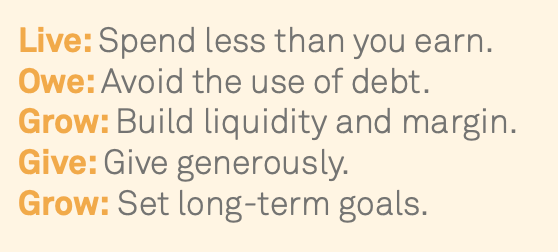
Working in the financial industry for just short of a quarter of a century (why didn’t I stay just one more year?) and now having worked with Christian financial professionals for the past 10 years, I have come to this conclusion: Our personal finances should not be complicated – just follow five simple principles:

  1. Spend less than you earn
  2. Avoid the use of debt
  3. Build liquidity / margin
  4. Give Generously
  5. Set Long-term Goals

Here’s the problem – any of these principles are far too easy to violate. Statistically, at least 34% of working Canadians violate the first principle. Specifically, 27% spend everything they earn, and 7% spend more than they take in, according to a Financial Wellbeing Index from LifeWorks. This situation is particularly prevalent among parents, who are twice as likely to report spending beyond their income. Furthermore, 1 in 6 Canadians (17%) have monthly spending that exceeds their income, and 1 in 4 (27%) borrow to cover essential expenses like food and daily necessities.

If we spend more than we earn, it leads to the violation of the second principle where borrowing becomes the means of acquiring the necessities in life. The rise in credit card debt among working Canadians is also significant, increasing from 29% in 2021 to 42% in 2022. 

Here’s the reality – we are called to be stewards over everything placed in our hands. Is there one principle that trumps another? Or are each of these principles equal in importance?

For Christians, giving is a top priority, particularly when it comes to the teaching around the tithe (giving 10%). I’ve often said that giving is a way to invite God into our finances, but each of these principles is rooted in biblical wisdom, not just the principle of giving.

Here’s an example:

A faithful Christian couple is dedicated to Principle 4: Give Generously. However, they may have violated Principle 2 (Avoid the Use of Debt), when they borrowed to acquire rental properties. They borrowed when interest rates were low with a variable rate mortgage (not a fixed term); then the spike in interest rates has increased their payment beyond their rental income. This couple is now struggling financially and forced to violate Principle 1 (now spending more than they earn), with no ability to follow Principle 3: build liquidity.

How would you advise in this situation? Should they now suspend / pause their giving (at least for a time) to right their financial ship? What should they do to be better stewards.

What principle should be priority for this couple at this time? Is it”spend less than you earn” because it is the key provide the ability to abide by the other principles?

  1. Spending less than you earn will allow you to
  2. Avoid the use of debt and
  3. Build liquidity / margin and
  4. Give generously and
  5. Accomplish your long term goals.

Would you agree or disagree?

Remembering His Words

Remembering His Words

I always remember the words I have often heard my grandfather, Arch Woodworth, quote as he would testify in church: “Be not weary in well-doing for in due season you will reap if you faint not.”

I didn’t have to look up this Bible verse because I heard them multiple times, more than I can count. He probably was not even aware that I was listening, but his words quoting the Apostle Paul of course, have stuck with me. I often quote them myself because they still encourage to me today!

I remember them only because I heard him quoted it at the end of pretty much any testimony he shared. It makes me wonder how my grandchildren will quote me. What am I passing on to my children and grandchildren?

The best example of a father has to be our Heavenly Father. He made sure that His Son knew He was “well pleased” with Him. The timing of this message is important. It was sent at the baptism of Jesus before He had even performed any miracles or accomplished anything of eternal significance. The Father was simply saying, I’m proud that you are my child and you are on this earth.

I wrote about this on Father’s Day in 2020 and have made an effort to reach out to my kids every Father’s Day to send them a message from their Dad.

If you are a father, reach out to your children and let them know that you are “well pleased” with your child(ren), not because of what they may have accomplished, but because hearing that from you will mean more than you may ever realize.

Happy Father’s Day!

An Eye Exam

An Eye Exam

I recently had an eye exam and there was no significant change in my prescription. This reminded me of the words of Jesus in the famous Sermon on the Mount. I googled the verse of interest and immediately received this AI generated overview:

The Bible verse “If your eyes are healthy, your whole body will be full of light,” is found in Matthew 6:22. It essentially means that if your mind and heart are focused on good things, your whole life will be filled with light and positivity. If your “eye” (representing your inner self) is not focused on God, the truth, and good things, your whole life will be filled with darkness. 

Is Your Eye Healthy?

That certainly seems to be a reasonable explanation, but is that really the extent of what Jesus was saying here? To fully understand, might I suggest we need more SI (Spiritual Insight), since AI (Artificial Intelligence) has its limits. Maybe a quick look at the context of this verse might give us a clue.

Matt. 6:20 talks about treasure and the places it can be stored (heaven or earth). The next verse connects our heart with where we place our treasure. Inserted here are two verses about having a healthy or clear eye vs. an evil or unhealthy eye which results in darkness. This is followed by the reference to two masters and the inability to serve both with the simple conclusion: “You cannot serve God and money.” Then, the instruction to not worry about the things needed in life, like food and drink and clothes – some of the things we purchase with money.

With this context in mind, why does Jesus speak about the eye being good or evil, bringing light or darkness? Could the health of the eye be a reference to our attitude about our financial resources?

Is Your Eye Envious?

This is not the only time Jesus referenced the eye. In Matthew 20, He spoke about “the kingdom of heaven” being like a landowner who hired workers for his vineyard. These individuals were hired at different times during the day – some early morning, others at 9 am, others at noon, then others at 3 pm and more at 5 pm. At the end of the workday, the workers were called to receive their pay, “beginning with the last ones hired and going on to the first” (v. 8). Naturally, the people who worked the entire day expected to be paid more than those who started work at 3 or 5 pm and this led to complaints.

The story concludes with a few questions:

“Is it not lawful for me to do what I wish with what is my own? Or is your eye envious because I am generous?”

In this story, Jesus was illustrating that the darkness on the inside of these workers was due to a desire for more (an amount above the original agreed amount). All day these workers knew what they were going to be paid but this focus shifted when they saw that others who worked less were being paid the same (meaning their hourly wage was less than those hired later). There was an immediate discontentment when they compared themselves with people who were hired 8 hours later. Comparison is the enemy of contentment.

Let’s assume you or I were hired at the start of the day – would we be any different? If we worked 10 -12 in the day and others worked only two hours, it would be natural to expect more pay, wouldn’t it?

Is Your Eye Clear?

The point Jesus is making here is that the eye is not clear and greed enters the heart through our eyes. How would you define greed? Maybe it’s as simple as the desire for more. AI says it is characterized by a strong, often selfish, yearning for more than what is needed or deserved. Greed is often associated with materialism, envy, and a focus on self-interest. 

Here’s how Tim Keller spoke about the eye and greed:

Greed is different than other sins. This is why Jesus says this is an eye sin. This darkens your eye spiritually. Jesus did not say to anybody, “Watch out, you might be committing adultery.” If you’re committing adultery; you know you’re committing adultery. You don’t say, “Oh, you’re not my wife!” It doesn’t happen. But Jesus has to say, Watch out, you might be greedy. Greed hides itself. It blinds you in a way that adultery doesn’t. Over the years as a pastor, I’ve had people come in to talk to me about sins, but I don’t remember anybody coming to me to confess the sin of greed.

https://www.plough.com/en/topics/faith/discipleship/watch-out-you-might-be-greedy

It’s such a challenge to recognize this darkness or even know it has found a place in our hearts. In fact, “The heart is deceitful above all things and beyond cure. Who can understand it?” (Jer. 17:9)

Jesus said that “from within, out of the heart proceed …” a long list which includes coveting and envy (Mark 7:21, 22). The word envy is literally “an evil eye.”

Tim Keller explained how easy it is for us to not even consider the possibility that we might be materialistic with this realistic example:

Materialism has the power to get you to choose a job, not one that you love, not one that you’re good at, not one that helps people, but one that makes you money. You do it because it will get you to a certain status in life. You choose the job on the basis of that. For five to ten years the adrenaline can keep you going, but after a while you find yourself empty inside. Why did you choose the job? Your eye was dark.

https://www.plough.com/en/topics/faith/discipleship/watch-out-you-might-be-greedy

Is Your Eye Focused?

When your eye is dark it is easier to refuse to help someone who has a genuine need (Deut. 15:9) than to truly have compassion and help them. Our response to others is determined by what is in our heart and Jesus is saying the entrance into the heart is through the eye. The instruction in the verse that follows is pretty clear:

Give generously to the poor, not grudgingly, for the LORD your God will bless you in everything you do.

Deut. 15:10 NLT

So what did Jesus mean when he spoke about a clear eye? It wasn’t just focusing on good things (as AI suggests), so your life will be filled with positive things. It was about having the right perspective – shifting your focus away from greed and discontentment which is the darkness. Instead, the light brings generosity and contentment into view. A clear eye means we view the resources we have differently, we begin to ask why we have these resources.

The “evil eye” focuses on getting more while the “good eye” focuses on giving more.

Let me wrap this up with Proverbs 22:9:

“He who is generous will be blessed, For he gives from his food to the poor.”

The newer translations just use the word generous here, but that word refers to one who “has a good eye” – the KJV translates it as one with a bountiful eye.

Consider this in light of what Jesus said:

“When your eye is healthy, your whole body is filled with light.”

The healthy or “bountiful eye” speaks of generosity that flows from an abundance mindset and is not restricted at all by scarcity thinking.

Do You Need Corrective Lenses?

In a 2012 study published in Science, behavioural economists Mullainathan and Shafir discovered something remarkable:

When we perceive scarcity (even if it doesn’t match reality), our brain undergoes a measurable shift. Our mental bandwidth narrows, focusing intensely on what we might lose while becoming blind to potential gains.

https://breakingbank.media/ca/breaking-the-scarcity-cycle-a-guide-for-smarter-wealth-management/?ref=sadeyemi&utm_source=email&utm_medium=email+marketing

This confirms what the Sermon on the Mount stated more than 2000 years earlier:

But when your eye is unhealthy (perceiving scarcity), your whole body is filled with darkness (your mental bandwidth narrows). And if the light you think you have is actually darkness, how deep that darkness is!

A scarcity mindset negatively limits our ability to be generous, which is a dark place. Lord, open our eyes to Your light and deliver us from the dark. For my physical eyes, I need corrective lenses and I use them every day. Do we not need the same discipline to wear our spiritual lenses daily? How else can we have “a bountiful eye?”

Who to Trust in These Times

Who to Trust in These Times

It seems that everyone is talking about President Trump these days. Some are fearing what seems to be inevitable now – a recession, while others see Trump’s aggression on Canada as a threat to its sovereignty as a nation. Politicians are searching for ways to negotiate or strike back against the imposed tariffs. There are more questions than answers, right now. One thing is certain, things have become extremely uncertain.

As Christians, we often quote this very familiar verse about trust from Proverbs that says “Trust in the Lord with all your heart and lean not on your own understanding.” At times of uncertainty like our world is facing right now, the tendency is to lean more on ourselves and try to understand, which is not real trust. My experience tells me it is much easier to say “I trust the Lord,” but much more difficult to really live a life trusting Him. The tendency is to lean and begin to trust what we understand.

“Trust Me”

Canada is in the middle of a leadership transition and therefore, not in a strong bargaining position. In the coming days, each of these leaders will try and position themselves as the best person and the best party to stand for the interests of Canada. In essence, they are saying, “Trust me.”

It’s difficult to understand what the end game might be for President Donald Trump in regards to Canada. It is also a challenge to determine who can be trusted most to lead Canada through these challenging times. Maybe our focus is completely wrong. Maybe this is the perfect opportunity to trust God!

The fact is this: when we do not understand, we can so easily spiral into anxious thoughts about our future – job insecurity, higher cost of living, etc. When we focus on our understanding or lack of understanding, the result is the same which is the opposite of rest.

Trust Yourself

Compare Proverbs 3:5 to a much less familiar verse in Proverbs that uses a similar word for “understanding:”


Do not wear yourself out to get rich;

do not trust your own cleverness (emphasis mine).

Proverbs 23:4 NIV

The pursuit of wealth is so easily connected with an individual’s own cleverness. The NASB says we should not exhaust ourselves to gain wealth; in fact we should “Cease from the consideration (or understanding) of it.” What exactly are we to cease from? Surely the instruction is not to stop considering how we ought to earn income, after all, we are also instructed to provide for our family (1 Tim 5:8).

It’s pretty clear: Proverbs instructs us to seek wisdom and understanding (Prov. 4:1-9). Consider King Solomon who had the unique opportunity to ask God for anything (1 Kings 3:5) … his request was to have an understanding mind. “And God gave Solomon wisdom and understanding beyond measure” (1 Kings 4:29). God not only gave Solomon wisdom, but also added an extra bonus by giving him what he did not ask for: “both riches and honour” (1 Kings 3:13). So he was granted wisdom and wealth, but the choice before him is the choice we all must make: where to lean.

Consider the Source

Clearly, Scripture is teaching us that the source of wisdom and understanding matters. When we look at Solomons’s life and leadership we can see how he drifted from the source of wisdom.

It’s far too easy to think we are the source of any wealth we have accumulated and lean on our own cleverness for more wealth. Where we lean affects our heart, often without us even realizing it. Maybe that’s why the Israelites were reminded to remember that the Lord your God gives you the power to gain wealth (Deut 8:18).

In the same way, political leaders around the world can naturally lean on their own understanding or cleverness to resolve issues that affect millions of citizens. Take a look at these verses as it relates to the King of Tyre:

Your wisdom has certainly made you rich, because you have storehouses filled with gold and silver. You’re a clever businessman and are extremely wealthy, but your wealth has led to arrogance! Ezekiel 28:4-5 CEV (Emphasis mine)

When one possesses wealth and wisdom and sees themselves as the source of what they have, it can lead to arrogance and pride.

When you set your eyes on wealth, it is [suddenly] gone. For wealth certainly makes itself wings Like an eagle that flies to the heavens. Do not eat the bread of a selfish man, Or desire his delicacies; for he is like one who is inwardly calculating. “Eat and drink!” he says to you, but his heart is not with you.

Proverbs 23:5-6 AMP, 7 ESV

Why would someone who is trying to impress you by offering a meal be “inwardly calculating” the cost of that meal? Maybe it is because when someone sees themselves as the source of this wealth, it is natural to think about how much this generosity costs.

Trust the Lord

When you recognize that any wealth you have is from another source other than yourself, you begin to understand that you are a steward, therefore you are not the true source. Then, where you lean shifts to the true source of the wealth (Deut 8:18). At this point, our own ability to gain wealth shifts to a source that is much great than ourselves.

This is a significant heart shift – this shift means that what we “treasure” also shifts (see Matt. 6:21) because our heart now has a different focus – one where giving is a greater priority, greater than the cost of generosity or how this amount will be replaced. The heart of the steward has trust in a higher source than their own “cleverness” to generate wealth. The steward has clarity about money that was previously missing: wealth is now seen as a tool rather than just a resource to be stored.

The End Game is trust!

Proving Your Faith as a Financial Advisor

Proving Your Faith as a Financial Advisor

We all have aspirations in life that often mean we need to “prove” ourselves first. If you consider one’s experience to apply for a new position, we put together a resume to prove that we are qualified to do this job. Even more than that, we want to demonstrate that we are “the best” candidate to be hired for this role.

What exactly are we trying to prove? For financial advisors, many have set a goal to be the most trusted advisor – therefore attracting clients and business relationships to them. That seems to make sense but as a Christian professional, is this the best goal?

Since I read Matthew 3:8 a few weeks ago, I haven’t been able to get it out of my mind. John the Baptist, was preparing the way for Christ by giving this instruction:

“Prove by the way you live that you have repented of your sins and turned to God.”

John was really asking if they had any fruit in their lives that demonstrated that they were living a life surrendered to God.

In other words, is there proof in your practice that sets you apart or makes you unique from those who have no relationship with God? In your conversations, the way you use money, your business practices, your marriage and family relationships – all these should be positively impacted because you have “turned to God.”

John’s message and also that of Jesus, called people toward repentance – a change in thinking. When we change the way we think, the result is we change our behaviour – what we do. Here’s the big question: Is there proof in your life and your work that you have “turned to God?”

My question to Christian advisors many times is this: Is there any difference in your advice to clients because you are a Christian? Here’s how one advisor responded:

After going through the CKA material this past year and spending time with my cohort, I have learned a lot. The CKA® training and shared learning experience with my cohort has changed my perspective on my role in the financial business. I have been encouraged to practice these Biblical principles in my personal life and incorporate them into my business. 

When meeting with clients during their last review, I decided to add to the agenda a discussion about their legacy planning & giving goals.  I wasn’t sure how the clients would respond as this was out of my typical market based conversation (and personal comfort zone). Thankfully, the clients very much resonated with the agenda item and the questions I asked about their giving goals. We had a truly life giving conversation about their ministry passions, future opportunities to give, and how we can help them achieve these more personal goals. I believe the clients went from concerns about short term market trends (which are out of our control anyway) to a place of gratitude about how God has blessed them and excited about how God could use them (and their resources) to bless others. I hope and pray I can have more review meetings like this!   

For advisors in the cohort it has meant weekly meetings over five months with many hours of study to be prepared for the discussion times together. The result in the advisors words:

  • 1) a changed perspective on my role in the financial business
  • 2) life giving conversation(s) with clients
  • I added the “s” – I’m confident more life giving conversations will follow because of the changed perspective.

Therefore let your lives prove your change of heart

Weymouth New Testament Matthew 3:8

Discover Your Why: Fulfillment in Work and Life

Discover Your Why: Fulfillment in Work and Life

Well the Labour Day weekend is upon us and for many, it marks the end of a season and shifts students back into the school year and those at work into a busy fall. Mark Twain helps me see

“The two most important days in your life are the day you are born and the day you find out why.”

Mark Twain

Finding your why is truly what makes your work significant. I have heard it said that your job is what an employer pays you to do; your work is what you were born to do. I’m convinced that when you discover your why, you truly live out your calling in life.

Ken Boa in his book, Conformed to His Image says:

“Our primary calling is to know and love God. Our secondary calling is to express this relationship in everything we do and with everyone we encounter.”

As a teenager, I felt a “call” on my life and the best way I could interpret it at the time was to become a pastor. However, the majority of my career has been in the financial services industry, providing insurance and investment advice. My perspective was that my work as a financial advisor was my job (secular) and I believed my “calling” to ministry was my true work (sacred). As the years passed, I questioned if I had “missed my calling” or did I choose the wrong profession?

My problem was that my secondary calling (my work as a financial advisor) was somehow disconnected from my primary calling (to know and love God). Ken Boa explains it this way:

“If the secondary is not related to the primary, we slip into the error of dichotomizing the “spiritual” and the “secular” when they should really be integrated. When this happens, our relationship with the Lord is disconnected from the everyday activities of our lives.”

I certainly felt I was serving the Lord in my business, but somehow the everyday activities of my work became disconnected from my calling. My focus as an advisor was on growing my business, developing relationships and serving clients. While that ethic was typical of this industry, my secondary calling lacked the perspective that only comes by incorporating my primary calling. My work as an advisor (secondary) needed to be an expression of my primary calling. Dr. Ken Boa explains it this way:

“Secular work becomes spiritual when done to the glory of God. Spiritual work becomes secular when done to please and impress men.”

My level of fulfillment through my work reached new heights when the secular and the sacred were merged. This seems so simple now as I reflect, but it required a shift in my perspective. Recognizing the opportunity to love and bring glory to God (primary calling) through my practice (secondary calling), transformed my work life and brought a fresh perspective. In essence, I was transformed into the person I was born to be and now Labour Day becomes important – not the day I was born, but a better understanding of “why” I was born. Dr. Ken Boa sums this up perfectly:

“When we keep our primary calling first and seek to express it in and through our secondary calling, we become more holistic in our thinking and practice.”

Our Relationships Don’t Belong to Us!

Our Relationships Don’t Belong to Us!

I read this statement in a devotional recently and was challenged with the thought. Paul David Tripp writes that:

Fellowship is God caring enough to put people in your life to encourage, rebuke and comfort you.

New Morning Mercies, Paul David Tripp (Aug. 19)

I’ve been in relationship with some people for many years now, which begs the question: “Why are these people (or this person) in my life?”

Tripp explains it this way:

“We cannot allow ourselves to have an owner’s view of our relationships, as if they exist for the sole purpose of our happiness. Our relationships don’t belong to us – They belong to God for his use, for his purpose.”

This changes our perspective – if we don’t own these relationships and they are not “about us” solely, there must be a reason, a deeper purpose. The unseen part of relationship is how they came to be and also why they came to exist.

If we take the “owner’s view” it means either we or the person we are in relationship with took the initiative to establish contact. This easily excludes God’s part in this relationship and means we can miss seeing his purpose.

My wife and I met while we were attending the same college. We take for granted our chance meeting at an airport in late April 1985 and then meeting again the following weekend in her hometown. This was the only weekend she was home because she was between semesters while attending university. That chance weekend meeting clinched my decision to attend the same university that summer where our relationship began to develop. The rest, as they say, is history.

Was this simply a series of coincidences, where each of us initiated our relationship to spend time together? Or was God more involved than we often give Him credit for?

I choose to believe that my relationships are an example of God caring enough to infuse people into my life for His use and His divine purpose.

One of the other life-changing experiences for me was joining the community of Christian financial professionals, known as Kingdom Advisors. It was a game-changer when it became clear that I didn’t have to separate my faith from my work as a financial advisor.

Here’s the advice from Kingdom Advisors:

“Don’t spend another day feeling divided between your faith and your career. Get certified by Kingdom Advisors and fully integrate your faith into your financial practice.”

I’m looking forward to connecting with advisors in a cohort this fall (meeting weekly starting Sept. 4th) to walk with advisors through 20 Modules of Core Training. This journey together will be a key to fully integrate your faith into your financial practice and continue to build God-ordained relationships.

When You Don’t Run Alone: 1924 & 2024

When You Don’t Run Alone: 1924 & 2024

I did have opportunity to watch some of the Olympics that just concluded and one of my highlights was Canada running in the men’s 4×100 Relay race. This was quite a surprise as the announcer shared: “They got the baton around the track faster than anybody else! With four men who didn’t have the individual clock speed here at these games. What a reversal of fortune for these men here tonight.” They did not medal in the individual races they ran, yet had the best time when they ran the relay.

You can watch the video here: https://www.cbc.ca/player/play/video/9.6476926

The key to their success is how they worked together as a team and were able to win the gold medal, which they were unable to accomplish when running alone.

This reminded me of the Olympics 100 years earlier – 1924, long before I was born, but I have read and previously written about Eric Liddell. He was a devout Christian and missionary to China, who felt it a priority to run in the Olympic games. His sister felt that his training for the 1924 Olympics deterred him from returning to China as a missionary. I’m confident she saw his calling and work in life was being a missionary, not running. However, Liddell said, “I believe God made me for a purpose, but he also made me fast! And when I run I feel His pleasure.”

But when the timetable for the Games was released, the 100m heats were on a Sunday and Eric Liddell dropped a stunning revelation. The Christian Sabbath was the Lord’s Day and there was nothing in this world that could persuade him to run.
Liddell’s decision meant he had to give up on his strongest event and switch his focus to the 400m. Instead of a straight dash to the finish line, this event required the stamina to maintain the pace around a full lap of the track, described at the time as the quarter-mile race.

https://www.bbc.com/culture/article/20240705-olympics-hero-eric-liddell-and-the-real-story-behind-chariots-of-fire

Fellow Scottish athlete Tom Riddell said this longer distance exposed Liddell’s idiosyncrasies, but he could still rely upon that electrifying pace. Riddell told the BBC he had asked Liddell about his tactical approach: “In his own words he said, ‘Well, when the gun goes, I go as fast as I can, and I trust to God that I’ll have the strength to do the second half.’ And I think he really did.”

The truth is Liddell was running an individual race but he was not running alone!

We usually would not class running or involvement in a sporting activity as spiritual, or for God, but simply a physical activity. For Liddell, running wasn’t just a fun activity but a God honouring one.

The mistake we often make is in categorizing our activities, whether it’s exercising or working as a non-spiritual activity. We view our walking, running, or cycling as a physical activity and our work as secular. In doing so, we separate it from what is sacred, rather than sensing the pleasure of God in that activity.

Here is a great piece of advice: Whatever you do, do it enthusiastically, as something done for the Lord … (Col 3:23). The reality is that when we serve others (in our work), we are actually serving the Lord, not just men (Eph. 6:7). If we can say when we walk or work that “we feel His pleasure,” God is truly walking and working with us and through us. This adds a brand new energy to our efforts. When you work, you are not working alone.

It’s not original to me but here’s a great question and the best advice:

Don’t you realize that in a race everyone runs, but only one person gets the prize? So run to win!

The Apostle Paul – 1 Corinthians 9:24 NLT

Celebrate Canada Day Weekend

Celebrate Canada Day Weekend

As I went for a bike ride, my mind began to wonder about what I should celebrate, particularly on this Canada Day weekend!

It made me think about a question that was posed to me back in 2014, around the time I was making a very significant decision. I was a financial advisor with an established practice in Newfoundland, but was asked if I would consider working with Christian advisors across Canada. The question went something like this: “Is God calling you to work with your clients (in your home province) or is He calling you to work with financial professionals across the country?” We moved to Ontario in 2015, so that answers that question.

Two flags fly on my back deck, one from the province we still call “home” and the other is the country where I get to serve financial professionals who are interested in incorporating biblical wisdom in their advice to clients.

Seven things Kingdom Advisors can Celebrate in Canada:

  1. The 113 Members of Kingdom Advisors who have been personally and professionally enriched by completing the Kingdom Advisors Core Training.
  2. The 95 Financial Professionals who earned the Certified Kingdom Advisor® designation.
  3. The 82 Active CKA®s in Canada searchable by Christians desiring to be served by an advisor who aligns with their personal values.
  4. The 14 Kingdom Advisors Study Groups and the 80+ attendees that meet monthly to be equipped as Christian advisors.
  5. The 22 Champions – an exclusive subset of our members who are passionate about the advancement of this industry and are committed to investing their time, influence, and resources to accelerate its growth and development.
  6. The 186 Active Members of Kingdom Advisors.
  7. The 135 Redeeming Money Conference Attendees in 2024.

Living a Legacy

These are some of the numbers but what thrills me most is seeing advisors finding fulfillment and opportunities for ministry in their work. Let me highlight one of our CKA®s from Edmonton, AB. John Kok has shared his wisdom in a dozen churches (based on his recent newsletter). He recognizes the CKA® designation sets him apart as a financial professional, who has pursued faith/work integration to the highest credentialed level in the financial advising world. John shared at our Regional Event in Calgary this May and will lead the Charting Your Legacy Study starting Sept. 24, 2024.

John invited another advisor to the KA Regional Event this May and he already completed the training. Here’s Craig Jensen‘s feedback about the training:

“The one area of takeaway was the focus on prayer before every meeting. There were occasions when I would pray before meetings, but through this training, I have understood now on a higher level the importance of a prayer for every meeting and follow-up prayer. So, focused prayer is the biggest take away for me. I feel very blessed to have been introduced to Kingdom Advisors through John and I look forward to adding what I’ve learned to my ongoing discipleship with others.”  

Advice for the Summer

Tim Jenkins is a CKA® from Peterborough, ON who published a blog entitled : Don’t Miss the Season to Create Exceptional Wealth. I would summarize it this way: The summer season presents the ideal conditions for creating (relational) wealth! Summer is when we take time off and our loved ones and relationships are not usurped by busyness. Let’s be intentional to become more wealthy this summer!

Happy Canada Day!